AMD Ryzen 5 9600 Benchmarks Nearly Match the Ryzen 5 9600X
AMD’s Ryzen 5 9600 could become an attractive option for budget-conscious PC builders, with early PassMark benchmark results suggesting performance close to the more expensive Ryzen 5 9600X. Built on AMD’s Zen 5 architecture, the six-core processor reportedly delivers competitive single-threaded and multithreaded performance while maintaining a 65W thermal design power (TDP).
AMD has traditionally expanded its desktop CPU portfolio by introducing standard non-X models alongside higher-clocked X-series processors. These variants often share the same core architecture and cache capacity but operate at lower default frequencies, offering a potentially better balance between performance, power consumption, and price.
The Ryzen 5 9600 follows this approach. According to the reported benchmark data, its performance trails the Ryzen 5 9600X by only a small margin. If retail pricing remains competitive and availability improves, the processor could offer a compelling entry point into AMD’s AM5 desktop platform.
📊 PassMark Benchmarks Reveal a Small Performance Gap #
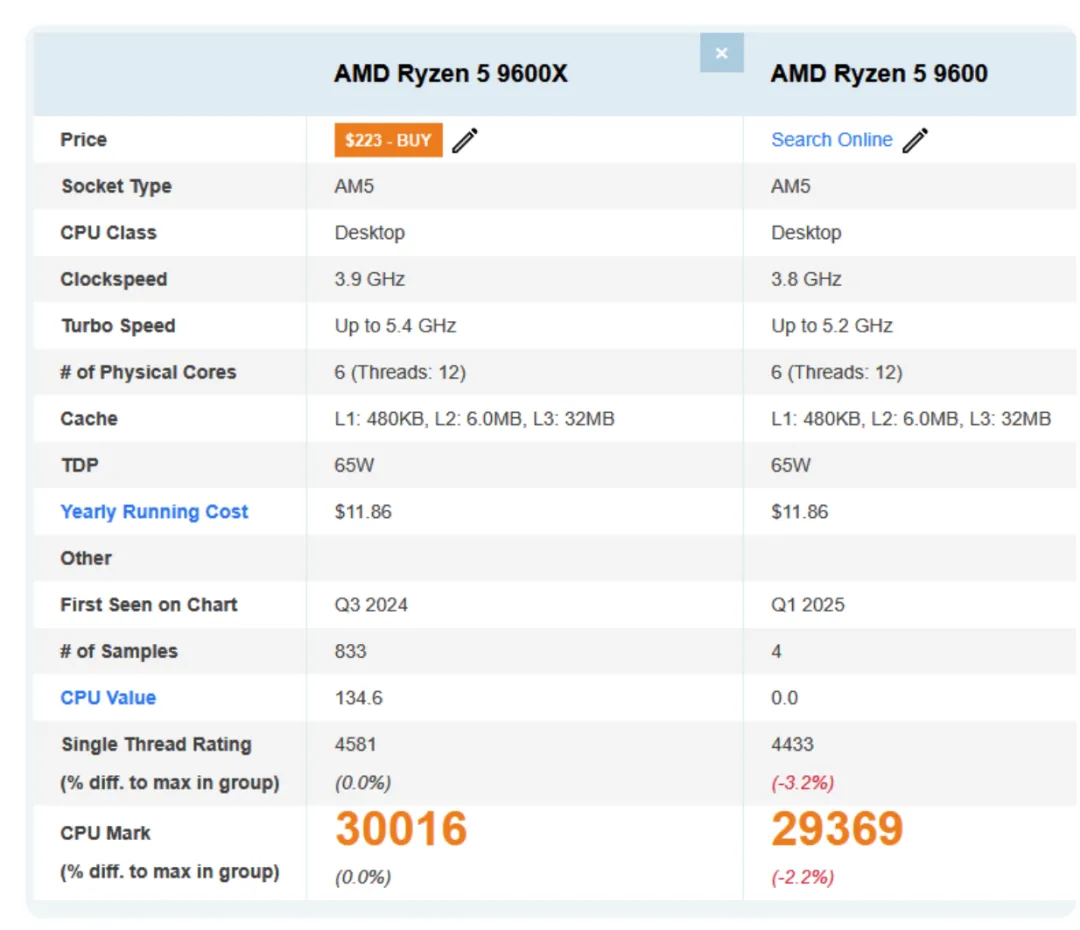
According to the reported PassMark database results, the Ryzen 5 9600 delivers approximately 4,433 points in single-threaded testing and 29,369 points in multithreaded testing.
The Ryzen 5 9600X scores approximately 4,581 and 30,016 points in the corresponding tests. These results suggest that the non-X model retains most of the CPU performance of its higher-clocked counterpart.
Ryzen 5 9600 vs. Ryzen 5 9600X Specifications #
| Specification | Ryzen 5 9600 | Ryzen 5 9600X |
|---|---|---|
| CPU architecture | Zen 5 | Zen 5 |
| CPU cores | 6 | 6 |
| Threads | 12 | 12 |
| Base clock | 3.8 GHz | 3.9 GHz |
| Maximum boost clock | Up to 5.2 GHz | Up to 5.4 GHz |
| L3 cache | 32MB | 32MB |
| TDP | 65W | 65W |
| Manufacturing process | TSMC 4nm CPU chiplet | TSMC 4nm CPU chiplet |
| PassMark single-thread score | Approximately 4,433 | Approximately 4,581 |
| PassMark multithread score | Approximately 29,369 | Approximately 30,016 |
The Ryzen 5 9600’s reported base frequency is 100 MHz lower than that of the 9600X, while its maximum boost frequency is 200 MHz lower.
The resulting benchmark differences are relatively small: approximately 3.2% in single-threaded performance and 2.2% in multithreaded performance, based on the reported scores.
These figures suggest that the two processors could deliver similar performance in many CPU-intensive applications. However, synthetic benchmark results alone do not establish identical real-world performance. Cooling, motherboard firmware, memory configuration, and workload characteristics can all affect the final outcome.
What the PassMark Results Actually Measure #
PassMark evaluates several aspects of CPU performance, including integer and floating-point operations, compression, encryption, vectorized workloads, and other computational tasks.
Its single-threaded score helps illustrate performance in workloads that depend heavily on one CPU thread, while the multithreaded result reflects aggregate performance across multiple threads.
Neither score directly predicts gaming frame rates or application responsiveness across every workload. Nevertheless, the reported results provide a useful initial comparison between the two processors.
⚙️ Zen 5 Architecture Delivers Strong Per-Core Performance #
The Ryzen 5 9600 inherits AMD’s Zen 5 architecture, which introduces changes to the CPU front end, execution resources, branch prediction, and cache subsystem.
AMD has cited an approximately 16% improvement in instructions per cycle (IPC) over Zen 4 in its architectural comparisons. Actual gains vary by workload and should not be interpreted as a guaranteed 16% performance increase in every application.
Zen 5 also provides support for AVX-512 instructions, which can accelerate compatible vectorized workloads, including selected scientific computing, data-processing, and AI-related applications.
For additional context, see AMD’s Zen 5 Threadripper benchmark analysis, which explores the architecture’s performance in a higher-core-count desktop platform.
Six Cores and Twelve Threads Remain Relevant for Mainstream PCs #
The Ryzen 5 9600’s six-core, 12-thread configuration targets mainstream desktop workloads without requiring the higher power budgets associated with many high-performance processors.
For office productivity, software development, everyday multitasking, and mainstream gaming, this configuration can provide substantial processing capacity. It can also support lightweight content creation, although heavily parallel workloads may benefit from CPUs with more cores.
The reported benchmark results suggest that the Ryzen 5 9600 retains much of the single-threaded and multithreaded performance expected from the 9600X.
Some preliminary performance estimates have placed the processor near 2,000 points in Cinebench R23 single-core testing and around 15,000 points in multithreaded testing. These figures should be treated as estimates rather than independently verified results for a retail system.
The final performance profile will depend on actual operating frequencies, power settings, cooling, and benchmark methodology.
🎮 Gaming Performance: A Potential Budget-Friendly Option #
For gaming-oriented desktop builds, the Ryzen 5 9600 could provide performance close to the 9600X while offering a lower-cost entry point into the Zen 5 platform.
At 1080p, CPU performance can have a substantial influence on frame rates when paired with a sufficiently powerful graphics card. At higher resolutions, the graphics processor often becomes the primary performance constraint, reducing the impact of relatively small differences between CPUs.
CPU Performance Versus GPU Limitations #
The practical difference between the Ryzen 5 9600 and 9600X will vary by game and graphics configuration.
In CPU-limited workloads, the 9600X’s higher maximum boost frequency could provide an advantage. In GPU-limited scenarios, the performance difference may be smaller because both processors can feed the graphics card at a similar rate.
For example, games such as Cyberpunk 2077 can respond differently to CPU and GPU upgrades depending on resolution, graphics quality, ray tracing settings, and the graphics card being used.
The original performance estimates suggest that pairing the Ryzen 5 9600 with a midrange GPU such as an NVIDIA GeForce RTX 4060 or AMD Radeon RX 7600 could support mainstream gaming at 1080p and 1440p. However, frame rates will depend heavily on the specific game and graphics settings, so these configurations should not be treated as guaranteeing a fixed performance target.
For buyers primarily interested in gaming, the 9600X’s small reported benchmark advantage may not justify a substantial price premium if both processors deliver similar performance in their preferred titles.
💰 Pricing and Value: The Ryzen 5 9600 Could Challenge the 9600X #
Pricing will be central to the Ryzen 5 9600’s market position.
At the time of the original reporting, the Ryzen 5 7600 was cited at approximately RMB 1,499, while the Ryzen 5 9600X had reportedly declined from its initial price of RMB 1,949 to around RMB 1,449.
The Ryzen 5 9600 was estimated to launch at approximately RMB 1,400. If the price estimate proves accurate, the processor could offer an appealing combination of Zen 5 performance and relatively low operating power.
Ryzen 5 9600 vs. Ryzen 5 7600 #
The Ryzen 5 7600 remains a useful reference point because it also features six cores, 12 threads, and a 65W TDP.
The two processors use different CPU architectures: the Ryzen 5 7600 is based on Zen 4, while the Ryzen 5 9600 uses Zen 5. The newer architecture and higher reported boost frequency could give the 9600 an advantage in workloads that respond to improved per-core performance.
The Ryzen 5 9600 may be particularly attractive to builders who want to enter the AM5 ecosystem or assemble a balanced gaming system without spending more than necessary on the CPU.
However, the value calculation should include motherboard cost, memory, cooling, and processor availability rather than comparing CPU prices alone.
Lower Power Consumption and Cooler Requirements #
A 65W TDP makes the Ryzen 5 9600 suitable for systems designed around relatively modest cooling requirements.
The original reporting also indicated that the processor would include AMD’s Wraith Stealth cooler. If offered with the retail package, the bundled cooler could reduce the initial cost of a basic system build.
Actual temperatures and noise levels would still depend on the case, ambient conditions, workload, and cooler installation. Users seeking lower temperatures or quieter operation under sustained heavy workloads may prefer an aftermarket cooler.
Compared with higher-power CPUs, the combination of a 65W rating and six-core configuration may also simplify power and thermal planning for compact desktop systems.
🖥️ AM5 Compatibility and Platform Features #
The Ryzen 5 9600 belongs to AMD’s AM5 desktop platform, which supports DDR5 memory and PCIe connectivity through compatible processors and motherboards.
Existing X670 and B650 motherboards may support the processor after a suitable BIOS update, depending on the motherboard manufacturer’s compatibility list and firmware release.
Memory and Expansion Considerations #
The Ryzen 5 9600 supports DDR5 memory, with DDR5-5600 to DDR5-6000 representing a potential target range for balanced system configurations. Actual stability and performance depend on the memory kit, motherboard, BIOS settings, and integrated memory controller.
The AM5 platform also supports PCIe 5.0 connectivity where provided by the relevant processor and motherboard configuration, offering flexibility for compatible storage and graphics devices.
For a practical build, buyers should verify processor support and the required BIOS version before purchasing a motherboard, particularly when using existing AM5 hardware.
These compatibility considerations can reduce upgrade costs, but the exact expansion options remain motherboard-specific.
🛒 Retail Availability Remains a Key Uncertainty #
Despite the promising reported performance, availability was a concern at the time of the original reporting.
Although AMD had listed the Ryzen 5 9600 on its official website, the processor was reportedly difficult to find through domestic retail channels in China. Unofficial reports suggested that early supply might focus on OEMs and system integrators rather than boxed retail products.
Reports from February 2025 also indicated that some European retailers had begun offering preorders at prices approximately $20 below those of the Ryzen 5 9600X, while North American retail availability remained unclear.
These observations reflect the market situation described in the original reporting period and should not be interpreted as a statement of current availability.
For consumers, limited retail supply can undermine an otherwise attractive price-to-performance proposition. A competitive processor offers little practical value to independent PC builders if it cannot be purchased at a reasonable price.
Wider boxed-retail availability would give enthusiasts more flexibility when selecting components and assembling their own systems.
📝 Conclusion: A Promising Value-Oriented Zen 5 CPU #
The AMD Ryzen 5 9600 appears to follow a familiar strategy: deliver most of the performance of a higher-clocked X-series processor at a potentially more accessible price.
Reported PassMark results place it close to the Ryzen 5 9600X in both single-threaded and multithreaded testing, with performance differences of approximately 3.2% and 2.2%, respectively. Its six-core, 12-thread design, 32MB of L3 cache, and 65W TDP could make it a strong candidate for budget-oriented gaming systems and mainstream productivity PCs.
The Zen 5 architecture, DDR5 memory support, and AM5 platform compatibility add to its appeal, particularly for users building a new desktop or upgrading an existing compatible system.
Ultimately, the Ryzen 5 9600’s success will depend on its actual retail price, real-world performance, and availability. If AMD can deliver the processor close to the reported price estimate, it could become a compelling alternative to the Ryzen 5 9600X for buyers who prioritize value over marginal performance gains.