
AMD Zen 6 Low-Power Cores Explained: A New Design for Medusa APUs
AMD is expanding its CPU architecture strategy with Zen 6 by introducing a dedicated low-power core designed specifically for energy-efficient client platforms. Unlike previous generations that primarily differentiated between standard-performance and high-density cores, Zen 6 adds a third core category optimized for minimizing power consumption during background and lightly threaded workloads.
Rather than being a simplified derivative of Zen 6, the new design combines proven architectural components from multiple Zen generations into a modular core that prioritizes efficiency without sacrificing modern ISA compatibility. Expected to debut in the upcoming Medusa APU family around CES 2027, the new core is intended for laptops, handheld gaming PCs, and other power-sensitive devices where battery life and thermal efficiency are critical.
🔋 Zen 6 Introduces a Third CPU Core Category #
Beginning with the Zen 6 generation, AMD’s processor lineup expands to three distinct CPU core types:
- Zen 6 Classic cores
- Zen 6C Density cores
- Zen 6 Low-Power (Zen 6LP) cores
Classic and Density cores have already appeared in the EPYC 9006 server family, while the new low-power core has yet to be officially announced in shipping products.
Instead of targeting high-performance computing, Zen 6LP is designed to handle background processes, idle workloads, and other low-intensity tasks with minimal energy consumption. This enables higher-performance cores to remain inactive whenever possible, improving overall system efficiency and extending battery life.
🖥️ Linux Kernel Patches Reveal Early Support #
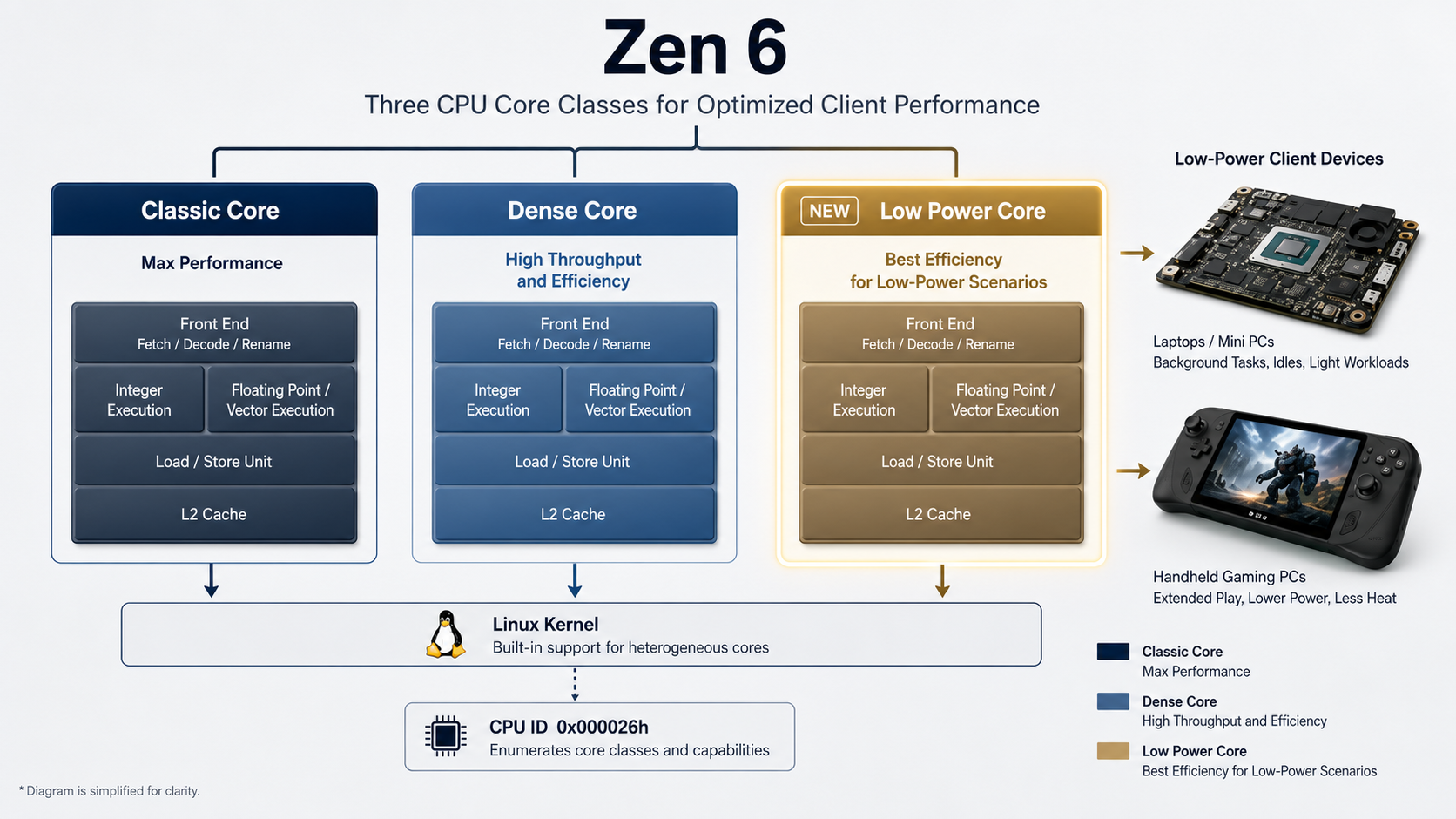
Evidence of the new architecture recently surfaced through Linux kernel development.
Kernel patches introduce a dedicated CPU identifier for the low-power core:
80000026h.EBX[31:28] = 2
AMD has also implemented logic that explicitly distinguishes the low-power core from existing Zen 6C Density cores.
Current kernel support indicates that when user-space software queries processor information through supported interfaces, the new core currently reports its cpu_type as:
unknown
This placeholder reflects the early stage of software enablement rather than the absence of hardware differentiation.
Another notable addition involves boost ratio calculations.
For AMD and Hygon processors supporting the relevant HTR core features, the low-power core dynamically computes boost ratios based on peak performance characteristics instead of relying on a fixed performance limit. This behavior follows a similar execution path to AMD’s efficiency-oriented cores while maintaining separate identification within the operating system.
🏗️ A Hybrid Architecture Built from Multiple Zen Generations #
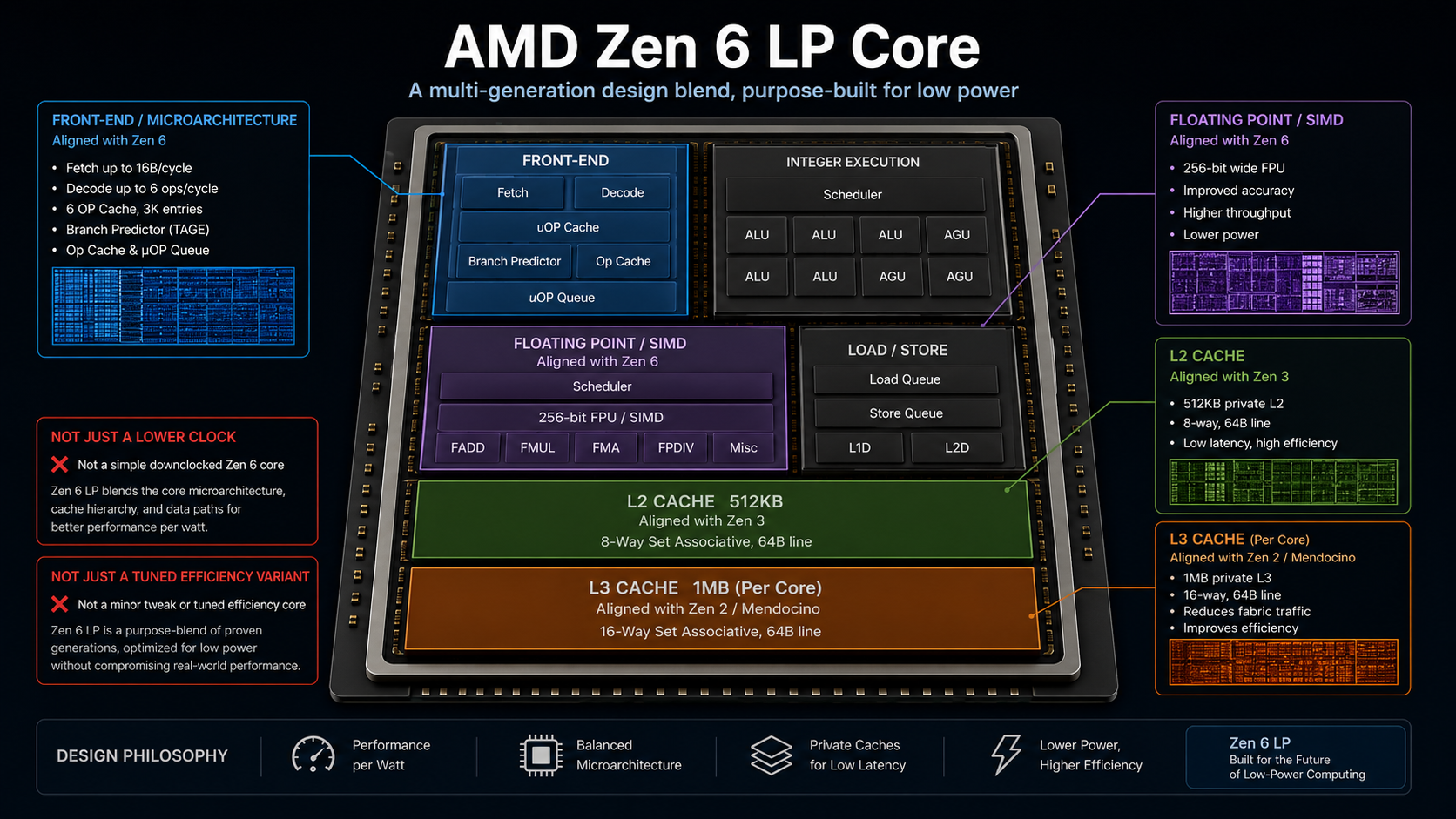
Perhaps the most interesting aspect of Zen 6LP is its underlying design philosophy.
Rather than simply downclocking a Zen 6 core or reusing Zen 6C, AMD appears to have assembled the architecture using mature components from several previous Zen generations.
Although the processor fully supports the Zen 6 instruction set architecture (ISA), its internal building blocks originate from multiple architectures.
Current information indicates the following composition:
| Component | Design Origin |
|---|---|
| Instruction Set Architecture | Zen 6 |
| Core Microarchitecture | Zen 5 |
| Floating Point Unit (256-bit FPU) | Zen 4 |
| L2 Cache (512 KB) | Zen 3 |
| L3 Cache (1 MB per core) | Zen 2 / Mendocino |
This modular approach allows AMD to reuse well-established IP blocks while optimizing the overall design for power efficiency instead of maximum performance.
Unlike Zen 6C—which focuses primarily on improving compute density within the same architectural family—Zen 6LP represents an entirely separate development track beginning at the architectural design level.
⚙️ Designed for Maximum Energy Efficiency #
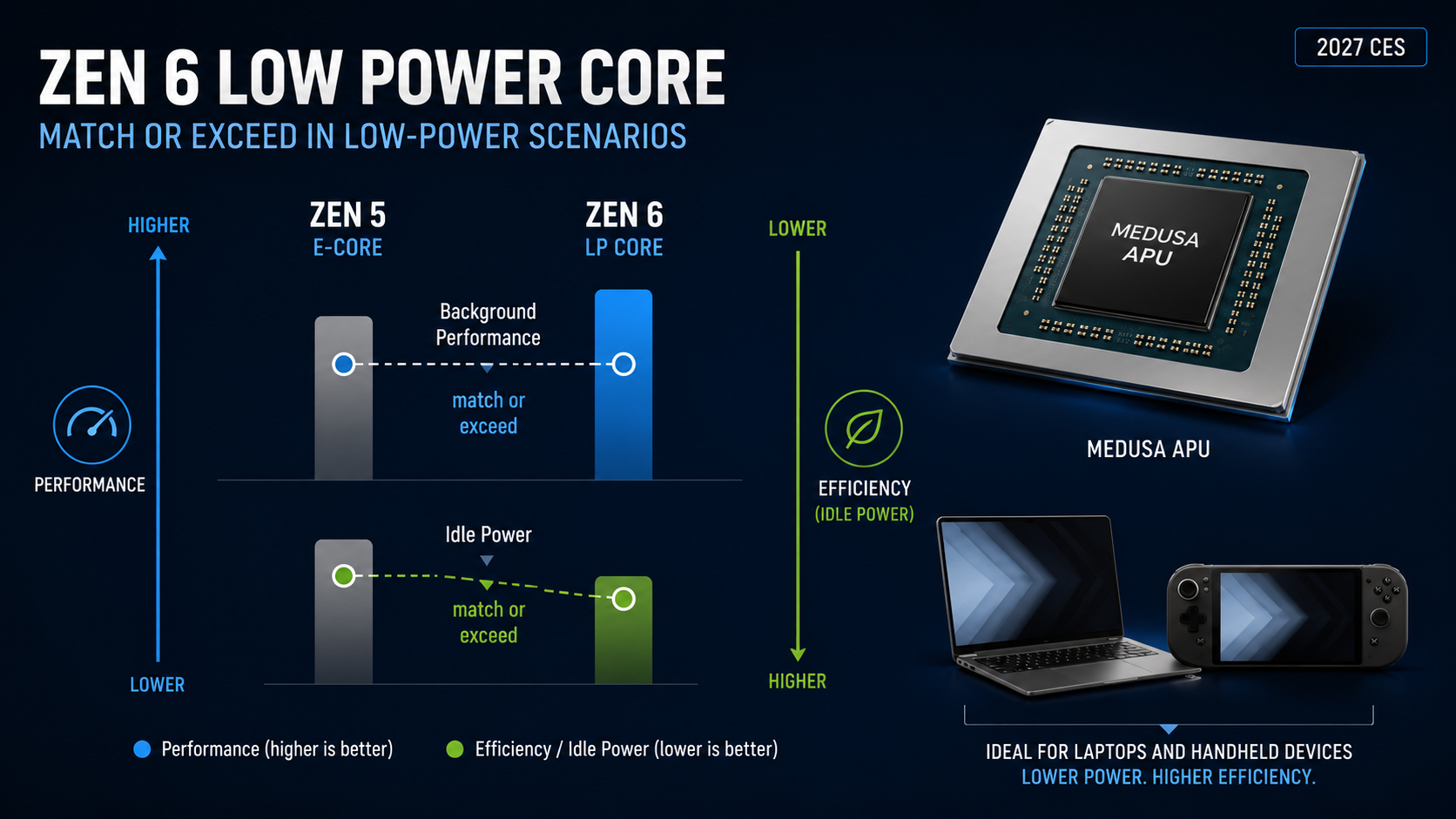
AMD’s primary objective with Zen 6LP is reducing power consumption during low-demand workloads.
Typical scenarios include:
- Background operating system services
- Idle desktop operation
- Media playback
- Web browsing
- Lightweight productivity applications
- Mobile standby tasks
By assigning these workloads to specialized low-power cores, higher-performance Zen 6 cores can remain in lower power states for longer periods.
This strategy mirrors broader industry trends toward heterogeneous CPU architectures that intelligently allocate workloads according to their performance requirements.
🚀 Expected Performance #
Current disclosures suggest that the Zen 6 low-power core is capable of matching—or potentially exceeding—the performance of AMD’s existing Zen 5 efficiency-focused cores.
However, AMD has not clarified whether these comparisons refer to:
- Absolute compute performance
- Performance per watt
- Energy efficiency
- Overall workload efficiency
Given the architecture’s intended role, improvements in performance-per-watt are likely to be more significant than increases in raw computational throughput.
The final balance between efficiency and performance will become clearer once production hardware becomes available.
💻 Medusa APUs Will Be the First Platform #
The new low-power core is expected to debut within AMD’s upcoming Medusa APU family.
Current reports indicate that Medusa processors may combine multiple CPU core types on a single chip, including:
- Standard Zen 6 cores
- Zen 6C Density cores
- Zen 6LP Low-Power cores
This heterogeneous design enables the processor scheduler to assign workloads to the most appropriate core type, improving responsiveness while minimizing overall power consumption.
Potential target platforms include:
- Thin-and-light laptops
- Gaming handhelds
- Portable productivity devices
- Battery-powered mobile PCs
Such devices stand to benefit most from reduced idle power consumption and improved energy efficiency.
📅 Expected Launch Timeline #
Although AMD has not officially announced Zen 6LP products, current roadmap information points toward the Medusa APU family launching around CES 2027.
Additional details—including:
- Clock frequencies
- Core counts
- Power characteristics
- Benchmark results
- Product configurations
are expected to emerge closer to release.
Until production hardware is available, performance expectations should be viewed as preliminary rather than definitive.
📊 Outlook #
The introduction of Zen 6LP represents an important evolution in AMD’s processor strategy. Instead of relying solely on traditional high-performance and high-density core designs, AMD is embracing a more heterogeneous architecture that better addresses the demands of modern mobile computing.
By combining architectural elements from Zen 2 through Zen 6 into a purpose-built low-power core, AMD aims to improve battery life, reduce idle power consumption, and optimize workload scheduling across future client processors.
If Medusa APUs deliver the expected balance of efficiency and responsiveness, Zen 6LP could become a key differentiator for AMD’s next generation of laptops and handheld gaming systems, further strengthening the company’s position in the increasingly competitive mobile processor market.