Arm CSS for Mobile 2 Debuts C2 CPU and AI-Native Mali GPU
Arm has unveiled CSS for Mobile 2, an AI-focused computing subsystem designed to shift mobile performance optimization from individual IP blocks toward coordinated CPU, GPU, memory, system interconnect, software, and physical implementation.
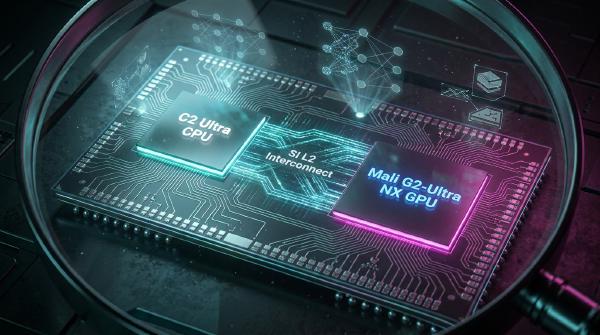
Introduced at Arm’s annual Arm Everywhere China event, the platform combines the new Arm C2 CPU cluster, second-generation Scalable Matrix Extension (SME2) support, and Arm’s first AI-native Mali GPU, the Mali G2-Ultra NX.
Arm says the C2 CPU cluster can deliver up to a 70% improvement in AI model performance, while the Mali G2-Ultra NX can provide up to 4× higher frame rates and per-frame energy efficiency in selected neural graphics workloads.
The platform also introduces the SI L2 System Interconnect, which supports LPDDR6 and is designed to reduce data-transfer overhead between CPU, GPU, and memory. Arm reports approximately 45% lower CPU-to-DRAM latency compared with the previous-generation SI L1.
Together, these components target a new class of mobile workloads in which AI agents continuously perceive, retrieve information, reason, and execute actions while smartphones simultaneously render increasingly sophisticated graphics.
🚀 CSS for Mobile 2 Targets System-Level AI Optimization #
Mobile workloads are becoming increasingly heterogeneous.
An on-device AI agent may need to process speech, retrieve local context, execute a language model, interact with applications, and respond to the user within a single workflow. At the same time, mobile games are demanding increasingly complex lighting, ray tracing, physics, and high-resolution rendering.
These workloads place pressure on more than raw compute throughput. Latency, memory bandwidth, power consumption, thermal limits, and scheduling efficiency increasingly determine the quality of the final user experience.
Arm’s response is CSS for Mobile 2, which treats the mobile compute subsystem as a coordinated platform rather than a collection of independent IP blocks.
The platform consists primarily of:
- C2 CPU cluster with C2-Ultra, C2-Pro, and SME2
- Mali G2-Ultra NX AI-native GPU
- SI L2 System Interconnect
- Supporting software, developer tools, and physical implementation technologies
Arm partners can use individual components or combine them with proprietary and third-party IP to create differentiated SoC configurations.
The architecture is also designed to support earlier PPA—power, performance, and area—optimization during physical implementation, allowing partners to co-optimize silicon implementation alongside the underlying architecture.
⚡ C2 CPU Cluster Brings SME2 to Agentic AI Workloads #
The Arm C2 CPU cluster provides programmable compute and system-level task orchestration for workloads that cannot be efficiently handled by a single accelerator.
Its architecture combines C2-Ultra, C2-Pro, and second-generation SME2 technology.
Compared with the previous generation, Arm reports:
- Up to 15% higher single-thread performance
- Up to 12% higher cluster-level multi-thread performance
- Up to 70% higher AI model performance
- Up to 38% lower power consumption at equivalent peak performance for C2-Ultra
- Up to 12% higher average performance in workloads such as messaging and email
An example flagship configuration uses 2× C2-Ultra and 6× C2-Pro cores.
Arm says this configuration can achieve up to a 1.7× performance improvement on the latest AI models compared with the previous generation.
C2-Ultra targets latency-sensitive workloads #
C2-Ultra is designed for workloads that benefit from high single-thread performance, including application launches, interactive UI operations, agent orchestration, and burst processing.
Compared with the SME2-equipped C1-Ultra, Arm reports up to a 70% increase in peak AI performance.
C2-Pro balances sustained performance #
C2-Pro is designed for longer-running workloads where performance and efficiency must be balanced.
The microarchitecture builds on the previous-generation C1-Pro while targeting more advanced manufacturing processes and higher implementation frequencies.
The DynamIQ Shared Unit (DSU) connects the CPU cores and provides shared L3 cache resources for efficient instruction and data sharing across the cluster.
SME2 accelerates on-device model processing #
SME2 is a central component of the C2 platform’s AI acceleration strategy.
Arm says the second-generation SME2 implementation doubles its AI compute capacity to nearly 6 TOPS. Its matrix-oriented execution is particularly useful during the prefill or encoding phase of language-model inference, where matrix multiplication can become the dominant computational workload.
During token-by-token decoding, however, the bottleneck often shifts toward memory bandwidth because model weights must repeatedly move through the memory hierarchy.
The C2 cluster addresses this through its private L2 and shared L3 caches, reducing unnecessary accesses to system-level cache and DRAM.
SME2 also includes LUTi lookup-table instructions, allowing low-bit model weights such as 2-bit and 4-bit representations to remain compressed until they reach the compute core. The data can then be expanded into execution formats such as INT8, FP16, or FP32.
This approach can reduce memory traffic and footprint for workloads that rely heavily on lookup operations.
🔮 C2 Accelerates End-to-End Agentic AI Workflows #
Arm’s performance analysis extends beyond isolated model benchmarks to complete agentic AI workflows involving speech processing, memory retrieval, reasoning, application execution, and web browsing.
In these tests, an SME2-equipped C2-Ultra configuration delivered a reported 24% overall performance improvement compared with the previous-generation configuration.
Individual stages showed further gains:
- Speech-to-text: Up to 40% lower latency
- Information retrieval and search: Up to 41% higher performance
- Reasoning workloads: Approximately 25% average speedup
These improvements highlight why CPU-side AI acceleration remains important even as smartphones incorporate dedicated NPUs and other specialized AI engines.
Agentic workflows are inherently heterogeneous. The CPU may need to coordinate multiple stages, execute application logic, process retrieved context, and decide where individual operations should run.
The C2 architecture is therefore positioned not simply as an AI compute engine but as an orchestration layer for on-device AI workloads.
🎮 Mali G2-Ultra NX Makes the GPU AI-Native #
Arm’s second major component is the Mali G2-Ultra NX, the company’s first Mali GPU designed with integrated neural acceleration.
The GPU combines:
- Dedicated neural network acceleration
- A new graphics execution engine
- Third-generation hardware ray tracing
- Traditional shader-based rendering
- Neural graphics technologies
The architectural goal is to divide graphics workloads according to the type of computation involved.
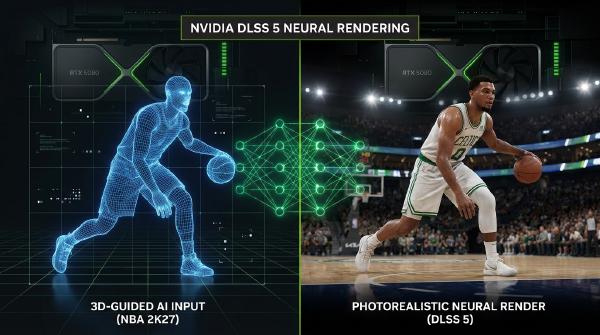
Traditional rasterization remains on conventional GPU hardware, while neural networks handle tasks such as super-resolution, frame generation, and denoising.
Arm reports that selected neural graphics workloads can achieve up to 4× higher frame rates and per-frame energy efficiency.
The company also reports:
- Up to 20% higher benchmark graphics performance
- Up to 14% higher non-AI gaming performance
- Up to 13% lower DRAM traffic
🔬 Neural Graphics Reduce Rendering Workloads #
The Mali G2-Ultra NX integrates neural accelerators directly into the shader architecture and reuses GPU memory systems, coherent caches, and control infrastructure.
Arm says the neural accelerators can be power-gated when inactive, with the GPU targeting demanding graphics workloads within an approximately 1W power envelope in the demonstrated scenarios.
Three technologies form the core of Arm’s neural graphics approach.
Neural Super Sampling #
NSS (Neural Super Sampling) reconstructs higher-resolution output from lower-resolution render targets.
Instead of rendering every target pixel through the traditional graphics pipeline, the GPU can render a fraction of the pixels and use neural reconstruction to generate the remainder.
Arm reports that NSS can nearly double frame rates while significantly reducing external memory traffic compared with native rendering.
Neural Frame Rate Upscaling #
NFRU (Neural Frame Rate Upscaling) generates intermediate frames between conventionally rendered frames.
This enables higher apparent frame rates without requiring the GPU to fully render every displayed frame.
In Arm’s Neural Dawn demonstration, NFRU enabled the use of more than 1,000 dynamic light sources through the MegaLights technology while supporting a reported 120 FPS target and reducing memory traffic by approximately 33%.
Neural Super Sampling and Denoising #
NSSD (Neural Super Sampling and Denoising) combines resolution reconstruction with neural denoising.
This is particularly useful for ray-traced scenes, where reducing the number of rays per pixel can lower computational cost but introduce visible noise.
The neural pipeline uses information including color, depth, motion vectors, and historical frames to reconstruct and clean the final image.
Arm says its neural graphics models are trained using actual game-rendering data and can be retrained or fine-tuned for different game content, artistic styles, and quality targets.
Neural rendering changes the pixel workload #
Arm demonstrated a three-frame sequence in which the first and third frames render only one-quarter of their pixels traditionally, with the remaining pixels reconstructed through NSS or NSSD. The middle frame is generated through NFRU.
Across the sequence, Arm says only one-eighth of the total pixels are conventionally rendered, while the remaining pixels are reconstructed or generated through neural processing.
Compared with traditional rendering, Arm reports:
- Up to 4× higher frame rates
- DRAM bandwidth reduced to as little as 30% of the original level
- Per-frame dynamic energy reduced to as little as 25% of the original level
In Neural Dawn, Arm and Sumo Digital used Unreal Engine to demonstrate NFRU and NSSD, with reported gains of up to 4× performance, up to 70% lower external memory traffic, and 60 FPS operation within an approximately 2W GPU power budget.
🧱 New GPU Execution Engine Expands Register Capacity #
The Mali G2-Ultra NX also introduces a redesigned Execution Engine, which Arm describes as its largest ISA-level GPU update in seven generations.
Register capacity per warp is doubled compared with the previous generation.
The architecture also introduces dynamic register allocation designed to reduce register spilling as shader programs become larger and more complex.
This is increasingly relevant to modern mobile rendering pipelines, where increasingly sophisticated shaders must coexist with ray tracing, neural processing, and other compute workloads.
✨ RTUv3 Advances Mobile Hardware Ray Tracing #
The Mali G2-Ultra NX incorporates Arm’s third-generation ray-tracing architecture, RTUv3.
The new implementation is designed to reduce the memory and computational overhead associated with complex lighting, shadows, reflections, and geometry.
Arm reports up to a 13% reduction in DRAM traffic across major ray-tracing benchmarks.
The architecture also introduces a more compact ray-triangle data structure and hardware support for Opacity Micromaps (OMM).
OMM is particularly relevant to scenes containing large quantities of transparent or partially transparent geometry, including foliage, fabric, and layered materials.
In Arm’s demonstration, enabling OMM increased frame rates by approximately 30% while reducing ray-tracing workloads by up to 70%.
Arm says more than 14 billion Mali GPUs have shipped to date, giving the company a large installed base through which neural graphics technologies can reach mobile developers.
🔗 SI L2 System Interconnect Reduces Data Movement #
The third major component of CSS for Mobile 2 is the SI L2 System Interconnect.
Designed to support LPDDR6, the interconnect focuses on cache coherency, low latency, memory-system efficiency, and support for emerging memory technologies.
Arm reports approximately 45% lower CPU-to-DRAM latency compared with the previous-generation SI L1.
The interconnect also provides coherency and Quality of Service (QoS) mechanisms that can help coordinate task scheduling and priority across CPU, GPU, memory, and other computing resources.
This matters because AI and graphics workloads increasingly compete for the same memory bandwidth.
Reducing data movement can therefore produce system-level gains even when the underlying compute engines remain unchanged. Less movement between compute units means less latency, lower memory power, and more available bandwidth for workloads that actually require it.
🛠️ Software Ecosystem Extends CSS for Mobile 2 #
Arm is pairing its new hardware with a broader software stack intended to reduce the effort required to exploit the platform.
The ecosystem includes KleidiAI, the Arm AI Portal, AI framework integrations, optimized models, developer tools, and support for major game engines.
KleidiAI exposes SME2 acceleration #
KleidiAI integrates optimized Arm CPU implementations into mainstream AI frameworks, allowing supported workloads to take advantage of SME2 without requiring developers to manually rewrite every operation for the underlying architecture.
Arm highlighted collaborations involving ecosystems and models from companies including Google, Tencent, and Alibaba, covering areas such as SME2 acceleration, quantization, model compression, and text-to-speech.
Arm AI Portal connects models with hardware #
The Arm AI Portal provides access to optimized and validated models, performance information, accuracy metrics, code examples, and deployment resources.
Developers can use the platform to evaluate models according to device architecture, runtime, data type, model format, and workload requirements.
Arm also provides access through development environments and agentic workflows using MCP servers, skills, and plugins.
For teams with proprietary models, Arm says an early-access optimization toolkit can help adapt models for specific devices and target architectures.
🎯 CSS for Mobile 2 Reframes Mobile Performance Around Workloads #
The significance of CSS for Mobile 2 is broader than the performance figures of any single CPU or GPU.
Mobile systems are increasingly expected to execute agentic AI, real-time graphics, ray tracing, multimodal inference, and conventional applications simultaneously under strict power and thermal constraints.
That changes the optimization problem.
Peak TOPS or isolated benchmark performance does not fully determine how effectively a smartphone can execute an end-to-end workload. Memory movement, cache behavior, accelerator utilization, CPU orchestration, GPU rendering efficiency, and software optimization all contribute to the final result.
Arm’s CSS for Mobile 2 addresses these factors as a coordinated architecture.
The C2 CPU provides high-performance general-purpose compute and SME2 acceleration for latency-sensitive AI workloads. The Mali G2-Ultra NX adds neural processing directly to the graphics pipeline, allowing AI techniques to reduce traditional rendering costs. The SI L2 interconnect focuses on moving data between these engines more efficiently.
The result is a mobile compute platform designed around a simple architectural principle: use the right compute resource for each part of the workload while minimizing unnecessary computation and data movement.
As on-device AI agents become more capable and mobile graphics continue to approach desktop-class techniques, this system-level approach could become increasingly important for delivering higher intelligence and visual quality without exceeding the power and thermal limits of smartphones.