Chiplet GPUs and CPUs: The 2026 Silicon Revolution
As of April 22, 2026, the semiconductor industry has reached a turning point: disaggregated architecture (chiplets) is no longer optional—it’s essential for scaling high-performance silicon.
Driven by physical limits like reticle size and economic constraints in advanced nodes, chipmakers are shifting from monolithic dies to modular systems-in-package (SiP) designs.
🚀 Intel’s Chiplet GPU Vision: Fully Modular Logic #
Intel’s latest chiplet GPU patent signals a bold departure from traditional GPU design.
Instead of a single large die—or even a hybrid design like current GPUs—Intel is pursuing fully decoupled logic tiles.
Key Innovations #
-
Independent Compute Tiles
Each tile contains its own compute units and local memory (e.g., HBM3e or future HBM4), forming a self-contained processing block. -
Symmetrical Design Philosophy
Unlike designs with a central compute die and surrounding memory dies, Intel’s approach treats each tile as an equal participant in computation. -
Extreme Power Gating
Unused tiles can be completely powered off, significantly reducing idle power consumption—one of the biggest pain points in modern GPUs. -
Workload-Specific Configuration
GPUs can be assembled like building blocks:- More compute tiles → data center workloads
- Specialized tiles → gaming or ray tracing
- Flexible scaling → customized silicon without redesign
This represents a shift toward true modular computing, where GPUs become configurable platforms rather than fixed designs.
🔗 Advanced Packaging: The Real Enabler #
Disaggregation only works if communication between chiplets is fast enough. Intel’s strategy depends heavily on advanced packaging technologies:
-
Foveros 3D Packaging
Enables vertical stacking of logic dies, reducing distance and improving bandwidth. -
EMIB (Embedded Multi-die Interconnect Bridge)
Provides ultra-high-speed lateral connections between tiles on the same package.
Why It Matters #
-
Near-Monolithic Latency
Communication between tiles approaches the performance of a single die. -
Process Node Optimization
Different tiles can use different manufacturing nodes:- Compute tiles → cutting-edge Intel 18A (1.8nm)
- I/O or control tiles → mature, cost-efficient nodes
-
Better Yield, Lower Cost
Smaller dies are easier to manufacture—defects affect only one tile, not the entire chip.
This packaging layer is what transforms chiplets from a concept into a scalable reality.
🎮 AMD Ryzen 7 9800X3D: Gaming Performance Leader #
While Intel is pushing GPU modularity, AMD continues to dominate the gaming CPU space with the Ryzen 7 9800X3D.
Key Innovations #
-
Higher Clock Speeds
Breaks the traditional X3D limitation:- 4.7 GHz base
- 5.2 GHz boost
Delivering both gaming and general-purpose performance.
-
Inverted 3D V-Cache Design
The cache is placed beneath the compute die (CCD), improving thermal efficiency by bringing CPU cores closer to the heat spreader. -
Unlocked Overclocking
A first for X3D chips, allowing enthusiasts to tune performance and fully utilize its ~104MB total cache.
This combination makes the 9800X3D not just a gaming chip—but a well-rounded high-performance CPU.
📊 Industry Outlook: The Shift to Systems-in-Package #
By 2026, the industry transition from monolithic chips to systems-in-package (SiP) is nearly complete.
Key Trends #
-
Heterogeneous Computing
Modern processors combine multiple specialized dies:- Compute
- Memory
- I/O
- AI accelerators
-
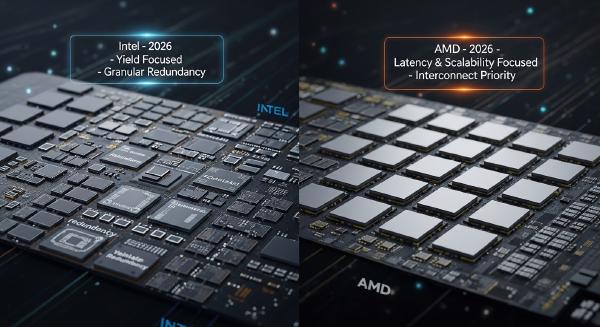
Intel vs. AMD Strategies
- Intel → Betting on Intel 18A + chiplet GPUs to regain leadership
- AMD → Leveraging 3D V-Cache + vertical stacking to dominate gaming
-
Consumer Impact
Chiplets improve value:- Higher performance per dollar
- Better yields reduce cost
- Fewer fully defective chips
🔮 Final Takeaway #
The chiplet revolution is fundamentally changing how processors are built:
- Chips are no longer single entities—they are modular systems
- Performance scaling now depends as much on packaging as on transistor density
- Flexibility and efficiency are replacing brute-force scaling
In 2026, the question is no longer whether chiplets will dominate—but how quickly fully modular architectures will reshape the entire computing landscape.