
Intel Raptor Lake Next HX CPUs Leak Ahead of 2027 Launch
Recent hardware leaks suggest Intel is preparing another refresh of its Raptor Lake architecture for early 2027. Dubbed Raptor Lake Next, the upcoming processor family is expected to coexist with the newer Nova Lake platform while targeting users who require proven high-performance computing solutions across desktop and mobile systems.
According to information disclosed by industry sources, Intel’s mobile strategy for Raptor Lake Next will focus exclusively on the high-performance HX segment, with flagship models reaching 24 cores and 32 threads. At the same time, Intel is reportedly removing vPro and SIPP support across the entire lineup, a decision that could significantly affect enterprise customers while having little impact on mainstream consumers.
As with all pre-release information, these details remain based on third-party leaks and should be treated as unofficial until Intel provides formal confirmation.
🚀 Intel’s 2027 Mobile CPU Roadmap #
While Nova Lake is expected to serve as Intel’s next major architectural leap, Raptor Lake Next appears positioned as a complementary product family designed to address mainstream performance segments.
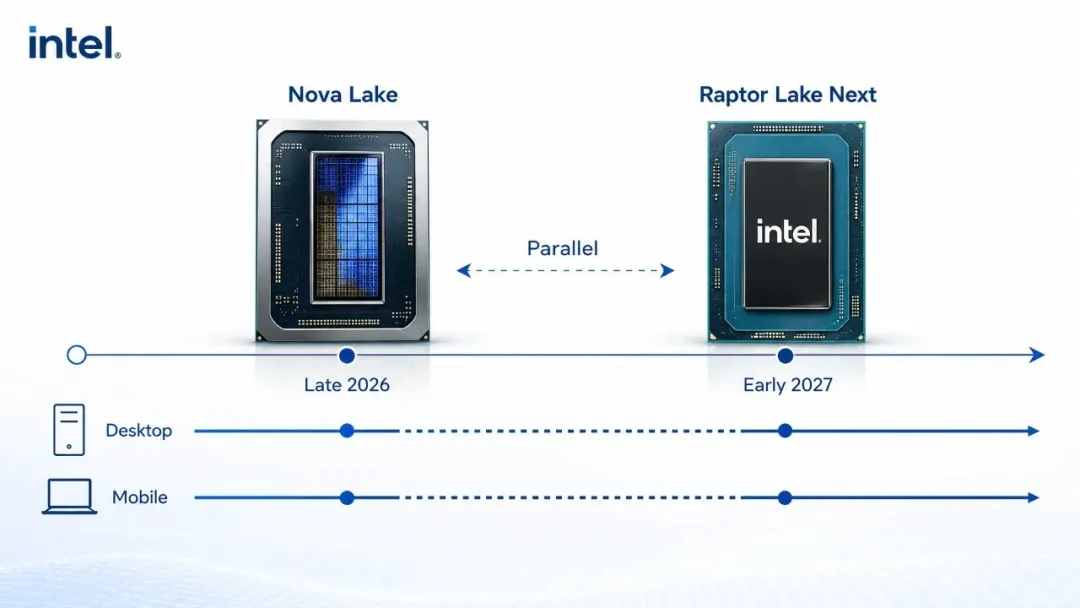
Coexisting With Nova Lake #
Rather than replacing Nova Lake, Raptor Lake Next is rumored to launch alongside it.
This dual-platform strategy could allow Intel to:
- Serve multiple price tiers simultaneously
- Leverage existing manufacturing investments
- Extend the lifecycle of proven architectures
- Provide OEMs with additional product flexibility
The approach mirrors Intel’s historical practice of maintaining multiple processor families across different market segments.
Mobile Focus on HX-Class Systems #
Current leaks indicate that Intel will only release HX-series mobile processors under the Raptor Lake Next branding.
This means:
- No low-power U-series variants
- No mainstream H-series models
- No efficiency-focused mobile lineup
Instead, Intel appears focused entirely on:
- Gaming laptops
- Mobile workstations
- Performance notebooks
- Desktop replacement systems
Users seeking thin-and-light systems will likely need to look toward other Intel product families.
⚙️ Core Configurations Revealed #
The most detailed portion of the leak concerns core counts and processor segmentation.
Flagship Core 9 Configuration #
At the top of the stack sits a Core 9-class processor featuring:
- 8 Performance Cores (P-Cores)
- 16 Efficient Cores (E-Cores)
This configuration delivers:
- 24 total cores
- 32 total threads
Thanks to Hyper-Threading on the P-Cores, the flagship maintains the same thread count as Intel’s previous high-end HX processors while continuing to emphasize hybrid-core scaling.
Core 7 Variants #
The Core 7 family reportedly includes two configurations:
| Model Tier | Core Configuration | Total Cores |
|---|---|---|
| Core 7 | 8P + 12E | 20 Cores |
| Core 7 | 6P + 8E | 14 Cores |
The presence of a 6P+8E configuration is particularly interesting because similar layouts previously occupied lower-tier product segments.
This shift may indicate:
- Product stack restructuring
- New pricing strategies
- Broader Core 7 positioning
- Simplified SKU segmentation
However, no official pricing or branding information has surfaced.
🔍 Incremental Evolution Rather Than Major Reinvention #
Based on currently available information, Raptor Lake Next appears to be an evolutionary refresh rather than a completely new architecture.
Similar Foundation to Previous Generations #
Aside from revised product segmentation, leaks suggest that much of the underlying design remains familiar.
Information that remains unknown includes:
- Clock frequencies
- Cache sizes
- Memory support improvements
- Power consumption profiles
- Platform-level enhancements
Without those details, estimating real-world performance gains remains impossible.
Why Intel May Continue Refreshing Raptor Lake #
Several factors could explain Intel’s decision to continue extending the Raptor Lake lineage:
- Mature manufacturing processes
- Lower development costs
- Strong OEM adoption
- Proven compatibility ecosystem
- Market demand for high-core-count HX systems
For notebook manufacturers, a familiar platform often reduces validation costs and accelerates product development cycles.
🏢 The Biggest Change: Removal of vPro and SIPP #
Perhaps the most notable feature adjustment is not related to performance at all.
According to the leak, Intel plans to remove both vPro and SIPP support from the entire Raptor Lake Next family.
What Is Intel vPro? #
Intel vPro is a collection of enterprise-oriented technologies designed to simplify large-scale device management.
Common capabilities include:
- Intel Active Management Technology (AMT)
- Remote device administration
- Hardware-assisted security features
- Remote KVM functionality
- Fleet management integration
These features are frequently required in enterprise procurement environments.
Understanding SIPP #
The Stable IT Platform Program (SIPP) provides long-term platform stability for organizations that deploy thousands of systems.
Benefits typically include:
- Reduced hardware validation cycles
- Consistent driver support
- Predictable platform availability
- Simplified IT maintenance
For enterprise customers, SIPP can be a critical purchasing requirement.
💼 Impact on Enterprise and Workstation Buyers #
The removal of vPro and SIPP could significantly affect business-focused deployments.
Potential Procurement Challenges #
Many corporations maintain strict procurement policies requiring:
- Remote management capabilities
- Enterprise security standards
- Long-term platform support commitments
Without vPro certification, Raptor Lake Next systems may be excluded from certain enterprise purchasing programs.
Organizations that rely heavily on centralized IT management may instead choose:
- Nova Lake business platforms
- Alternative Intel product families
- Competing enterprise-focused solutions
For workstation fleets and large corporate rollouts, this could become a decisive factor.
Reduced Appeal for Managed Deployments #
Industries commonly dependent on vPro include:
- Financial services
- Government agencies
- Healthcare organizations
- Large educational institutions
- Enterprise IT departments
For these users, processor performance alone is rarely sufficient.
Manageability often carries equal or greater importance.
🎮 Why Consumers Are Unlikely to Care #
For most individual buyers, the removal of vPro support will have little practical impact.
Gaming and Content Creation Remain Unaffected #
Typical consumer workloads rarely involve:
- Remote KVM access
- Enterprise fleet management
- Centralized device administration
- Corporate security policies
As a result, gamers and enthusiasts are unlikely to notice any missing functionality.
Consumer Purchasing Criteria Remain the Same #
Individual buyers will continue focusing primarily on:
- Gaming performance
- Multithreaded workloads
- Battery life
- Thermals
- Pricing
The absence of vPro does not affect these areas directly.
For many users, the change will be effectively invisible.
⚔️ Positioning Against Future Competition #
By the time Raptor Lake Next launches, the mobile CPU market is expected to become even more competitive.
Internal Competition From Nova Lake #
Perhaps the biggest challenge may come from Intel itself.
Nova Lake is expected to introduce:
- New architectural improvements
- Enhanced efficiency
- Platform-level innovations
- Next-generation performance targets
This raises questions about how Intel will differentiate Raptor Lake Next from its newer offerings.
External Competition #
The broader competitive landscape will also include:
- AMD’s future Ryzen HX processors
- ARM-based Windows platforms
- AI-focused laptop CPUs
- Emerging workstation-class mobile solutions
Intel’s ability to position Raptor Lake Next effectively will depend on pricing, availability, and performance relative to these alternatives.
📈 What the Leak Suggests About Intel’s Strategy #
Taken together, the leaked specifications point toward a pragmatic market strategy.
Rather than introducing a radical redesign, Intel appears focused on:
- Extending a proven architecture
- Maintaining high-performance HX offerings
- Serving gaming and enthusiast segments
- Simplifying enterprise product segmentation
- Supporting multiple CPU platforms simultaneously
This approach could allow Intel to maximize market coverage while Nova Lake addresses next-generation performance ambitions.
📌 Conclusion #
If the latest leaks prove accurate, Intel’s Raptor Lake Next lineup will serve as a high-performance refresh aimed primarily at gaming laptops, mobile workstations, and enthusiast systems. Featuring up to 24 cores and 32 threads, the flagship HX processors should continue delivering strong multithreaded performance while leveraging a familiar architectural foundation.
The most significant change, however, may be the complete removal of vPro and SIPP support. While this decision could limit adoption among enterprise customers and managed workstation deployments, mainstream consumers are unlikely to notice any downside.
As always, buyers should remember that current information originates entirely from unofficial sources. Intel has not yet confirmed specifications, branding, pricing, launch timing, or feature sets. Official announcements remain the only definitive source for evaluating the future role of Raptor Lake Next within Intel’s broader processor roadmap.