NVIDIA RTX Spark N1X: ARM Grace Meets Blackwell GPU
NVIDIA has confirmed that the first RTX Spark N1X Windows PCs will reach the market in October 2026, marking a major expansion of NVIDIA’s silicon strategy into consumer and professional PC platforms.
The N1X combines a NVIDIA Grace ARM CPU, a Blackwell GPU, and up to 128GB of LPDDR5X unified memory within a single system architecture. Rather than pairing a conventional CPU with a discrete GPU and separate VRAM, the platform gives both processors direct access to a shared memory pool.
The architecture is particularly targeted at local AI inference, AI agents, content creation, 3D workloads, and compact workstation systems. NVIDIA is also positioning the platform for Windows gaming and general productivity, although its real-world success will depend heavily on Windows-on-ARM software compatibility, driver maturity, power management, and OEM system design.
🧩 N1X Hardware Architecture #
NVIDIA has confirmed two primary N1X configurations for the initial product generation.
| Specification | High-End N1X | Standard / Value N1X |
|---|---|---|
| CPU | 20-core NVIDIA Grace ARM CPU | 18-core NVIDIA Grace ARM CPU |
| GPU Architecture | Blackwell | Blackwell |
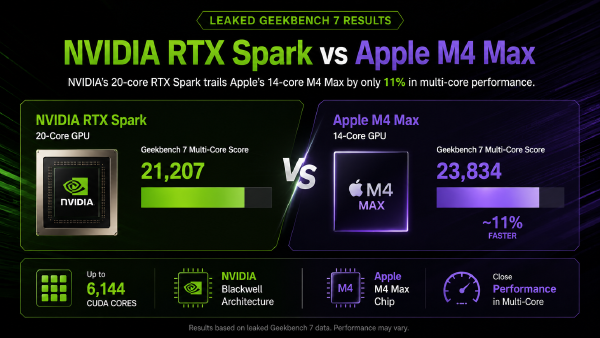
| CUDA Cores | 6,144 | 5,120 |
| Unified Memory | 24GB–128GB LPDDR5X | 24GB–32GB LPDDR5X |
| Form Factors | Laptops and compact desktops | Laptops initially |
| Primary Target | Local LLM inference, AI, 3D rendering | 1440p gaming, AI productivity |
The high-end configuration is particularly unusual for a laptop-class system because of its potential 128GB unified memory capacity.
Grace CPU #
The N1X uses NVIDIA’s Grace ARM CPU architecture rather than a conventional x86 processor from Intel or AMD.
The high-end configuration provides 20 CPU cores, while the lower-tier version uses 18 cores.
For native ARM64 applications, the CPU can operate without x86 translation overhead. Applications that remain compiled primarily for x86 Windows will instead depend on Microsoft’s compatibility and translation mechanisms.
Blackwell GPU #
The graphics component is based on NVIDIA’s Blackwell architecture.
The high-end N1X configuration reportedly provides 6,144 CUDA cores, while the standard configuration includes 5,120 CUDA cores.
Beyond conventional rasterized graphics, the GPU provides NVIDIA’s broader RTX compute stack, including hardware-accelerated AI, ray tracing, and other CUDA-based workloads.
🔮 Unified LPDDR5X Memory #
One of the N1X platform’s defining characteristics is its shared memory architecture.
Traditional PC designs generally separate CPU system memory from GPU VRAM:
Conventional PC

CPU ── System RAM
 │
 └── PCIe ── Discrete GPU ── VRAM
The N1X instead combines CPU and GPU access around a common memory pool:
RTX Spark N1X

             ┌── Grace CPU
             │
Unified LPDDR5X Memory
             │
             └── Blackwell GPU
This architecture is particularly valuable for workloads that need to move large amounts of data between CPU and GPU processing stages.
Large Model Memory Capacity #
The high-end configuration can reportedly support up to 128GB of unified LPDDR5X memory.
Unlike a conventional GPU with a fixed VRAM allocation, unified memory can be dynamically shared between the operating system, applications, CPU workloads, and GPU workloads.
For local AI, this provides an important capacity advantage. Larger models can potentially remain resident in the system’s shared memory without being constrained by a relatively small dedicated VRAM pool.
Reducing CPU-GPU Data Movement #
With a conventional discrete GPU, large datasets and model components may need to move between system memory and dedicated GPU memory across the platform’s interconnect.
A unified-memory design reduces the need for explicit duplication of data between physically separate memory pools.
However, unified memory does not eliminate all memory-access limitations. Actual AI performance will still depend on memory bandwidth, access patterns, GPU utilization, cache behavior, model quantization, and how effectively the software runtime schedules CPU and GPU operations.
The 128GB capacity therefore should not be interpreted as equivalent to having a 128GB high-bandwidth discrete GPU VRAM pool.
🚀 Local AI and Developer Software #
NVIDIA is positioning N1X as a local AI platform as much as a graphics solution.
The system is expected to support NVIDIA’s established acceleration stack, including CUDA, TensorRT, and RTX acceleration technologies.
llama.cpp and vLLM Optimization #
NVIDIA is also highlighting optimizations for open-source inference frameworks such as llama.cpp and vLLM.
The company claims that these optimizations can deliver up to 1.9x faster local inference performance under its stated testing conditions.
Developer-facing applications such as LM Studio and Ollama can provide higher-level interfaces for running local models, while the underlying NVIDIA software stack handles GPU acceleration.
Actual performance will vary substantially according to model architecture, quantization format, context length, batch size, memory bandwidth, and the specific N1X configuration.
AI Agent Workloads #
The platform’s large shared-memory capacity also makes it relevant to increasingly sophisticated local AI agents.
Agent workloads often combine multiple components, including:
- Large language models
- Embedding models
- Retrieval systems
- Tool execution
- Local databases
- Code-generation environments
- Background inference processes
A large unified memory pool can simplify these heterogeneous workloads because applications do not need to reserve a fixed amount of physical memory exclusively for the GPU.
🌐 NVIDIA PAIR and Networked AI Workloads #
NVIDIA is also introducing PAIR, a local network orchestration mechanism designed to distribute AI tasks across idle network-connected PCs.
PAIR is intended for task delegation and workload scheduling, rather than combining the physical memory of multiple machines into one giant memory pool.
This distinction is important.
A network of N1X systems could potentially increase aggregate AI throughput by distributing independent tasks across multiple machines, but it does not turn several 128GB systems into a single 256GB or 512GB shared-memory GPU.
Network latency, bandwidth, scheduling overhead, and model replication requirements remain important considerations for distributed local AI workloads.
🎮 Gaming and Content Creation #
Although local AI is a major focus, N1X is also designed to function as a conventional RTX PC platform.
The Blackwell GPU supports NVIDIA’s modern graphics technologies, including:
- Hardware-accelerated ray tracing
- DLSS
- Ray Reconstruction
- Multi Frame Generation
- Hardware video encoding
- CUDA-based creative applications
NVIDIA says major game publishers and developers, including Electronic Arts, Embark, and Ubisoft, are optimizing titles for the platform.
1440p Gaming Target #
The standard N1X configuration is positioned toward 1440p gaming and on-device AI productivity.
The actual gaming experience, however, will depend on several factors beyond CUDA-core count, including GPU power limits, cooling capacity, memory bandwidth, driver optimization, game compatibility, and the overhead of Windows-on-ARM software translation when native ARM64 binaries are unavailable.
💻 Windows on ARM Compatibility #
The N1X introduces a significant software consideration because its CPU architecture is ARM rather than x86.
Native ARM64 applications can take full advantage of the Grace CPU architecture without translation.
Legacy x86 applications, by contrast, rely on Windows compatibility and translation technologies.
This creates three broad software scenarios:
| Application Type | Expected Execution Model |
|---|---|
| Native ARM64 | Runs directly on the ARM CPU |
| x86-64 application | Runs through Windows translation |
| GPU-accelerated application | Performance depends on native application support, drivers, and NVIDIA acceleration libraries |
For developers, the availability of native ARM64 builds may ultimately be as important as the hardware specifications themselves.
Applications that rely heavily on low-level x86 instructions, legacy drivers, kernel extensions, or unsupported third-party dependencies may encounter compatibility issues.
🏭 October 2026 Hardware Ecosystem #
NVIDIA says the first wave of N1X systems is expected to reach the market in October 2026.
The announced ecosystem includes several form factors and OEM designs.
Reported launch products include:
- Lenovo Yoga 9n 2-in-1
- ASUS ProArt GR1X mini PCs
- ASUS ProArt N1X laptops
- Acer compact RTX Spark desktop designs
Additional systems are expected from manufacturers including HP, Dell, MSI, and Microsoft.
The variety of designs suggests that NVIDIA is treating N1X as a broader PC platform rather than a single reference system.
🌡️ Power, Thermals, and Real-World Performance #
The N1X specifications do not tell the entire performance story.
Exact clock speeds, memory bandwidth, sustained power consumption, and thermal limits are expected to vary by OEM implementation.
This is particularly important for laptops.
A compact chassis may impose substantially tighter thermal constraints than a larger workstation or desktop enclosure. Two systems using the same N1X tier could therefore deliver different sustained performance depending on:
- GPU power limits
- CPU package power
- Cooling-system capacity
- Fan curves
- Memory configuration
- Chassis airflow
- OEM firmware
- Long-duration workload behavior
Short benchmark bursts will therefore be less informative than sustained AI inference, rendering, compilation, and gaming workloads.
🔎 What to Watch in October #
The October launch will provide the first opportunity to evaluate whether N1X’s architectural advantages translate into meaningful real-world benefits.
The most important validation points include:
- Actual memory bandwidth under CPU and GPU contention
- Local LLM performance across different model sizes and quantization formats
- Sustained GPU performance under long workloads
- Power efficiency compared with conventional x86 systems
- Windows-on-ARM compatibility
- NVIDIA driver stability
- Native ARM64 application availability
- OEM pricing and configuration differences
- Thermal throttling in thin laptops
- Performance scaling across the 24GB–128GB unified-memory configurations
These measurements will determine whether unified memory provides a practical advantage over conventional CPU-plus-discrete-GPU architectures rather than simply offering a compelling specification sheet.
🧭 NVIDIA’s New PC Strategy #
The RTX Spark N1X represents a significant architectural departure from the conventional Windows PC.
Instead of combining an x86 CPU, system RAM, PCIe-connected discrete GPU, and dedicated VRAM, NVIDIA is bringing its Grace ARM CPU and Blackwell GPU into a tightly integrated unified-memory platform.
That architecture is particularly well suited to workloads where memory capacity and CPU-GPU data movement are major constraints, especially local AI inference and increasingly complex agentic applications.
The central question is whether NVIDIA can combine that hardware advantage with sufficient software compatibility, power efficiency, driver maturity, and competitive pricing.
If it can, N1X could establish a new class of ARM-based Windows workstations in which large unified memory pools become a central feature rather than an exception.