Huawei Kirin 9050 Pro Brings 3D LogicFolding to Mate XT2
Huawei has introduced the Kirin 9050 Pro, its latest flagship mobile processor and the silicon platform powering the company’s Mate XT2 tri-fold smartphone, with a starting price of ¥19,999 RMB.
The new SoC represents a significant architectural milestone for Huawei. The company provided a detailed technical breakdown of a new Kirin processor at a flagship product launch for the first time in six years, highlighting a proprietary 3D integration approach called LogicFolding.
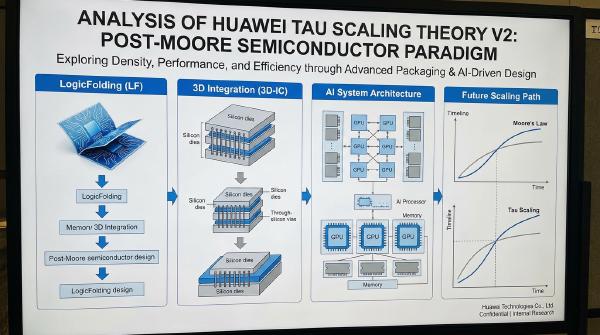
Huawei describes LogicFolding as a commercial implementation of “Tao’s Law” (韬定律), using wafer-to-wafer hybrid bonding to move beyond conventional two-dimensional logic layouts. The company claims the technology increases transistor density by 55% per square millimeter while reducing power consumption for certain core workloads by as much as 66%.
Beyond its 3D integration technology, the Kirin 9050 Pro combines a 9-core Linxi CPU, an upgraded Maleoon GPU, a DaVinci NPU capable of running a 30-billion-parameter multimodal model locally, and a Balong modem with enhanced satellite connectivity.
🧩 LogicFolding Introduces 3D Logic Integration #
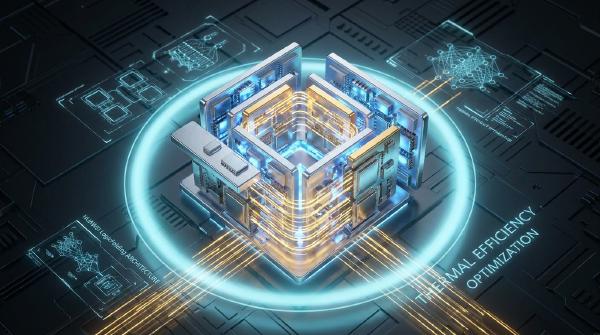
The most significant architectural feature of the Kirin 9050 Pro is Huawei’s LogicFolding technology.
According to Huawei, the technology builds on research associated with He Tingbo, a Huawei board member and President of its Semiconductor Business. Rather than relying exclusively on conventional planar scaling, LogicFolding vertically integrates logic using wafer-to-wafer hybrid bonding.
Huawei reports a hybrid-bonding pitch of approximately 1.5 micrometers, with around 50 million vertical interconnects connecting the stacked structures. Approximately 10% to 15% of those interconnects are allocated to high-speed signal pathways.
The resulting 3D architecture is claimed to deliver:
- 55% higher transistor density per square millimeter
- Up to 66% lower power consumption for core tasks
- Improved physical integration of compute resources
- Shorter interconnect paths between vertically integrated logic structures
The approach reflects the broader semiconductor industry’s move toward advanced packaging and 3D integration as traditional process-node scaling becomes increasingly difficult and expensive.
⚙️ 9-Core Linxi CPU Targets Workload-Specific Performance #
The Kirin 9050 Pro uses Huawei’s Linxi CPU architecture, combining nine primary CPU cores with an additional ultra-low-power micro core.
The main CPU configuration consists of:
- 1 Super core
- 2 Big cores
- 4 Efficiency cores
- 2 Small cores
- 1 ultra-low-power Micro core
Huawei reports a 24% increase in peak single-core performance and a 52% improvement in concurrent multi-core performance compared with the previous generation.
Heavy-load cluster #
The Super and Big cores are designed for demanding workloads such as application launches, large file operations, and intensive game processing.
Huawei claims that large-file loading performance improves by approximately 50%, while the high-performance cluster provides additional compute capacity for sustained workloads.
Efficiency cluster #
The four efficiency cores are positioned for interactive multitasking, including floating-window applications, video streaming, split-screen workloads, and general interface operations.
This arrangement allows the system scheduler to avoid using the highest-performance cores for workloads that do not require their full compute capability.
Daily-use cluster #
Two smaller cores handle lightweight workloads such as web browsing, content feeds, and short-form video playback with a lower power budget.
Always-on micro core #
A dedicated micro core operates independently for low-power background functions, including always-on display processing, sensor-hub operations, and notification polling.
This heterogeneous architecture allows the Kirin 9050 Pro to match compute resources more closely to workload requirements rather than activating high-performance cores unnecessarily.
🎮 Maleoon GPU Delivers Major Graphics Improvements #
Huawei has also substantially expanded the Maleoon GPU inside the Kirin 9050 Pro.
The architecture doubles both its compute resources and L2 cache compared with the previous generation. Huawei claims this results in a 142% increase in real-time graphics rendering performance.
The GPU also incorporates hardware ray tracing capabilities, with Huawei citing support for calculations involving up to 50 million light rays for mobile graphics workloads.
For content creation, Huawei reports more than a 40% improvement in 4K video export performance, making the GPU upgrade relevant beyond gaming.
The combination of increased compute capacity, larger cache resources, and hardware ray tracing positions the Maleoon GPU as a major contributor to the Kirin 9050 Pro’s overall performance uplift.
🤖 DaVinci NPU Enables 30B-Parameter AI On Device #
The Kirin 9050 Pro’s DaVinci NPU is designed around tighter coordination between memory and compute resources, targeting increasingly demanding generative AI workloads.
One of Huawei’s headline capabilities is local execution of a 30-billion-parameter multimodal Mixture-of-Experts (MoE) model, with approximately 2 billion active parameters per inference pass.
Huawei positions this as an industry-first smartphone implementation of an on-device MoE multimodal model at this scale.
The architecture enables AI functions without requiring every inference request to be sent to a remote cloud service. Huawei specifically cites the Pangu 30B-A2B model as an example of a workload that can operate locally.
Potential applications include natural-language photo organization and semantic searches across complex media collections.
For mobile AI, the significance extends beyond parameter count. Running large multimodal models locally requires balancing compute throughput, memory bandwidth, power consumption, thermal limits, and inference latency. The Kirin 9050 Pro’s NPU and 3D integration architecture are therefore closely connected to Huawei’s broader push toward on-device AI.
🛰️ Balong Modem Improves Satellite and Weak-Signal Performance #
The Kirin 9050 Pro also integrates an upgraded Balong baseband supporting Huawei’s space-ground connectivity strategy.
The platform supports Tiantong satellite voice calling and BeiDou messaging, with Huawei reporting:
- 42% higher satellite paging success rate
- More than 40% faster connection establishment
- 25% lower weak-signal latency
Huawei says the weak-signal improvements target scenarios such as underground parking areas, basements, and high-speed rail environments.
These improvements are aimed at maintaining more responsive connectivity when conventional cellular conditions deteriorate.
🔐 Security Architecture Adds Post-Quantum Detection #
Security processing is handled through a combination of Huawei’s Mobile Security Processor (MSP) and an embedded secure element (eSE).
Huawei reports that the security subsystem has achieved EAL5+ CCRC certification and incorporates hardware-level detection for post-quantum cryptographic algorithms.
The post-quantum capability is intended to prepare the platform for cryptographic threats associated with future quantum computing systems, although the practical security value depends on the specific algorithms, implementation, key-management architecture, and software ecosystem deployed on top of the hardware.
🌡️ Performance Gains Extend to Thermal Efficiency #
Huawei’s architectural changes are also intended to improve sustained performance under thermal constraints.
The company reports a 2.5°C reduction in gaming temperatures compared with the previous tri-fold generation.
Combined with the claimed reduction in task-level power consumption from LogicFolding, the thermal improvements could help the Kirin 9050 Pro sustain higher performance without exceeding the thermal limits of a thin foldable device.
This is particularly relevant to the Mate XT2 because a tri-fold smartphone has substantially more display area and mechanical complexity than a conventional handset while still operating within mobile thermal and battery constraints.
📈 Kirin 9050 Pro Architecture at a Glance #
| Subsystem | Architecture / Configuration | Reported Improvement |
|---|---|---|
| 3D Integration | LogicFolding wafer-to-wafer hybrid bonding | +55% transistor density/mm²; up to 66% lower task power |
| CPU | 9-core Linxi + Micro core | +24% single-core; +52% concurrent multi-core |
| GPU | Maleoon with doubled compute units and L2 cache | +142% rendering performance |
| NPU | DaVinci with memory-compute coordination | 30B total / 2B active parameter MoE model on device |
| Modem | Balong space-ground fusion | +42% satellite paging; +40% connection speed |
| Security | MSP + eSE | EAL5+ CCRC; post-quantum algorithm detection |
| Thermals | Enhanced platform-level optimization | 2.5°C lower gaming temperature |
🔬 Huawei’s Shift Toward 3D Mobile Silicon #
The Kirin 9050 Pro is notable not only for its individual CPU, GPU, NPU, and modem improvements but also for the way Huawei is approaching mobile processor scaling.
As conventional transistor scaling becomes more challenging, 3D integration, advanced packaging, heterogeneous compute, and specialized accelerators are becoming increasingly important paths to improving performance and efficiency.
LogicFolding represents Huawei’s attempt to apply this strategy directly to a commercial mobile SoC. If the company’s density and power claims translate into sustained real-world gains, the technology could provide Huawei with another avenue for improving mobile silicon without relying solely on conventional planar scaling.
The Kirin 9050 Pro therefore serves as both the compute platform for the Mate XT2 and a demonstration of Huawei’s broader direction in advanced mobile semiconductor architecture.