RTX Spark Laptops Arrive: Surface Laptop Ultra and Local AI
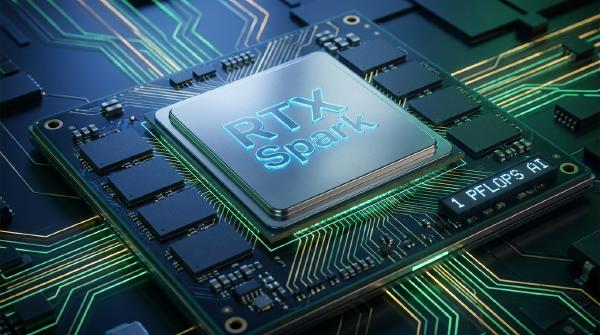
NVIDIA’s RTX Spark platform is bringing workstation-class AI capabilities into a new category of Windows PCs. Following demonstrations of its hardware and software capabilities, NVIDIA and Microsoft have introduced a lineup combining NVIDIA’s Blackwell RTX graphics architecture, Grace CPUs, unified memory, and Windows-based AI development tools.
The headline product is Microsoft’s Surface Laptop Ultra, a premium laptop designed for developers, creative professionals, and users who want to run increasingly sophisticated AI workloads locally. Alongside it, Microsoft unveiled the Surface RTX Spark Dev Box, a compact desktop system aimed at local model development and AI agent experimentation.
The launch represents a broader shift in PC architecture. Instead of relying exclusively on cloud inference or transferring workloads to remote GPU servers, developers can use a local machine to run models, execute coding agents, process creative workloads, and play modern games.
According to Microsoft’s official announcement, Surface Laptop Ultra preorders opened on October 7, 2026, with availability beginning October 16. The Surface RTX Spark Dev Box is scheduled to ship in November.
💻 Surface Laptop Ultra: Microsoft’s New AI Flagship #
Microsoft positions the Surface Laptop Ultra as its most powerful Surface Laptop to date. Its defining feature is the integration of NVIDIA’s RTX Spark N1X superchip, which combines an Arm-based Grace CPU and a Blackwell RTX GPU with shared system memory.
The integrated architecture is designed to support AI inference, software development, creative applications, and gaming without requiring a separate discrete GPU.
Hardware Configurations #
The RTX Spark N1X family includes variants with different CPU core counts and GPU resources.
| Specification | RTX Spark N1X 650 | RTX Spark N1X 675 |
|---|---|---|
| CPU | 18-core NVIDIA Grace CPU | 20-core NVIDIA Grace CPU |
| CPU architecture | Arm Cortex-X925 and Cortex-A725 | Arm Cortex-X925 and Cortex-A725 |
| GPU architecture | NVIDIA Blackwell RTX | NVIDIA Blackwell RTX |
| GPU cores | 5,120 CUDA cores | 6,144 CUDA cores |
| Unified memory | Configuration-dependent, up to 64 GB for the 5,120-core variant | Up to 128 GB |
| Storage | 512 GB PCIe 4.0 SSD in the entry configuration | 1 TB PCIe 5.0 SSD in the high-end configuration |
| Starting configuration price | $2,599 | Approximately $5,899 |
The table summarizes the configurations described in the launch material; memory and storage options can vary by SKU and market. NVIDIA’s RTX Spark product specifications provide the platform-level hardware details.
The higher-end N1X 675 configuration is particularly relevant to local AI inference because its larger unified memory capacity allows more model weights, runtime allocations, and context data to coexist in memory.
Industrial Design and Thermal Architecture #
Surface Laptop Ultra combines a high-performance platform with a comparatively thin chassis.
Key design features include:
- Thin and lightweight construction: The chassis measures less than 18 mm thick and weighs less than 4.5 lb, or approximately 2 kg.
- 15-inch PixelSense Ultra touchscreen: The display supports touch interaction and is designed for creative work, visualization, and development.
- Improved thermal capacity: Microsoft claims up to 2.5 times the thermal power capacity of its existing Surface Laptop designs, helping sustain performance under demanding workloads.
- User-removable storage: The SSD can be replaced or upgraded without treating the entire system as a sealed storage configuration.
- Expanded connectivity: The device includes USB-C, HDMI, USB-A, an SD card reader, and a 3.5 mm headphone jack.
Microsoft also highlights peak HDR brightness of up to 2,000 nits and claims up to 25% higher peak HDR brightness than the MacBook Pro M5 Pro specifications it used for comparison. As with any display benchmark, the result depends on the measurement conditions and comparison models.
Magnetic USB-C Charging #
One unusual hardware feature is Microsoft’s Magnetic Connect interface, described as the first built-in magnetic USB-C charging implementation on a laptop.
The supplied charging cable attaches magnetically to the designated USB-C port and releases easily when pulled. Unlike a proprietary charging connector, the port remains capable of standard USB-C data and video functions.
This design combines the convenience of a magnetic charging connection with the flexibility of a multipurpose USB-C interface.
Storage Expansion and MacBook Trade-In #
Surface Laptop Ultra supports user-removable storage, giving developers and creative professionals greater flexibility when their project files, model weights, or local datasets outgrow the original SSD.
Microsoft has also introduced a qualifying MacBook Pro trade-in promotion offering up to $1,000 in cash back. The offer is subject to eligibility requirements and regional restrictions; Microsoft’s published terms identify the United States and Canada as eligible markets.
⚡ RTX Spark: Up to One Petaflop of Local AI Performance #
The RTX Spark platform’s central proposition is that a portable Windows PC can deliver substantial AI compute locally.
During the launch event, NVIDIA CEO Jensen Huang joined Microsoft CEO Satya Nadella to discuss the relationship between the two companies and the role of Windows in the AI agent era.
The partnership builds on decades of NVIDIA graphics hardware, CUDA software, Windows gaming, and developer tooling. Its latest objective is to make local AI inference and agent execution practical on consumer and professional PCs.
Understanding the One-Petaflop Claim #
NVIDIA advertises up to one petaflop of AI performance for RTX Spark under FP4 precision, using its sparsity feature. This is a theoretical peak figure for a specific operating mode, not a guarantee of sustained performance across every model or workload.
The number nevertheless illustrates how dramatically local AI hardware has evolved. A system weighing around 2 kg can combine a high-core-count CPU, thousands of Blackwell GPU cores, and up to 128 GB of unified memory.
For developers, the benefits extend beyond raw arithmetic throughput. A sufficiently capable local system can reduce dependence on remote inference, keep sensitive data on-device, and make it easier to experiment with models that would otherwise require a dedicated GPU server.
Actual performance depends on the model architecture, quantization, context length, runtime support, memory bandwidth, and the extent to which the workload maps efficiently to the GPU.
What Local AI Compute Enables #
RTX Spark is designed to support several workload categories.
Local LLM inference: Larger unified memory capacity allows developers to load quantized models that exceed the practical memory limits of conventional thin-and-light laptops.
AI-assisted software development: Local models can support code generation, repository analysis, debugging, and agentic development workflows while reducing the need to send every request to a cloud service.
Creative applications: The Blackwell RTX GPU accelerates supported rendering, video processing, image generation, and other compute-intensive creative tasks.
Gaming: The platform supports NVIDIA technologies such as ray tracing, DLSS, and Reflex in compatible applications, alongside the growing Windows on Arm software ecosystem.
Private and offline workflows: Applications that run entirely locally can reduce cloud exposure and operate without continuous access to remote inference services, provided their models and dependencies are available on the device.
Local execution does not automatically guarantee complete privacy or offline operation. Applications may still communicate with remote services, update components, or transmit telemetry, depending on their configuration.
RTX Spark and DGX Spark Serve Different Roles #
RTX Spark and NVIDIA’s DGX Spark share architectural and software foundations, but target different environments.
| Platform | Primary role | Operating environment | Typical workloads |
|---|---|---|---|
| RTX Spark | Consumer and professional AI PC | Windows on Arm | Local AI, creative work, gaming, coding agents |
| DGX Spark | Compact AI development system | NVIDIA DGX OS based on Linux | Model development, experimentation, and AI engineering |
| DGX Station for Windows | Higher-capacity desktop AI workstation | Windows | Larger local models and advanced AI development |
RTX Spark brings NVIDIA’s AI software stack into a Windows laptop or compact desktop form factor. DGX Spark targets dedicated local AI development, while DGX Station for Windows provides a substantially larger system-memory budget for demanding model workloads.
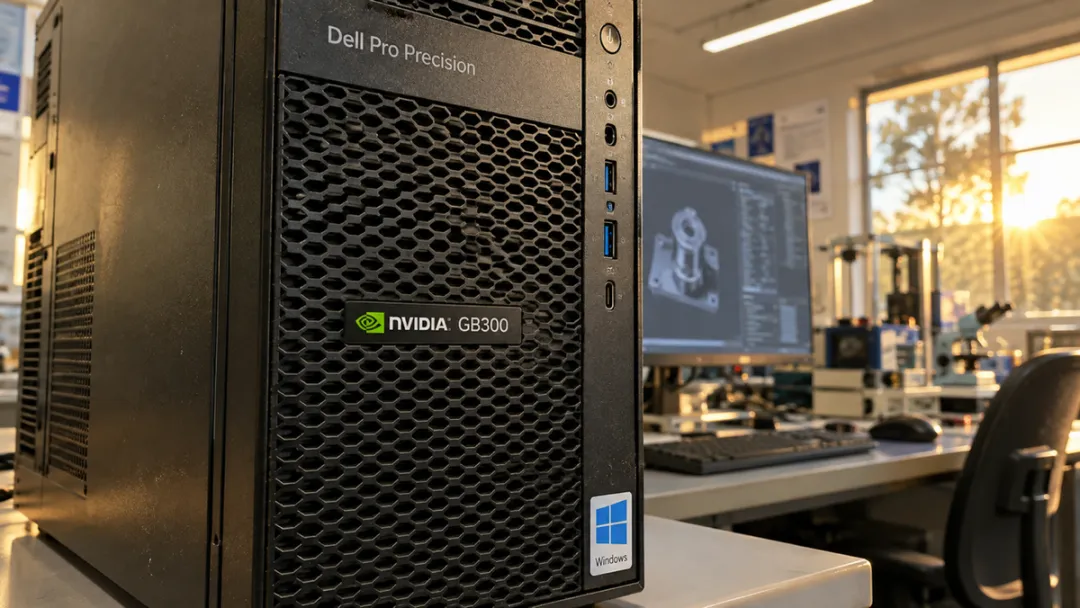
Microsoft has separately highlighted Windows systems powered by NVIDIA’s GB300 Grace Blackwell Ultra platform, with up to 748 GB of unified memory in the announced DGX Station configuration. That system belongs to a different performance and capacity class from Surface Laptop Ultra.
Creator and Gaming Capabilities #
RTX Spark is not exclusively an AI accelerator. Its Blackwell RTX GPU also supports graphics and media workloads.
Relevant capabilities include:
- Fifth-generation Tensor Cores and support for NVFP4.
- Hardware-accelerated video encoding and decoding, including AV1 and 4:2:2 workflows on supported formats.
- Hardware ray tracing.
- NVIDIA DLSS and Reflex technologies in compatible games.
- NVIDIA CUDA for supported compute and AI applications.
The ability to use the same machine for model inference, application development, video editing, and gaming makes RTX Spark a broader platform than a specialized inference appliance.
Actual game compatibility and frame rates depend on the title, graphics settings, drivers, thermal limits, and Windows on Arm support. Desktop GPU comparisons should therefore be treated as workload-specific rather than as universal performance equivalence.
🖥️ Surface RTX Spark Dev Box: A Desktop for AI Development #
Alongside Surface Laptop Ultra, Microsoft introduced the Surface RTX Spark Dev Box, a compact desktop system aimed at developers, AI engineers, and technical teams.
The Dev Box starts at $5,999 and is scheduled to ship in November 2026. It uses the RTX Spark platform to provide local AI compute in a desktop-oriented form factor.
Its principal advantage is a ready-to-use Windows development environment. The announced software setup includes:
- Visual Studio Code.
- Git and GitHub CLI.
- GitHub Copilot.
- Windows Subsystem for Linux (WSL).
- Python.
- Node.js.
- Additional tools and runtimes commonly used in AI development.
Preconfiguring the environment reduces the time required to install compilers, runtimes, repositories, and development dependencies. This is particularly useful for teams that want to begin testing local models or building agents immediately.
The Dev Box is also intended to complement cloud infrastructure. Developers can prototype and evaluate models locally, then move workloads to larger remote systems when they exceed local memory or compute capacity.
🔐 Microsoft Execution Containers: Security for Windows AI Agents #
Hardware is only one part of Microsoft’s strategy. A major software component is Microsoft Execution Containers (MXC), an infrastructure layer designed to make AI agent execution safer and more governable on Windows.
AI agents can read files, run commands, invoke tools, and interact with applications. These capabilities make them useful for autonomous workflows, but they also create security risks if an agent receives unrestricted access to a user’s files, credentials, or network resources.
MXC provides containment and policy controls that allow an organization to define what an agent may access and what actions it may perform.
Microsoft describes the technology in its Windows Developer Blog announcement.
Policy-Driven Agent Execution #
MXC is designed to establish explicit boundaries around agent activity.
Depending on the configured policies and supported integration, these controls can govern:
- File-system access.
- Network destinations and access.
- Available execution tools.
- Access to inference services and credentials.
- Monitoring and auditing of agent activity.
The objective is to allow an agent to complete useful work without granting it unrestricted access to the entire operating system.
For example, a coding agent may need access to a project repository, a compiler, and a test runner. It should not automatically receive permission to inspect unrelated personal files or connect to arbitrary network endpoints.
By enforcing these restrictions at the operating-system level, MXC provides a foundation for running more autonomous workloads on personal computers and managed enterprise devices.
Sandboxing does not remove every risk associated with AI agents. Prompt injection, tool misuse, malicious dependencies, and incorrectly configured policies still require attention. Isolation should therefore be combined with least-privilege permissions, careful secret management, and monitoring.
Ecosystem Integration #
NVIDIA has integrated OpenShell with MXC to provide a security and runtime layer for autonomous agents.
The announced ecosystem includes support for tools and frameworks such as:
- GitHub Copilot.
- OpenAI Codex.
- OpenClaw.
- Replit.
- LM Studio.
- Unsloth AI.
Microsoft has also identified additional planned integrations, including Anthropic Claude Code, Manus, Perplexity, and Raycast.
This approach allows developers to use different AI applications while relying on common policy and containment mechanisms rather than implementing every security control independently.
The value of a shared execution layer grows as agents become more capable and begin interacting with more local applications, data sources, and development tools.
🤖 Windows Hybrid AI: Local Models and Cloud Intelligence #
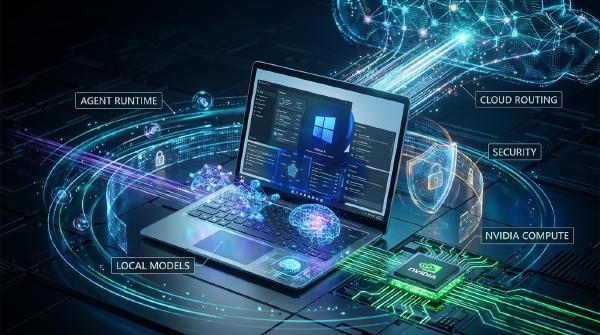
Microsoft’s broader Windows strategy combines local inference with cloud-based intelligence rather than requiring every task to execute on one side.
This hybrid model recognizes that different workloads have different compute, privacy, latency, and cost requirements.
Local Context, Actions, and Models #
Windows AI capabilities are designed around three related functions.
Local context: Applications can use authorized local information, such as project files and active working context, to produce more relevant results.
Local actions: Agents can perform tasks such as file organization, development operations, troubleshooting, and other workflows, subject to the permissions and controls configured for their environment.
Local models: The system can use on-device inference for suitable operations, reducing dependence on cloud calls and potentially improving privacy and responsiveness.
These features make the PC more than a terminal for cloud-hosted AI services. The operating system becomes part of the agent execution environment, with local compute and security policies influencing how tasks are completed.
Hybrid Model Routing #
For complex workloads, local models may not provide the best combination of quality, latency, or tool-use capability. Larger cloud models can still be valuable for reasoning-intensive tasks or operations that exceed local resources.
Microsoft’s hybrid AI direction aims to route tasks according to the capabilities available locally and in the cloud.
A practical policy might use local models for routine coding assistance, file operations, or data processing, then escalate more complex requests to a cloud model when appropriate.
This model can reduce unnecessary remote inference while preserving access to higher-capacity services when needed. The resulting benefits depend on how the runtime evaluates task requirements and how much context must be transferred between execution environments.
Redesigned Windows Search #
Microsoft is also improving Windows Search with an emphasis on semantic understanding and task-oriented interactions.
The announced direction includes:
- Faster access to common actions from the taskbar.
- Better tolerance for misspellings.
- Semantic interpretation of searches.
- Inline file previews.
- Integration with a broader Windows workflow.
These features reflect a move from traditional file-and-application lookup toward an interface that can interpret intent and help users act on the results.
Availability of individual search and agent capabilities may vary by Windows release, device, and rollout channel.
🧩 Local LLMs: The Role of Memory and Quantization #
The practical value of local AI depends not only on compute performance but also on how much model data fits into unified memory.
Large models can contain hundreds of billions of parameters. Loading their weights, KV cache, runtime buffers, and other allocations simultaneously can require substantial memory capacity.
Quantization reduces the number of bits used to represent model parameters, making larger models easier to run on a single machine. However, aggressive quantization can affect model quality, and total memory usage includes more than the compressed weight file.
MAI Code 1.1 Flash #
Microsoft has highlighted MAI Code 1.1 Flash as an example of the potential for local coding models.
The model is a 137-billion-parameter mixture-of-experts architecture with a 256K-token context window. A quantized on-device representation of approximately 53 GB has been described in Microsoft’s local-model materials.
Microsoft reports 72.6% on SWE-bench Verified for its model evaluation and 70.8% for the quantized on-device variant used in its published test configuration. These are vendor-reported figures obtained under specific software, quantization, and evaluation conditions, not universal results across all devices.
The example demonstrates why a laptop with 128 GB of unified memory can be useful for local AI development: it provides headroom for model weights, context data, runtime overhead, and other applications running concurrently.
Memory Capacity Is Not the Same as Available Model Memory #
A system advertised with 128 GB of unified memory does not necessarily provide all 128 GB to the GPU or model runtime.
The operating system, CPU applications, GPU allocations, KV cache, and other system components also consume memory. Depending on the model and context length, a large portion of the memory budget may be required for inference overhead rather than weights alone.
For developers evaluating a local AI system, the relevant questions include:
- How much memory does the model require at the selected quantization level?
- How much additional memory is needed for the intended context length?
- Does the runtime support the model architecture and the hardware backend?
- What inference throughput and response latency are achievable?
- Can the system run the model while maintaining sufficient capacity for other applications?
A model that loads successfully may still perform poorly if memory bandwidth, context processing, or GPU utilization becomes a bottleneck.
The strongest local AI configurations are therefore those that balance model size, memory capacity, software support, and sustained performance.
🌐 OEM Partners and the Future of RTX Spark PCs #
The Surface Laptop Ultra is only one implementation of the RTX Spark platform. NVIDIA’s strategy also involves bringing similar capabilities to systems from multiple PC manufacturers.
Partners identified in the broader RTX Spark ecosystem include Acer, ASUS, Dell, HP, Lenovo, MSI, and Gigabyte.
The announced and showcased product families include:
- ASUS ProArt P16 and P14.
- Dell XPS 16 Creator Edition.
- HP OmniBook Ultra 16.
- Lenovo Yoga 9n 2-in-1.
- MSI Prestige N16 Flip AI+.
Individual specifications, pricing, preorder status, and regional availability depend on each manufacturer and model.
Competition in the AI PC Market #
RTX Spark enters a competitive market that includes Intel Core Ultra, AMD Ryzen AI, Qualcomm Snapdragon X, and Apple’s M-series systems.
The platforms differ in CPU architecture, graphics resources, AI acceleration, memory configuration, power consumption, and software ecosystem.
RTX Spark’s distinctive proposition is the combination of an Arm-based CPU, Blackwell RTX graphics, unified memory, CUDA compatibility, and Windows application support. This makes the platform particularly relevant to developers who want to run local AI workloads alongside conventional Windows applications.
However, technical capability is only one part of the adoption equation. Software compatibility, driver maturity, battery life, sustained performance, pricing, and the availability of useful local AI applications will determine how successful the platform becomes beyond specialist users.
NVIDIA’s data-center business remains central to its overall AI strategy, but RTX Spark extends its technology into personal computing. If the software ecosystem develops as intended, these systems could give developers more opportunities to build and test AI applications directly on the machines they use every day.
✅ Conclusion: Local AI Becomes a Core PC Capability #
NVIDIA RTX Spark represents a shift toward PCs that can run increasingly capable AI workloads without relying exclusively on remote infrastructure.
Microsoft’s Surface Laptop Ultra combines a Grace CPU, Blackwell RTX graphics, unified memory, and Windows software into a premium portable system. The Surface RTX Spark Dev Box extends the same platform into a desktop development environment designed for local model experimentation and agent development.
The announcement also highlights an equally important software transition. Microsoft Execution Containers provide a policy-driven foundation for controlling what AI agents can access, while Windows hybrid AI capabilities aim to coordinate local and cloud resources according to workload requirements.
Three broader trends emerge:
- More capable local hardware: Unified memory and integrated AI acceleration allow larger models and more sophisticated workflows to run on personal computers.
- A more mature AI software stack: Windows, CUDA, local-model runtimes, and development tools make on-device experimentation more practical.
- Security and orchestration become essential: As agents gain the ability to act on local systems, containment, permissions, and model-routing policies become core parts of the computing platform.
RTX Spark does not eliminate the need for cloud infrastructure or dedicated AI servers. Instead, it expands the range of workloads that can be handled locally and gives developers more control over where inference and agent execution take place.
The ultimate impact will depend on real-world application performance, model compatibility, power efficiency, pricing, and whether local AI tools deliver enough value to justify the hardware investment. Nevertheless, the convergence of NVIDIA’s accelerated computing stack and Microsoft’s Windows ecosystem marks a significant new phase in the evolution of AI-capable personal computers.