Snapdragon 8 Elite Gen 6 vs Extreme: What’s New?
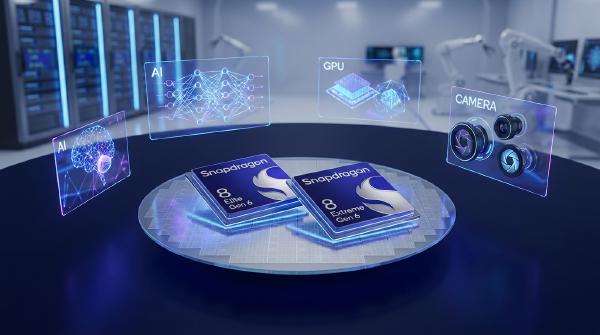
Qualcomm has introduced two new flagship mobile platforms at Snapdragon Summit 2026: the Snapdragon 8 Elite Gen 6 and Snapdragon 8 Elite Extreme Gen 6.
Rather than separating the two chips primarily through CPU clock speeds or core counts, Qualcomm is using a broader feature-stratification strategy for this generation.
Both platforms share the same fundamental CPU architecture, manufacturing technology, connectivity, memory support, and imaging capabilities. The Extreme model differentiates itself by adding higher-end GPU, AI, and video features aimed at premium ultra-flagship smartphones.
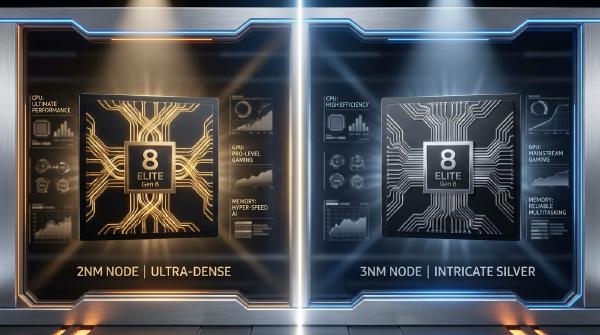
Both SoCs are manufactured using TSMC’s N2P 2nm process and represent Qualcomm’s first flagship mobile platforms to adopt GAAFET transistor technology.
⚙️ New 2nm Process and Oryon V4 CPU #
The transition to TSMC’s N2P process is one of the most significant changes in the new generation.
GAAFET Moves Qualcomm to a New Transistor Architecture #
The Snapdragon 8 Elite Gen 6 family moves away from the FinFET architecture used by previous generations and adopts Gate-All-Around Field-Effect Transistors (GAAFET).
GAAFET surrounds the transistor channel with the gate, providing tighter control over current flow.
The transition is intended to improve several aspects of semiconductor design, including:
- Transistor performance.
- Power efficiency.
- Logic density.
- SRAM scaling.
- Frequency headroom.
Moving to a 2nm-class process also gives Qualcomm additional transistor-density and efficiency advantages for increasingly demanding CPU, GPU, and AI workloads.
Oryon V4 Reaches 5GHz #
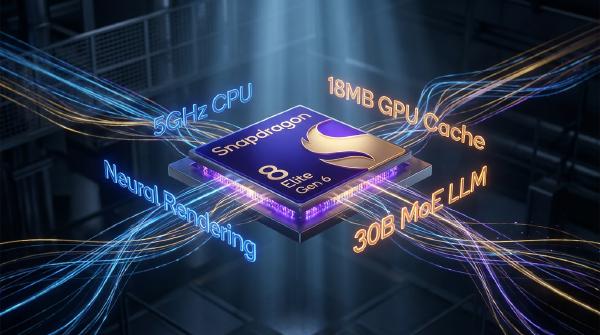
Both platforms use Qualcomm’s next-generation Oryon V4 CPU architecture.
The CPU configuration consists of:
- 2 Prime cores
- 6 Performance cores
- Up to 5.0GHz on the Prime cores.
- Up to 4.0GHz on the Performance cores.
The 5GHz peak frequency represents a new milestone for Qualcomm’s flagship mobile CPU lineup.
However, peak clock speed is only one part of smartphone performance. Sustained performance depends heavily on power limits, cooling hardware, firmware, workload characteristics, and the thermal design of each individual phone.
🌡️ New Offset PoP Packaging Targets Sustained Performance #
Qualcomm has also changed how the SoC and DRAM are packaged.
Traditional smartphone SoCs commonly use Package-on-Package (PoP) designs, with DRAM positioned directly above the logic package.
For the Snapdragon 8 Elite Gen 6 generation, Qualcomm is moving to an offset PoP configuration.
DRAM Moves Away from the Hottest Areas #
The packaged memory is shifted to the side of the main logic die rather than sitting directly above it.
This leaves more of the primary heat-generating regions around the CPU and GPU exposed.
Qualcomm can then place a heat-spreading structure over the logic die to maintain package flatness while improving the thermal path from the hottest areas.
The design sacrifices some packaging efficiency in exchange for improved thermal characteristics.
Longer Peak Performance #
Qualcomm claims that the new packaging approach can allow the platform to sustain peak performance for up to twice as long as the previous generation.
That figure should be interpreted as a platform-level claim rather than a guaranteed result for every smartphone.
Actual sustained performance will depend on each manufacturer’s:
- Vapor chamber design.
- Heat-spreader implementation.
- Chassis construction.
- Power-management configuration.
- Software and thermal policies.
- Ambient temperature.
The packaging change is therefore particularly important for workloads that maintain high CPU and GPU utilization for extended periods.
📡 FastConnect 8800 and Snapdragon X105 #
Connectivity is largely shared between the two Gen 6 platforms.
Both feature Qualcomm’s FastConnect 8800 connectivity system with:
- Wi-Fi 8.
- Bluetooth 6.0.
- 4×4 MIMO.
The platforms also integrate the Snapdragon X105 5G modem, which supports 3GPP Release 19.
Qualcomm specifies peak downlink speeds of up to 14.8Gbps, along with support for Dual SIM Dual Active (DSDA).
Because the modem and connectivity hardware are shared between the two platforms, Qualcomm’s differentiation strategy is focused primarily on compute, AI, graphics, and multimedia features rather than wireless connectivity.
🧠 Feature Stratification Defines the Extreme Edition #
The most important difference between the two platforms is how Qualcomm divides their advanced features.
The Snapdragon 8 Elite Gen 6 targets high-end flagship smartphones, while the Snapdragon 8 Elite Extreme Gen 6 adds specialized capabilities intended for the highest performance tier.
| Feature | Snapdragon 8 Elite Gen 6 | Snapdragon 8 Elite Extreme Gen 6 |
|---|---|---|
| GPU | Next-generation Adreno GPU | Next-generation Adreno GPU + Adreno Matrix Cores + 18MB high-bandwidth memory |
| NPU / AI | Hexagon NPU + Element Accelerator | Hexagon NPU + Element Accelerator + 50% additional shared memory |
| Memory | LPDDR5X and LPDDR6 | LPDDR5X and LPDDR6 |
| Memory bandwidth | Up to 84.8GB/s LPDDR5X / 127.2GB/s LPDDR6 | Up to 84.8GB/s LPDDR5X / 127.2GB/s LPDDR6 |
| ISP | Triple 20-bit Spectra ISP | Triple 20-bit Spectra ISP |
| Camera | 1× 32MP / 108MP ZSL or 3× 64MP ZSL | 1× 32MP / 108MP ZSL or 3× 64MP ZSL |
| Video capture | 8K 30fps HDR, 1080p 480fps | 8K 60fps HDR, 1080p 960fps |
| Video decoding | AV1, H.265, VP9 | AV1, H.265, VP9, APV, VVC |
The table shows that Qualcomm is not simply creating a higher-clocked version of the same platform.
Instead, the Extreme model adds capabilities that can affect specific workloads such as on-device AI, advanced graphics, and professional-grade video processing.
Adreno Matrix Cores Add a New GPU Layer #
The Extreme platform adds Adreno Matrix Cores and 18MB of high-bandwidth memory to its GPU subsystem.
These additions are designed to accelerate workloads that benefit from high-throughput matrix operations and additional local memory resources.
That makes the Extreme platform particularly relevant to demanding AI and graphics workloads, although real-world gains will depend on software optimization and application support.
Additional AI Memory #
Both platforms include a Hexagon NPU with an Element Accelerator.
The Extreme version additionally provides 50% more shared memory for AI workloads.
Additional local memory can help larger models and complex AI workloads operate more efficiently by reducing the need to move data between different levels of the memory hierarchy.
This distinction is particularly relevant as smartphone manufacturers increasingly use on-device models for generative AI, image processing, assistants, and other applications.
📸 Camera Hardware Remains Largely Shared #
Despite the differences in GPU and AI capabilities, the two platforms share the same core imaging architecture.
Both use a triple 20-bit Spectra ISP and support configurations including:
- 1× 32MP camera.
- 1× 10⁸MP camera with zero-shutter-lag support.
- 3× 64MP cameras with zero-shutter-lag support.
The larger differences appear in video processing.
The standard Gen 6 supports:
- 8K video at 30fps with HDR.
- 1080p slow motion at 480fps.
- AV1, H.265, and VP9 decoding.
The Extreme version increases video capabilities to:
- 8K at 60fps with HDR.
- 1080p at 960fps.
- APV and VVC decoding in addition to AV1, H.265, and VP9.
This gives the Extreme platform a more substantial advantage for high-end video capture and playback workloads than the camera sensor specifications alone would suggest.
📱 OEM Adoption and Smartphone Positioning #
Several major smartphone manufacturers have confirmed plans to use the new Snapdragon platforms.
The announced or expected OEM lineup includes:
- HONOR
- iQOO
- Motorola
- OnePlus
- OPPO
- REDMI
- RedMagic
- vivo
- Xiaomi
The two platforms are expected to occupy different positions within these manufacturers’ product portfolios.
The Snapdragon 8 Elite Gen 6 is positioned for high-end flagship smartphones, while the Extreme Gen 6 is intended for the most premium models where additional GPU, AI, and multimedia capabilities can justify the higher-tier platform.
Actual product configurations will still vary between manufacturers.
🔬 Peak Performance Is Only Part of the Story #
The Snapdragon 8 Elite Gen 6 generation represents a shift in Qualcomm’s flagship strategy.
Previous flagship comparisons often centered on straightforward specifications such as CPU frequencies, core counts, and GPU performance.
This generation introduces a more modular approach.
The two platforms share a common foundation:
- TSMC N2P 2nm manufacturing.
- GAAFET transistors.
- Oryon V4 CPU cores.
- 5GHz Prime-core frequency.
- FastConnect 8800.
- Snapdragon X105 5G.
- LPDDR5X and LPDDR6 support.
- Triple Spectra ISP architecture.
Qualcomm then separates the Extreme platform through additional GPU resources, AI memory, video capabilities, and specialized acceleration.
The result is a product strategy in which the difference between flagship tiers is increasingly determined by what the platform can do, rather than simply how fast its CPU cores can run.
Commercial smartphones will ultimately determine how much of that theoretical capability translates into real-world performance. Thermal design, firmware, software optimization, battery capacity, and sustained power limits will all influence the final experience.
For the Snapdragon 8 Elite Gen 6 family, the most important development may therefore be the combination of 2nm GAAFET manufacturing, Oryon V4 CPU architecture, redesigned thermal packaging, and feature-based platform differentiation rather than any single specification.