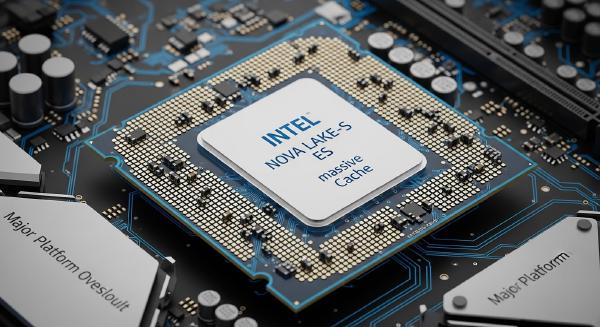
Intel Nova Lake-S Leak Reveals 28-Core CPU and BFC Suffix
A new leak has revealed specifications for seven processors reportedly belonging to Intel’s next-generation Nova Lake-S desktop platform.
The leaked lineup introduces several notable changes, including four-digit model numbers, a previously unseen BFC suffix, and a flagship configuration with 28 CPU cores.
According to the leaked specifications, the Core Ultra 9 4970K BFC combines 8 Performance cores (P-cores), 16 Efficient cores (E-cores), and 4 Low-Power Efficient cores (LP-E cores). That produces a total of 28 cores in a single compute-die configuration.
The leak also associates BFC models with a larger Big Last Level Cache (BLLC), 125W TDP configurations for K-series parts, 32-EU integrated graphics, and vPro support.
These specifications remain unofficial. Previous Nova Lake leaks have also changed over time, so final product names and configurations may differ.
🔥 Nova Lake-S Leaked Lineup #
The leaked list covers Core Ultra 9, Core Ultra 7, and Core Ultra 5 processors.
| Processor | P-cores | E-cores | LP-E | Total cores | BLLC | TDP | iGPU | vPro |
|---|---|---|---|---|---|---|---|---|
| Core Ultra 9 4970K BFC | 8 | 16 | 4 | 28 | Yes | 125W | 32 EU | Yes |
| Core Ultra 9 4950K | 8 | 16 | — | 24 | No | 125W | 32 EU | No |
| Core Ultra 9 4900 BFC | 6 | 12 | 4 | 22 | Yes | 65W | 32 EU | Yes |
| Core Ultra 7 4870K BFC | 8 | 12 | 4 | 24 | Yes | 125W | 32 EU | Yes |
| Core Ultra 7 4850K | 8 | 12 | — | 20 | No | 125W | 32 EU | No |
| Core Ultra 5 4650K | 6 | 12 | — | 18 | No | 125W | 32 EU | No |
| Core Ultra 5 4650KF | 6 | 12 | — | 18 | No | 125W | None | No |
The pattern suggests that the BFC variants add four LP-E cores and BLLC compared with their standard counterparts. The leaked table also associates these models with vPro support.
Intel has not publicly confirmed what BFC means, so the suffix should not be expanded beyond what the leaked data actually establishes.
🧩 The 28-Core Core Ultra 9 4970K BFC #
The most notable processor in the leak is the Core Ultra 9 4970K BFC.
Its reported configuration is:
- 8 P-cores
- 16 E-cores
- 4 LP-E cores
- 28 total cores
- BLLC
- 125W TDP
- 32-EU integrated GPU
- vPro support
The 4970K BFC differs from the leaked Core Ultra 9 4950K primarily through the additional four LP-E cores and the larger cache configuration.
This is particularly interesting because earlier Nova Lake-S leaks had also pointed toward a 28-core configuration. A previous shipping-manifest leak reportedly identified a 28-core Nova Lake-S processor, although the exact SKU and core breakdown were not confirmed at that time.
The latest leak therefore provides a more detailed picture of how that 28-core configuration could appear in Intel’s commercial lineup.
🧠 BLLC and the BFC Pattern #
The leaked specifications show a consistent relationship between BFC models and the larger-cache configuration.
The reported pairings include:
- 4970K BFC vs. 4950K
- 4870K BFC vs. 4850K
- 4900 BFC vs. its standard counterpart
In each case, the BFC version reportedly adds four LP-E cores and BLLC.
The Core Ultra 9 4900 BFC is particularly interesting because it combines 6 P-cores, 12 E-cores, and 4 LP-E cores for a total of 22 cores while operating at a reported 65W TDP.
That makes it the only non-K processor among the seven leaked models.
The exact capacity of BLLC has not been established by this particular leak. Earlier reports have suggested that single-compute-die Nova Lake-S configurations could reach up to 144MB of BLLC, but the cache capacity of each leaked SKU should not be assumed without additional evidence.
🔄 Earlier 4950K Leaks vs. the New Specification #
One of the more interesting details is the changing identity of the Core Ultra 9 4950K.
Earlier leaks had reportedly associated the 4950K with a 28-core configuration consisting of 8 P-cores, 16 E-cores, and 4 LP-E cores.
The newer leaked table instead lists the 4950K as a 24-core processor with 8 P-cores and 16 E-cores, without LP-E cores or BLLC.
This discrepancy illustrates why leaked processor specifications should be treated as preliminary.
Possible explanations include:
- Engineering-sample configurations changed during development.
- An engineering sample was later assigned a different retail SKU.
- Different sources obtained information about different configurations.
- One of the leaks may simply be incorrect.
The safest conclusion is that Intel has been testing Nova Lake-S configurations around the 28-core range, while the final commercial SKU mapping remains unsettled.
🧱 LGA 1954 and the Nova Lake Platform #
Nova Lake-S is also expected to introduce a new desktop platform based on the LGA 1954 socket and 900-series chipsets.
Evidence for the new platform is stronger than many individual SKU rumors. Intel’s own design-in infrastructure has reportedly referenced an LGA1954 Nova Lake-S interposer, while 900-series chipset entries have appeared in industry compliance databases.
The new socket represents another platform transition from the LGA1851 socket used by Arrow Lake-S.
Earlier leaks have also suggested that Intel could eventually offer configurations beyond the 28-core single-compute-die design, potentially reaching substantially higher core counts through multiple compute dies.
The currently leaked seven-chip lineup does not include those higher-core-count variants.
AMD Ryzen Z3 Handheld Processor #
Intel’s desktop leak arrives alongside new information about AMD’s next-generation Ryzen Z3 handheld processor.
According to recent leaks, Ryzen Z3 is expected to use a semi-custom version of AMD’s Medusa Point architecture, combining Zen 6 CPU technology with RDNA4m graphics for handheld gaming systems.
The reported design includes:
- 4 Zen 6 CPU cores
- 2 low-power cores
- 6 cores / 12 threads
- 12 RDNA4m Compute Units
- 15W target for Ryzen Z3
- 25W target for Ryzen Z3 Extreme
- 25 × 25 mm FF6 package
The configuration remains unofficial and may change before commercial products launch.
🎮 CPU Cores Traded for GPU Resources #
The most interesting aspect of Ryzen Z3 is the reported balance between CPU and GPU resources.
Standard Medusa Point configurations have been associated with a larger CPU configuration, reportedly including four Zen 6 cores, four Zen 6c cores, and two low-power cores.
The handheld Z3 design reportedly removes the four Zen 6c cores and instead increases the GPU configuration to 12 RDNA4m CUs.
This is a logical trade-off for a gaming handheld.
Games are generally sensitive to both CPU and GPU performance, but integrated handheld designs operate under strict power and thermal limits. Allocating more die area and power budget to the GPU can therefore make sense when the target workload is primarily graphics rendering.
The leaked configuration should nevertheless be considered preliminary. The source itself notes that the configuration may still change.
📦 Compact FF6 Package #
Ryzen Z3 is also reportedly designed around AMD’s FF6 25 × 25 mm package.
A smaller package is valuable in handheld systems because motherboard space, cooling volume, battery placement, and mechanical design are all tightly constrained.
Compared with the larger FP8 package associated with processors such as Strix Point, the reported FF6 footprint reflects the more specialized requirements of portable gaming hardware.
The combination of a semi-custom CPU/GPU configuration and a compact package suggests that Ryzen Z3 is being designed around the handheld form factor rather than simply repurposing a conventional notebook APU.
🧮 RDNA4m and Handheld Graphics #
The leaked Ryzen Z3 design reportedly uses RDNA4m, described as a derivative of AMD’s mobile-oriented graphics architecture with additional capabilities associated with newer RDNA generations.
The reported 12-CU configuration would give the Z3 a larger GPU allocation than the eight-CU configuration associated with standard Medusa Point designs.
The practical gaming performance will ultimately depend on more than CU count, however. Clock frequency, memory bandwidth, cache capacity, power limits, driver optimization, and upscaling technology will all influence real-world performance.
🕹️ MSI Claw 8 EX AI+ Adds Arc G3 Model #
On the handheld product side, MSI has introduced another configuration of the Claw 8 EX AI+, this time using Intel’s Arc G3 processor.
The new model is reported to cost 10,499 RMB in China and uses a 32GB memory and 512GB storage configuration.
Its reported processor configuration includes:
- 2 P-cores
- 8 E-cores
- 4 LP-E cores
- 14 total cores
- 14 threads
- Up to 4.6 GHz boost clock
The integrated GPU is reportedly an Intel Arc B370 with:
- 10 Xe cores
- Up to 2.2 GHz
- XeSS 3 support
- Up to 90 TOPS of AI performance
The handheld retains an 8-inch WUXGA display with a 1920 × 1200 resolution, 120Hz refresh rate, and VRR support. It also includes 32GB of LPDDR5X memory and a 512GB PCIe 4.0 SSD.
The new configuration demonstrates how Intel’s newer hybrid CPU architectures are being adapted to low-power gaming devices as well as desktop platforms.
🏛️ U.S. Government Equity Stakes and AI Companies #
A separate development involving Intel concerns the U.S. government’s investment in the company.
The U.S. government acquired a 9.9% stake in Intel in 2025 through an arrangement associated with the CHIPS Act. Subsequent reporting in 2026 discussed whether a similar government-investment structure could potentially be applied to AI companies such as OpenAI and Anthropic.
This is a policy and corporate-finance issue rather than a semiconductor product announcement, but it is relevant to Intel because the company’s government relationship has become an example cited in discussions about strategic U.S. technology companies.
Reports have noted that applying a similar structure to AI companies would raise different legal and financial questions. For example, Axios reported that a government investment in an AI lab would likely require congressional action.
The scale and structure of any hypothetical transaction should therefore not be treated as established policy.
💰 Why the Intel Structure Is Different #
The Intel arrangement occurred in the context of U.S. semiconductor policy and the CHIPS Act.
AI companies such as OpenAI and Anthropic have substantially different corporate structures, financing histories, valuations, and relationships with government programs. A direct comparison with Intel therefore has important limitations.
Any future government investment would need to address questions such as:
- What legal authority would permit the investment?
- Would Congress need to authorize the transaction?
- What voting or governance rights would accompany the stake?
- How would the investment be valued?
- Would the government receive common equity or another security?
- How would conflicts of interest be managed?
- What conditions would accompany the investment?
These questions remain separate from whether such a transaction would ultimately occur.
🧩 Four Hardware Stories, One Industry Trend #
The four developments covered here point to different aspects of the rapidly changing computing market.
Nova Lake-S shows Intel expanding its desktop architecture with more complex hybrid-core configurations, new platform infrastructure, and larger cache options.
Ryzen Z3 demonstrates how AMD is customizing CPU/GPU balance for handheld systems, trading general-purpose CPU resources for additional graphics capability within a strict power envelope.
MSI’s Claw 8 EX AI+ shows how those architectural changes are reaching commercial handheld products, with increasingly capable integrated graphics and AI acceleration.
Meanwhile, the Intel government investment illustrates how semiconductor manufacturing and national technology policy are becoming increasingly interconnected.
🧠 Conclusion #
The latest Nova Lake-S leak provides one of the clearest snapshots yet of Intel’s upcoming desktop strategy, including a reported 28-core Core Ultra 9 4970K BFC, four-digit model numbering, BLLC-equipped BFC variants, and the new LGA1954 platform.
At the same time, AMD’s rumored Ryzen Z3 points toward a more aggressively customized approach to handheld processors, with CPU resources rebalanced toward a larger integrated GPU.
MSI’s new Claw 8 EX AI+ configuration shows how Intel’s latest hybrid architectures are entering the handheld market, while the separate U.S. government investment in Intel highlights the increasingly strategic role of semiconductor companies in technology policy.
Most of the hardware specifications discussed here remain based on leaks rather than final manufacturer announcements. Core counts, model names, clocks, cache sizes, power limits, and product availability can still change before commercial launch.