Snapdragon X2 in 2026: Qualcomm Becomes a Real PC Contender
By April 2026, Qualcomm’s Snapdragon X series has crossed an important threshold. What began in 2024 as an ambitious—but imperfect—entry into the PC market has rapidly evolved into a credible challenge to both Apple Silicon and traditional x86 platforms.
The first-generation Hamoa chips proved the concept.
The second generation—Snapdragon X2—is where execution finally catches up.
This is no longer an experiment.
➡️ It’s a platform.
🚀 Snapdragon X2 “Project Glymur”: From Prototype to Product #
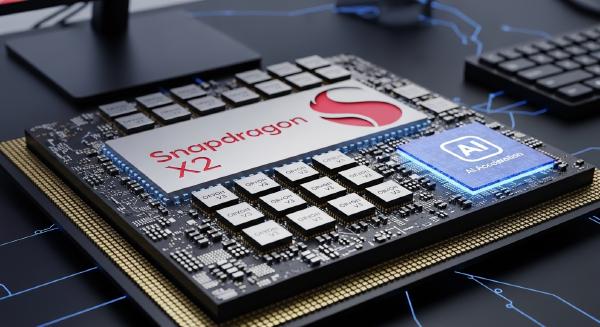
After early silicon validation under SC8480XP (Project Glymur), Qualcomm formally launched the Snapdragon X2 Series at CES 2026.
The lineup is clearly tiered for market coverage:
- Elite Extreme (flagship, up to 18 cores)
- Elite (high-end mainstream)
- Plus (volume segment)
What Actually Changed? #
-
3rd Gen Oryon CPU
Qualcomm’s custom CPU cores now deliver:- ~35% higher single-core performance
- ~43% better power efficiency vs Gen 1
-
A Massive AI Leap
The upgraded Hexagon NPU reaches ~80 TOPS, doubling down on on-device AI.This is significant because:
- It far exceeds Copilot+ PC requirements
- It outpaces many current competitors in raw AI throughput
In practical terms, Qualcomm is no longer just “AI-capable”—it is AI-forward by design.
⚔️ Performance: Closing the Triangle (Apple vs x86 vs ARM) #
Early 2026 benchmarks suggest Qualcomm has finally entered the top tier.
Against Apple Silicon #
-
Multi-Core
The X2 Elite Extreme (18-core) now competes directly with Apple’s M4 Pro in sustained workloads. -
Single-Core
In some benchmarks (e.g., Geekbench), it edges past the base M4. -
Efficiency
Apple still leads slightly in fanless performance-per-watt—but the gap is now small enough to be situational, not structural.
Against Intel and AMD #
-
Compatibility
x86 still dominates:- Gaming
- Legacy enterprise software
-
Battery Life
Qualcomm leads decisively in productivity scenarios:- 20+ hours real-world usage is increasingly common
This positions Snapdragon X2 as the best “all-day laptop” platform in the Windows ecosystem.
💻 The Mainstream Push: X2 Plus and Market Expansion #
To move beyond premium devices, Qualcomm introduced the Snapdragon X2 Plus lineup.
-
Configurations
- 10-core variant
- 6-core variant
-
Target Segment
- $700–$900 laptops
- Students, professionals, and general consumers
Replacing the Old Entry Tier #
The earlier X1P-42-100 (8-core) from 2024 is effectively phased out.
The new X2 Plus brings:
- Better CPU efficiency
- Stronger Adreno graphics
- Early ray tracing capabilities in integrated GPUs
This is critical:
➡️ Qualcomm is no longer just competing at the high end—it’s scaling into volume markets.
🔮 Software: The Quiet Breakthrough #
Hardware alone wasn’t the first-generation problem—software was.
That’s where Windows 11’s “Prism” emulation layer changes the narrative.
-
Then (2024):
Noticeable performance penalties
Compatibility concerns -
Now (2026):
- Most apps run seamlessly
- Performance overhead is often negligible
- Users frequently don’t know (or care) if an app is native
This is arguably the real inflection point.
Without this progress, the hardware gains wouldn’t matter.
🔮 Roadmap: What Comes After X2? #
The forward pipeline is already taking shape:
-
Snapdragon X3 (V3)
- Currently in simulation
- Expected launch: Q4 2027
-
Ecosystem Alignment
Major OEMs (Dell, Lenovo, HP) and Microsoft are increasingly aligned around:- ARM-native development
- AI-first workflows
The trajectory suggests Qualcomm is building a multi-generation platform, not just iterative chips.
📊 Generation Comparison (2024 → 2026) #
| Feature | Snapdragon X (Gen 1) | Snapdragon X2 (Gen 2) |
|---|---|---|
| CPU Architecture | 1st Gen Oryon | 3rd Gen Oryon |
| Max Core Count | 12 Cores | 18 Cores |
| AI Performance | 45 TOPS | 80 TOPS |
| Peak Clock | 3.8–4.3 GHz | Up to 4.7 GHz |
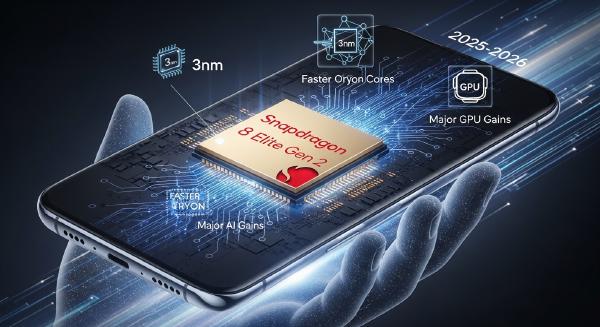
| Process Node | TSMC 4nm | TSMC 3nm (N3E/N3P) |
🔮 Final Take: The Third Pillar Has Arrived #
In 2024, Qualcomm was an outsider trying to prove ARM could work on Windows.
By 2026, that conversation is over.
We now have a three-way competition:
- Apple → Vertical integration, efficiency leadership
- Intel / AMD → Compatibility, performance breadth
- Qualcomm → Efficiency + AI + mobility-first design
Each has a distinct philosophy—but Qualcomm is no longer behind.
The ripple has become a wave.
And for the first time in decades, the PC market has something it hasn’t had in a long time:
➡️ Real architectural competition.