NVIDIA Invests $1 Billion in Nokia to Accelerate AI-RAN and 6G
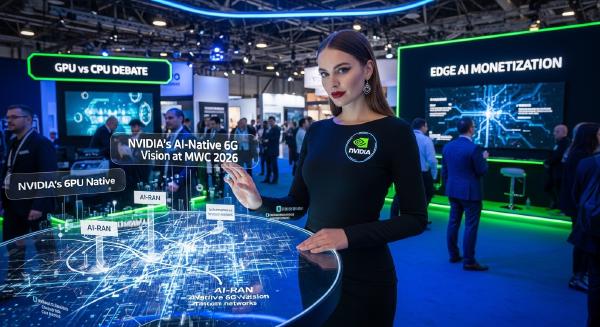
NVIDIA continues to expand beyond traditional AI infrastructure with another strategic move into a trillion-dollar industry. On July 15, 2026, Nokia announced a landmark partnership with NVIDIA to develop the world’s first commercial AI-RAN (Artificial Intelligence Radio Access Network) platform. As part of the agreement, NVIDIA will invest $1 billion in Nokia, acquiring an equity stake at $6.01 per share.
The collaboration represents far more than a financial investment. It signals NVIDIA’s ambition to extend its GPU ecosystem from data centers into global telecommunications infrastructure, positioning AI accelerators as foundational components of next-generation mobile networks.
📡 Understanding AI-RAN #
The Radio Access Network (RAN) forms the foundation of every cellular network, connecting mobile devices to the operator’s core infrastructure through distributed base stations. Conventional RAN deployments rely on highly specialized hardware designed for fixed communication workloads.
AI-RAN introduces a software-defined architecture where general-purpose GPUs perform both telecommunications processing and AI inference on the same platform.
| Feature | Traditional RAN | AI-RAN (NVIDIA + Nokia) |
|---|---|---|
| Hardware Platform | Dedicated ASICs | General-purpose GPUs |
| Architecture | Fixed-function hardware | Software-defined and programmable |
| Primary Workloads | Voice and mobile data processing | Radio processing plus AI inference |
| Upgrade Model | Hardware refresh cycles | Continuous software updates |
| Future Readiness | Limited flexibility | Designed for seamless evolution from 5G-Advanced to 6G |
Replacing dedicated ASICs with GPU-based computing transforms base stations into intelligent edge computing platforms capable of simultaneously processing wireless traffic and executing AI applications.
According to Nokia, AI-driven radio optimization is expected to significantly improve spectrum utilization:
- 20%+ improvement in spectral efficiency during initial deployments through AI-assisted beamforming and interference mitigation.
- Approximately 50% improvement by 2027.
- More than 100% improvement by 2028, effectively doubling network capacity within existing spectrum allocations.
If achieved in commercial deployments, these gains could substantially reduce operators’ need for additional spectrum while increasing overall network throughput.
💰 Why NVIDIA Is Investing $1 Billion #
Although the investment strengthens Nokia’s financial position, NVIDIA’s primary objective extends well beyond equity ownership.
The global telecommunications equipment market has long been dominated by three major vendors:
- Huawei
- Ericsson
- Nokia
By forming a deep strategic partnership with Nokia, NVIDIA gains a direct channel into carrier infrastructure worldwide. As operators modernize their networks, GPU acceleration could become a standard component of future base stations rather than an optional enhancement.
This positioning is especially valuable because mobile operators collectively invest billions of dollars each year in expanding and upgrading wireless infrastructure. Should AI-RAN become an industry standard, NVIDIA would secure an entirely new long-term market for its AI computing platform.
Nokia has also indicated that its AI-native 5G-Advanced and future 6G networks will be built around NVIDIA’s AI platform, enabling infrastructure upgrades through software rather than extensive hardware replacements.
As Orange, one of Europe’s largest telecommunications providers, described the industry’s direction:
“The evolution from 5G to 6G will be a continuous process; it will be a software journey rather than a hardware revolution.”
That philosophy aligns closely with NVIDIA’s long-term strategy of delivering programmable infrastructure powered by GPU computing.
📶 Competitive Implications for Huawei #
The NVIDIA–Nokia alliance significantly reshapes the competitive landscape in telecommunications.
Huawei remains one of the world’s largest suppliers of telecom infrastructure and possesses extensive expertise across radio hardware, networking software, and custom silicon. However, NVIDIA continues to dominate the broader AI accelerator ecosystem through CUDA, enterprise software, and mature AI development tools.
If AI performance becomes a major purchasing criterion for future wireless infrastructure, Nokia gains access to one of the industry’s most established AI computing platforms.
Nevertheless, Huawei is unlikely to remain passive. Its Ascend AI processors, combined with its vertically integrated networking portfolio, provide the foundation for developing an alternative AI-RAN architecture. As AI becomes increasingly integrated into wireless networks, competition may shift from traditional radio performance toward software ecosystems and AI computing capabilities.
🚀 NVIDIA’s Infrastructure Expansion Strategy #
The Nokia partnership fits into NVIDIA’s broader strategy of extending GPU computing across multiple high-value industries.
The company’s expansion can be viewed as a three-stage roadmap:
- Data Centers — AI training, inference, and high-performance computing.
- Automotive — Autonomous driving and intelligent vehicle platforms through NVIDIA DRIVE.
- Telecommunications — AI-RAN, edge AI, and future 6G infrastructure.
Rather than building isolated products for each sector, NVIDIA continues to leverage a unified GPU architecture supported by common software frameworks. This approach enables developers, enterprise customers, and infrastructure providers to deploy AI across multiple industries using a familiar ecosystem while increasing platform stickiness and reducing development overhead.
⚙️ Challenges Facing AI-RAN Adoption #
Despite its technical promise, AI-RAN must overcome several practical challenges before widespread commercial deployment.
Power Efficiency #
General-purpose GPUs typically consume considerably more power than custom-designed telecommunications ASICs. Operators must determine whether existing base station power and cooling systems can accommodate higher energy demands without significantly increasing operating costs.
Capital Expenditure #
High-performance AI accelerators remain expensive compared to traditional networking hardware. Carriers will need clear evidence that improvements in capacity, automation, and operational efficiency justify the increased upfront investment.
Carrier-Grade Reliability #
Telecommunications infrastructure is expected to achieve “five nines” availability—99.999% uptime. GPU-based systems must demonstrate long-term stability under demanding environmental conditions, including outdoor deployments with strict latency and reliability requirements.
📈 Outlook #
NVIDIA and Nokia plan to begin commercial AI-RAN deployments in 2027, with a roadmap targeting more than 100% spectral efficiency improvements by 2028.
Whether those performance targets can be achieved at commercial scale remains uncertain. Success will depend on balancing AI performance, energy efficiency, deployment costs, and carrier-grade reliability.
Regardless of the outcome, the partnership marks a significant milestone in the convergence of artificial intelligence and telecommunications. NVIDIA is no longer focused solely on powering AI servers inside data centers—it is positioning its GPU platform as a foundational technology for the next generation of intelligent mobile networks, extending its reach from hyperscale infrastructure to the global cellular edge.