Why NVIDIA Sees Co-Packaged Optics as the Future of AI Networking
As AI infrastructure scales toward clusters containing hundreds of thousands—or eventually millions—of accelerators, networking is rapidly becoming the industry’s most critical bottleneck. While GPUs remain the centerpiece of AI computing, the ability to move data efficiently between those processors increasingly determines overall system performance.
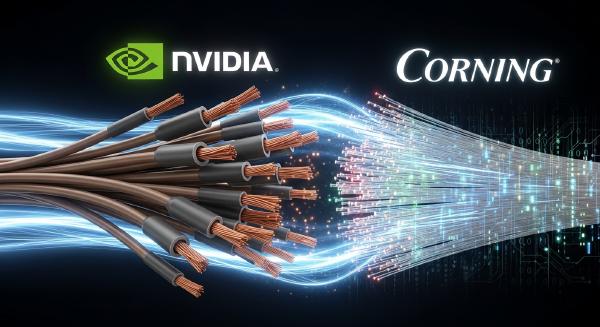
This challenge has elevated Co-Packaged Optics (CPO) from an experimental technology to one of the most strategically important developments in modern data center architecture. Compared to traditional copper interconnects and pluggable optical transceivers, CPO promises dramatically higher bandwidth, lower latency, and significantly improved power efficiency.
NVIDIA and Broadcom have emerged as the primary drivers of this transition. Their investments, product roadmaps, and ecosystem strategies suggest that CPO will become a foundational technology for next-generation AI factories.
🌐 Networking Becomes the Next AI Battleground #
Within the AI infrastructure supply chain, networking is currently experiencing the most dramatic architectural transformation.
Historically, improvements in AI performance came primarily from advances in:
- GPU compute performance
- Memory bandwidth
- Process technology
- Software optimization
Today, however, cluster scale has become the dominant driver of innovation.
Modern AI systems increasingly rely on thousands of GPUs operating as a unified computing resource. As cluster sizes continue to expand, networking technologies must evolve at an equally aggressive pace.
Two major trends are reshaping the industry:
- Rapid growth in AI cluster sizes
- Migration from 100G to 200G per-lane signaling
Both trends place enormous pressure on existing networking architectures and accelerate the need for optical technologies.
💰 NVIDIA’s Multi-Billion-Dollar Optical Investment Strategy #
NVIDIA’s recent capital allocation decisions highlight how seriously it views optical networking.
To strengthen the optical supply chain, NVIDIA has committed billions of dollars in strategic investments, including:
- A combined $2 billion investment in optical component leaders Coherent and Lumentum
- A separate $2 billion investment in Marvell
These investments are not merely financial. They signal NVIDIA’s determination to ensure that critical optical technologies mature quickly enough to support future AI infrastructure deployments.
The message is clear: CPO is no longer a research project. It is becoming a production technology.
🚀 From NVL72 to NVL576: Scaling Beyond Copper’s Limits #
The urgency behind CPO adoption becomes clearer when examining NVIDIA’s AI system roadmap.
With the Blackwell generation, NVIDIA introduced the NVL72 architecture, connecting 72 GPUs through high-speed NVLink interconnects within a single rack.
The upcoming Rubin generation expands this concept dramatically.
AI Cluster Scaling Roadmap #
| Architecture | Interconnect | Expansion Domain | Aggregate Bandwidth |
|---|---|---|---|
| Blackwell | NVLink 5 | NVL72 (1 Rack) | 130 TB/s |
| Rubin | NVLink 6 | NVL576 (8 Racks) | 260 TB/s |
Rubin Ultra will allow up to eight racks to operate as a single NVLink domain, effectively creating a giant unified GPU.
This scale creates a fundamental challenge for copper-based networking.
The Physical Limits of Copper #
Copper interconnects suffer from increasing signal degradation as bandwidth and distance rise.
Current practical limitations include:
- 100G per lane: approximately 5-meter reach
- 200G per lane: approximately 3-meter reach
A Rubin Ultra NVL576 deployment spanning eight racks can approach or exceed these physical limits.
As a result, traditional Active Electrical Cables (AECs) become increasingly impractical for large-scale deployments.
🔄 The Hybrid Transition to CPO #
NVIDIA’s immediate solution is a hybrid architecture.
Under Rubin Ultra:
- Intra-rack connections remain copper-based
- Inter-rack connections transition to CPO
This approach allows customers to preserve existing infrastructure where practical while leveraging optical technologies where necessary.
However, this transitional phase is expected to be short-lived.
Future architectures beyond Rubin Ultra are anticipated to move increasingly toward all-optical networking as cluster sizes continue expanding.
The anticipated NVL1152 generation is widely viewed as a potential tipping point where copper may no longer be viable even within portions of rack-scale systems.
🧩 How Co-Packaged Optics Works #
Traditional optical networking relies on pluggable transceivers attached to switches.
In a conventional design:
Switch ASIC → Copper Trace → DSP → Optical Module → FiberThis architecture introduces several inefficiencies:
- Long electrical traces
- Higher signal loss
- Additional DSP power consumption
- Increased latency
CPO fundamentally changes this design.
CPO Architecture #
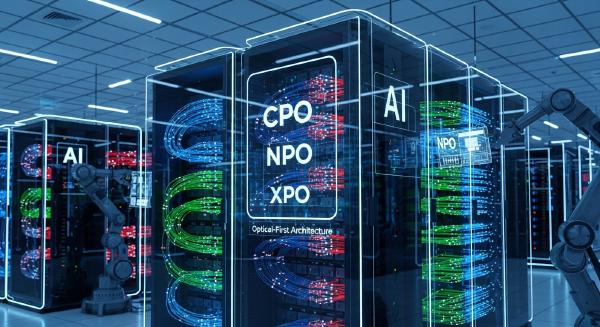
Switch ASIC → Ultra-Short Trace → Integrated Optical Engine → FiberBy integrating optical engines directly alongside the switch ASIC within the same package, CPO dramatically shortens electrical paths.
This architectural change unlocks multiple advantages simultaneously.
⚡ The Three Major Advantages of CPO #
Power Efficiency #
One of the largest benefits comes from eliminating standalone Digital Signal Processors (DSPs).
Traditional networks require DSPs to:
- Clean signal degradation
- Amplify transmission quality
- Maintain integrity across long electrical paths
By reducing trace length and minimizing signal loss, CPO removes much of this overhead.
Industry estimates suggest:
- Up to 5× better power efficiency
- Lower cooling requirements
- Reduced operational costs
These benefits become increasingly valuable as AI data centers consume gigawatts of power.
Bandwidth Density #
Because optical engines sit directly adjacent to the switch ASIC, significantly higher signaling rates become practical.
This enables:
- Greater aggregate bandwidth
- Higher port density
- More scalable architectures
As AI clusters expand, bandwidth density becomes just as important as compute density.
Lower Latency #
For AI inference workloads, latency increasingly determines system usefulness.
Modern AI applications demand:
- Faster token generation
- Real-time agent interactions
- Interactive reasoning systems
- Autonomous workflows
Reducing network latency directly improves user experience and AI responsiveness.
🤖 The Inference Era Makes CPO Essential #
The transition from AI training to AI inference further strengthens the case for CPO.
Inference workloads generate enormous network traffic due to:
- Model serving
- Retrieval systems
- Agent communication
- Multi-model orchestration
Industry forecasts suggest inference may eventually consume more data center power than training itself.
Projected growth trends indicate:
- Inference power demand growing at approximately 35% CAGR
- Training power demand growing at approximately 22% CAGR
As AI services become increasingly interactive, networking efficiency becomes a critical economic factor.
CPO enables scaling without creating unsustainable power requirements.
🏭 Supply Chain Transformation Is Already Underway #
The shift toward optical networking is reshaping the semiconductor ecosystem.
Several major suppliers have already repositioned themselves around CPO and silicon photonics.
Credo #
Credo recently acquired DustPhotonics to expand beyond its traditional Active Electrical Cable business.
The acquisition accelerates its move into:
- Silicon photonics
- Optical interconnects
- CPO-related infrastructure
Marvell #
Marvell has aggressively expanded its optical portfolio through acquisitions and partnerships.
Its acquisition of Celestial AI significantly strengthens its:
- Silicon photonics capabilities
- Optical networking portfolio
- AI interconnect offerings
Marvell also joined NVIDIA’s NVLink Fusion ecosystem, enabling tighter integration between custom accelerators and NVIDIA AI infrastructure.
These moves indicate that optical networking is becoming a long-term structural growth market rather than a temporary technology cycle.
⚠️ Challenges Slowing Adoption #
Despite its advantages, CPO still faces significant barriers.
Cost Considerations #
Traditional solutions remain attractive because:
- Copper is inexpensive
- Pluggable optics are mature
- Existing deployment processes are well understood
Most hyperscalers prefer to maximize the useful life of existing infrastructure before adopting new technologies.
This creates a natural delay in large-scale deployment.
Serviceability Concerns #
One of the most significant objections to CPO involves maintenance.
With traditional pluggable optics:
- Failed modules can be replaced within seconds
- No switch replacement is required
- Downtime is minimal
With CPO:
- Optical engines are integrated into the switch package
- Repairs become significantly more complex
- Failure handling procedures change dramatically
Reliability must therefore improve substantially to compensate for reduced serviceability.
📊 Reliability Improvements Are Emerging #
To address these concerns, vendors have invested heavily in reliability testing.
Recent testing has produced encouraging results.
Joint evaluations involving Broadcom and Meta reportedly demonstrated:
- Five times lower field failure rates
- Zero unrecoverable failures during extensive testing
- Millions of cumulative operating hours
While laboratory testing cannot fully replicate production environments, early commercial deployments during 2026 and 2027 will provide the first large-scale validation of these claims.
Successful deployments could accelerate industry-wide adoption significantly.
🏆 NVIDIA and Broadcom Lead the CPO Race #
Today, NVIDIA and Broadcom dominate the switching ASIC market and are therefore best positioned to drive CPO adoption.
Broadcom’s Strategy #
Broadcom has pursued CPO development since 2021.
Its latest platform, the Tomahawk 6-Davisson switch, delivers:
- Significant power reductions
- Higher optical integration
- Improved scalability
Broadcom is already developing subsequent generations aimed at doubling per-lane bandwidth.
NVIDIA’s Strategy #
NVIDIA’s approach extends across both scale-up and scale-out networking.
Its Spectrum-X Ethernet photonics platform integrates:
- Silicon photonics optical engines
- 1.6T optical technology
- Enhanced reliability features
NVIDIA also plans to deploy CPO directly within future NVLink-based AI factory architectures.
Perhaps most notably, NVIDIA has introduced a multi-ASIC networking architecture capable of delivering:
- 409.6 Tb/s aggregate bandwidth
- 5× better power efficiency than pluggable solutions
- Reduced total system costs
This positions NVIDIA to control both the compute and networking layers of future AI infrastructure.
🔮 The Future of AI Networking #
The transition to Co-Packaged Optics is no longer a question of if, but when.
As AI clusters continue scaling toward millions of interconnected accelerators, the limitations of copper become unavoidable. Power consumption, bandwidth density, signal integrity, and latency increasingly favor optical solutions.
While adoption will likely proceed gradually due to cost and operational considerations, the long-term direction appears clear.
The companies that successfully master CPO, silicon photonics, and next-generation optical networking will play a decisive role in shaping the next decade of AI infrastructure.
🏁 Conclusion #
Co-Packaged Optics represents one of the most consequential infrastructure transitions occurring within the AI industry. By integrating optical engines directly with networking silicon, CPO addresses the bandwidth, latency, and power challenges that increasingly constrain modern AI clusters.
NVIDIA’s multi-billion-dollar investments, Rubin roadmap, Spectrum-X photonics strategy, and commitment to rack-scale AI factories demonstrate that optical networking has become a strategic priority. Broadcom’s parallel investments and product development efforts further validate the industry’s direction.
As AI systems evolve from thousands to millions of interconnected accelerators, networking efficiency will become just as important as computational performance. In that future, Co-Packaged Optics may prove to be the critical technology that enables the next generation of AI infrastructure.