AMD EPYC 9006 Zen 6 SP7 Processors Officially Ship
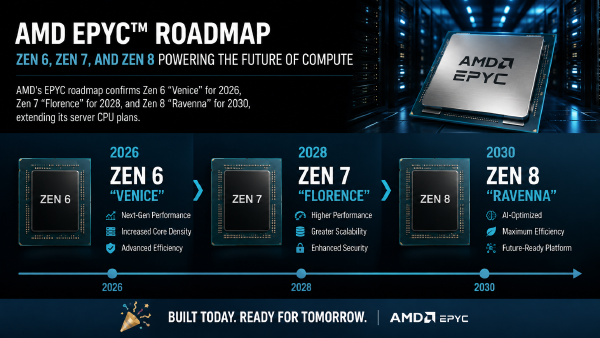
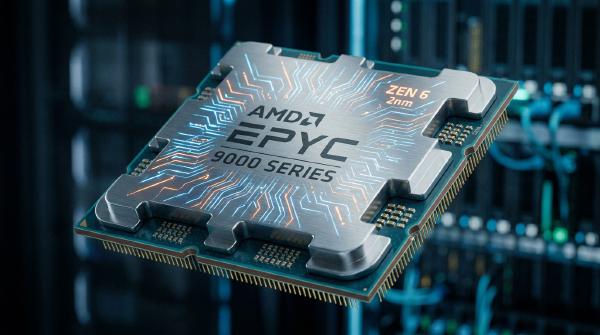
AMD’s first server processors based on the Zen 6 architecture have officially reached the market. On November 10, 2026, the company announced the availability of its 6th Gen EPYC 9006 SP7 lineup, targeting cloud computing, high-performance computing (HPC), enterprise applications, and the expanding infrastructure requirements of agentic AI.
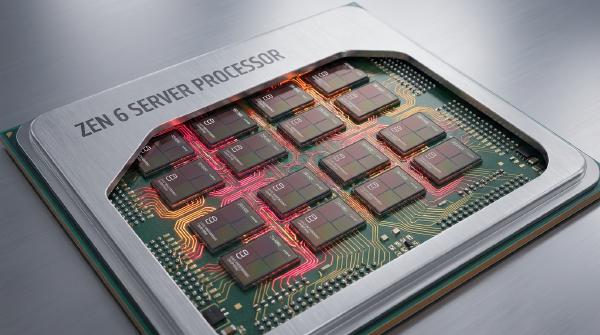
The new generation brings up to 256 cores and 512 threads, a 16-channel memory subsystem, PCIe 6.0 connectivity, and support for high-bandwidth MRDIMMs. AMD is positioning these processors as the foundation for data center systems where CPUs handle orchestration, data processing, and the workloads surrounding GPU accelerators.
Complete server systems from major OEM and ODM manufacturers are already shipping. Public cloud availability is less advanced. Microsoft Azure and Oracle Cloud Infrastructure (OCI) have announced plans to deploy the processors, but their corresponding instances remain listed as coming soon.
The hardware launch is underway. Broader cloud deployment is the next milestone.
🚀 EPYC 9006 SP7 Systems Begin Shipping #
The 6th Gen EPYC 9006 family is AMD’s first server processor generation built around Zen 6. It targets workloads ranging from general-purpose enterprise applications to high-density cloud environments and AI infrastructure.
AMD says complete systems powered by the new processors are shipping through major global server manufacturers. Customers can therefore purchase validated server platforms instead of sourcing individual CPUs and building systems independently.
Cloud availability is following a different schedule.
- Microsoft Azure: Plans to integrate the processors into infrastructure supporting AI-related services.
- Oracle Cloud Infrastructure: Upcoming Compute E7 instances are expected to use the new EPYC generation for enterprise workloads and CPU services surrounding AI models.
Neither provider has announced a firm public launch date for these instances.
This distinction matters when planning deployments. Organizations purchasing physical servers can already begin evaluating the new platform, while customers relying on managed cloud infrastructure must wait for their preferred providers to complete deployment, validation, and service configuration.
AMD’s rollout therefore starts with physical server systems, followed by cloud availability as infrastructure providers bring their platforms online.
🧠 EPYC 9996 Leads the 256-Core SP7 Lineup #
The flagship of the new family is the EPYC 9996, combining 256 cores with 512 threads.
Its headline specifications include:
| Specification | EPYC 9996 |
|---|---|
| Architecture | Zen 6 |
| Socket platform | SP7 |
| Maximum cores | 256 |
| Maximum threads | 512 |
| Maximum boost clock | 4.1 GHz |
| L3 cache | 1,024MB |
| Default TDP | 600W |
| 1,000-unit tray price | $14,904 |
The EPYC 9006 family includes nine SKUs, starting with the 64-core EPYC 9556 and extending to the 256-core EPYC 9996.
AMD is also offering high-frequency F-series models, including the EPYC 9686F and EPYC 9586F. These processors can reach boost clocks of up to 5.0 GHz, targeting workloads where per-core performance and clock speed matter more than maximizing total core count.
This product range gives server manufacturers several options for balancing performance, power consumption, and deployment costs.
A 256-core processor makes sense for heavily parallel workloads, high-density virtualization, and environments running many concurrent services. High-frequency models may be more appropriate for latency-sensitive applications, databases, and software that cannot efficiently distribute work across hundreds of cores.
Sixteen memory channels and PCIe 6.0 #
Memory bandwidth is a central part of the SP7 platform.
The platform supports:
- 16-channel DDR5 memory.
- MRDIMMs operating at up to 12,800 MT/s.
- RDIMMs operating at up to 8,000 MT/s.
- Up to 1.6TB/s of memory bandwidth per processor.
The I/O configuration also scales with the server design. Single-socket systems provide 96 PCIe 6.0 lanes, while dual-socket configurations offer up to 128 lanes. The platform additionally supports CXL 3.1.
These capabilities matter for workloads that continuously move data between CPUs, memory, storage, and accelerators. AI infrastructure, in particular, can place substantial demands on host memory and I/O even when GPUs perform most of the model computation.
High-bandwidth memory helps prevent the CPU from becoming a bottleneck when preparing data, coordinating accelerator workloads, or running memory-intensive services alongside AI applications.
For additional platform details, see AMD EPYC 9006 Venice: Up to 256 Zen 6 Cores and PCIe 6.0.
⚙️ Zen 6 Brings a Major Architectural Update #
The EPYC 9006 family is the first server lineup built around AMD’s Zen 6 architecture.
AMD’s positioning reflects a change in how data centers use CPUs. Traditional server processors run applications, databases, virtualization platforms, and infrastructure services. In AI deployments, they also coordinate accelerator workloads, manage data pipelines, and host the services that make model inference useful.
Agentic AI adds another layer of CPU activity. Agents may execute code, call external tools, query databases, and coordinate with other agents. These operations can generate substantial processor demand even when GPUs handle the most intensive model computations.
AMD says Zen 6 includes several architectural changes intended to improve performance across these workloads.
Manufacturing and core design #
According to the disclosed architectural details, Zen 6 is manufactured using TSMC’s N2P process node.
The core also introduces a redesigned vector engine with native FP16 instruction support and a split integer scheduler.
AMD reports an approximately 27% IPC improvement over Zen 5.
IPC, or instructions per cycle, measures how much work a processor can complete during each clock cycle. Higher IPC can improve performance without requiring a proportional increase in clock speed. Actual application performance, however, also depends on memory behavior, cache efficiency, software optimization, and power limits.
The redesigned vector engine and FP16 support are particularly relevant to compute-intensive applications. They provide additional capabilities for certain AI and numerical workloads without requiring every operation to run on an external accelerator.
Why CPUs still matter in AI infrastructure #
The growth of GPU computing has not eliminated the need for high-performance server CPUs.
A large AI deployment still needs processors to:
- Schedule and coordinate workloads.
- Feed data to accelerators.
- Run databases, storage services, and networking software.
- Manage virtual machines and isolated execution environments.
- Handle application logic and external tool execution.
- Keep accelerator resources supplied with work.
For agentic systems, these responsibilities become increasingly relevant because an agent’s workflow often involves numerous operations outside the model itself.
Consider a coding agent. The model generates code, but the surrounding infrastructure must also read repositories, execute tests, inspect files, communicate with development tools, and manage isolated execution environments.
Those operations consume CPU cycles, memory bandwidth, and I/O resources.
AMD is using Zen 6’s core count, memory subsystem, and vector capabilities to target this broader infrastructure role.
📊 AMD’s Performance Claims and Independent Benchmarks #
AMD has published several performance comparisons for the flagship EPYC 9996.
According to the company’s internal testing, the processor delivers:
- Up to 3.7x the performance of NVIDIA Vera CPU systems.
- Up to 2.2x the performance of Intel Xeon 6980P systems.
- Up to 2x the performance per dollar compared with Intel Xeon 6980P systems.
These are vendor-reported results. Test configurations, workloads, compiler settings, and comparison systems all influence the outcome, so the figures should not be treated as universal performance ratios across server applications.
Independent testing provides another perspective.
Tom’s Hardware published testing on launch day using a dual-socket EPYC 9996 system, providing a total of 1,024 hardware threads. In its SPEC CPU 2026 integer throughput testing, the system delivered generational performance improvements of up to 93%.
The review also reported that the EPYC 9686F outperformed NVIDIA Vera in selected scientific computing and HPC workloads.
These results offer useful evidence of the processors’ potential, but they still represent specific benchmark configurations. Production performance will depend on the software stack, memory configuration, server design, and workload characteristics.
Why benchmark context matters #
Server CPU comparisons are particularly sensitive to system configuration.
A dual-socket system can deliver substantially more aggregate compute capacity than a single-socket machine, but it also introduces differences in memory topology and inter-socket communication.
Throughput benchmarks may favor high core counts, while latency-sensitive applications often respond more strongly to per-core performance and memory access behavior.
For infrastructure buyers, the most useful comparisons are those that resemble actual deployment conditions:
- Single-socket versus dual-socket configurations.
- Performance per watt under sustained workloads.
- Database and virtualization performance.
- AI inference and data preparation workloads.
- Performance per dollar at realistic system prices.
The EPYC 9996’s specifications are impressive, but broader independent testing will determine where it provides the greatest practical advantage.
🤖 EPYC 9006 Joins AMD’s Helios AI Infrastructure #
AMD is incorporating 6th Gen EPYC processors into its Helios agentic AI open-rack blueprint.
The system combines several parts of AMD’s data center portfolio:
- 72 Instinct MI455X GPUs for accelerated computing.
- 18 6th Gen EPYC Venice CPUs for host processing and workload coordination.
- Pensando networking products for data center connectivity.
- ROCm software stack for accelerator programming and deployment.
The configuration illustrates AMD’s approach to building a complete AI infrastructure platform rather than selling CPUs and GPUs as isolated products.
The EPYC processors handle host-side processing, orchestration, and the software services surrounding the accelerators. The GPUs provide the parallel computing capacity required for large AI workloads, while networking and software connect the components into a deployable system.
This architecture is particularly relevant to agentic AI, where infrastructure must support more than model execution.
An agent may generate code, access external services, retrieve information, launch isolated tasks, and coordinate with other agents. Each operation creates additional work for the surrounding compute platform.
The combination of EPYC CPUs and Instinct accelerators gives AMD a way to address both sides of that infrastructure requirement.
For a closer look at the system architecture, see AMD Helios AI Rack: MI455X, Zen 6 EPYC and Pensando.
🔍 What to Watch as the SP7 Platform Expands #
The official launch marks an important milestone, but processor availability is only the first stage of a new server platform’s adoption.
Several developments will determine how quickly EPYC 9006 reaches production environments.
Cloud instance availability #
Azure and OCI have both indicated plans to use the new processors, but their corresponding instances have not yet launched publicly.
Cloud availability matters because many customers prefer evaluating new CPU generations through existing virtual machine and managed infrastructure services before committing to physical server deployments.
The timing, instance sizes, and pricing of these offerings will help determine how accessible the new generation becomes to cloud customers.
Real-world power efficiency #
A maximum TDP of 600W places the flagship EPYC 9996 in a demanding power and cooling category.
High core density can improve rack-level compute capacity, but only when the system’s cooling, power delivery, and workload utilization can support it.
Operators also need to consider the complete server configuration. CPU power is only one part of total system consumption, which includes memory, storage, networking, cooling, and other components.
Performance per watt will therefore matter as much as peak throughput for many data center operators.
Software and workload optimization #
Zen 6’s architectural improvements must translate into practical gains across compilers, operating systems, virtualization platforms, databases, and AI software.
The benefits of FP16 support, higher IPC, and increased core density will vary depending on how effectively applications use those features.
AMD’s ROCm ecosystem and its partnerships with server manufacturers and cloud providers will also influence adoption in AI environments.
Hardware specifications alone do not determine production performance. Software support, driver maturity, workload tuning, and system integration remain part of the equation.
AMD’s Zen 6 Server Generation Is Now Shipping #
The 6th Gen EPYC 9006 launch brings AMD’s Zen 6 architecture into commercial server systems, led by the 256-core EPYC 9996 and the new SP7 platform.
Its combination of 16-channel memory, up to 1.6TB/s of bandwidth, PCIe 6.0 connectivity, and multiple core configurations targets traditional enterprise computing as well as the infrastructure demands of AI.
AMD’s Helios blueprint also demonstrates how these processors fit into a broader strategy built around EPYC CPUs, Instinct GPUs, Pensando networking, and ROCm.
The next milestone is wider deployment. Complete systems are already shipping, but Azure and OCI instances remain pending. As cloud providers bring their offerings online and additional independent testing becomes available, customers will get a clearer picture of how EPYC 9006 performs across production workloads.
For AMD, this launch marks the beginning of the Zen 6 server generation’s commercial rollout. Its long-term impact will depend on application performance, power efficiency, platform availability, and how quickly customers adopt SP7.