RTX 5080 24GB Rumor: China Launch in December or January?
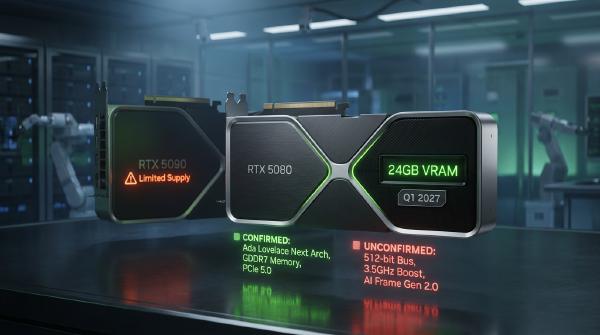
NVIDIA may be preparing a significant adjustment to its high-end GeForce graphics card lineup. According to information circulating through Chinese hardware distribution channels and reported by German technology publication ComputerBase, a new GeForce RTX 5080 variant equipped with 24GB of GDDR7 memory could arrive as early as December 2026, with January 2027 representing the latest expected launch window in the current report.
The rumored model would increase VRAM capacity by 50% compared with the existing 16GB GeForce RTX 5080. More importantly, the initial release is reportedly intended to target the Chinese market, potentially replacing both the standard 16GB RTX 5080 and the China-specific 32GB RTX 5090D V2 in NVIDIA’s regional product lineup.
The reported memory configuration is particularly interesting. Rather than introducing additional memory chips, NVIDIA could use eight higher-capacity 3GB GDDR7 modules instead of the eight 2GB modules found on the current RTX 5080.
This approach could provide a straightforward path to increasing memory capacity while retaining a similar eight-chip arrangement.
However, several critical details remain unknown. NVIDIA has not officially announced the card, and its final product name, GPU specifications, memory bandwidth, pricing, and regional availability have yet to be confirmed.
There are also conflicting reports about the launch schedule. Earlier information from Taiwanese hardware publication BenchLife pointed toward Q1 2027, while the latest Board Channels report suggests that NVIDIA may be accelerating the launch to December 2026 or January 2027.
🚀 1. NVIDIA RTX 5080 24GB: What the Latest Rumor Says #
The latest information comes from China’s Board Channels hardware community and distribution-related sources, with ComputerBase reporting the details on October 30, 2026.
According to the report, NVIDIA is preparing a new RTX 5080 variant featuring 24GB of GDDR7 memory.
The proposed launch window is:
- Earliest possibility: December 2026.
- Latest expected timing in the report: January 2027.
- Initial target market: China.
- Potential replacement: Existing 16GB RTX 5080 and China-specific RTX 5090D V2.
The most important implication is that NVIDIA may be reorganizing its high-end GeForce product lineup for the Chinese market.
1.1 Replacing the RTX 5080 16GB #
The current GeForce RTX 5080 comes with 16GB of GDDR7 memory.
While its GPU architecture provides substantial graphics and compute capabilities, memory capacity can become a limitation for certain demanding workloads.
A 24GB version would increase available VRAM by 50%, potentially making the card more attractive for:
- High-resolution gaming.
- Complex 3D rendering.
- Professional content creation.
- Large texture and asset workloads.
- Local AI inference.
- GPU-accelerated development.
According to Board Channels, NVIDIA may discontinue the existing 16GB configuration in favor of the higher-capacity variant.
However, the report specifically concerns supply and product positioning in China. It does not establish that NVIDIA intends to withdraw the 16GB RTX 5080 from every global market.
1.2 Replacing the China-Specific RTX 5090D V2 #
The other interesting part of the rumor involves the GeForce RTX 5090D V2.
The RTX 5090D V2 is a China-specific product configuration with 32GB of GDDR7 memory.
Under the reported roadmap, the proposed RTX 5080 24GB could take over part of the product-positioning role currently occupied by this regional flagship.
This would create an interesting shift in NVIDIA’s Chinese consumer GPU lineup.
Rather than relying on a higher-end RTX 5090D V2 configuration, NVIDIA could position a 24GB RTX 5080 as its primary high-capacity GeForce offering in the region.
However, this should not be interpreted as a confirmed performance replacement.
The RTX 5080 and RTX 5090D V2 belong to different GPU configurations, and memory capacity alone does not determine overall graphics or compute performance.
The reported change appears to concern product availability and market positioning rather than a direct architectural equivalence.
🧠 2. How Could NVIDIA Achieve 24GB GDDR7? #
The rumored memory upgrade is one of the most technically interesting aspects of the proposed RTX 5080.
The existing GeForce RTX 5080 uses eight GDDR7 memory chips, each providing 2GB of capacity.
If NVIDIA adopts higher-density 3GB GDDR7 modules, it could increase total memory capacity without necessarily changing the number of physical memory devices.
2.1 Current RTX 5080: Eight 2GB GDDR7 Chips #
The current 16GB RTX 5080 uses the following theoretical memory configuration:
| Component | Current RTX 5080 |
|---|---|
| Memory Type | GDDR7 |
| Memory Capacity | 16GB |
| Number of Memory Chips | 8 |
| Capacity per Chip | 2GB |
| Memory Interface | 256-bit |
The memory capacity calculation is straightforward:
\[ 8 \times 2\text{GB} = 16\text{GB} \]This configuration provides the memory capacity required by the current graphics card.
2.2 Rumored RTX 5080 24GB: Eight 3GB Chips #
The proposed 24GB version could use eight 3GB GDDR7 memory modules.
The resulting configuration would be:
| Component | Rumored RTX 5080 24GB |
|---|---|
| Memory Type | GDDR7 |
| Memory Capacity | 24GB |
| Number of Memory Chips | 8 |
| Capacity per Chip | 3GB |
| Memory Interface | Potentially 256-bit |
The capacity calculation becomes:
\[ 8 \times 3\text{GB} = 24\text{GB} \]This represents a 50% increase over the current model.
If NVIDIA retains the same basic eight-device memory arrangement, it may be possible to accommodate the additional capacity without a major PCB redesign.
However, memory-chip density, package compatibility, routing requirements, signal integrity, and board validation would still need to be addressed.
The proposed configuration has not been confirmed by NVIDIA.
2.3 Will Memory Bandwidth Increase? #
An important distinction is that more VRAM does not automatically mean more memory bandwidth.
The current RTX 5080 uses a 256-bit memory interface.
If the rumored 24GB model retains the same memory bus width and GDDR7 data rate, its theoretical memory bandwidth would remain unchanged.
For example, the current 30 Gbps memory configuration provides:
\[ 30\text{Gbps} \times \frac{256}{8} = 960\text{GB/s} \]A 24GB configuration using the same interface and data rate would still provide 960GB/s.
The additional capacity would provide more room for data storage, but it would not inherently increase the rate at which that data can be transferred.
NVIDIA could introduce faster GDDR7 memory or adjust the memory configuration, but no confirmed information currently establishes such changes.
🎮 3. Why 24GB VRAM Matters for Gaming and Content Creation #
Increasing GPU memory capacity can improve the range of workloads a graphics card can handle.
However, the actual benefit depends on whether an application exceeds the available memory capacity of the existing GPU.
3.1 High-Resolution Gaming #
Modern games increasingly use large textures, high-resolution assets, and complex rendering resources.
At 4K resolution, graphics workloads can require substantially more VRAM than traditional 1080p gaming.
A 24GB graphics card could provide additional memory headroom for:
- 4K gaming with high-resolution textures.
- Ray-tracing workloads.
- Large open-world environments.
- High-resolution texture modifications.
- Future graphics engines with increasingly complex assets.
When a workload exceeds available VRAM, the graphics driver may need to move resources between local graphics memory and system memory.
This can introduce additional latency and performance instability.
Having more available VRAM can reduce the likelihood of these situations.
However, a memory-capacity increase does not automatically improve average frame rates.
If a game already fits comfortably within 16GB, the 24GB version may provide little practical performance improvement.
3.2 Professional Rendering and Content Creation #
The additional memory could also benefit creators working with larger projects.
Examples include:
- Complex Blender scenes.
- High-resolution texture sets.
- Large CAD assemblies.
- GPU-based rendering.
- Video editing with multiple high-resolution streams.
- Visual effects and compositing.
For these applications, VRAM capacity can determine whether a project fits entirely within GPU memory.
A 24GB configuration could therefore enable larger projects or reduce the need for aggressive memory optimization.
The actual benefit will depend on application support and the GPU’s processing capabilities.
🤖 4. RTX 5080 24GB and Local AI Inference #
One of the strongest potential use cases for a higher-capacity RTX 5080 is local AI inference.
Consumer GPUs have become increasingly attractive for running large language models, image-generation systems, and other neural-network workloads locally.
The main advantage is that users can execute AI models without depending entirely on cloud inference services.
However, VRAM capacity is often one of the most important hardware constraints.
4.1 Why VRAM Matters for Local LLMs #
Large language models require memory to store several types of data:
- Model weights.
- Key-value (KV) cache.
- Runtime buffers.
- Intermediate activations.
- Other inference-related data structures.
The model weights are often the largest component.
For example, a 7-billion-parameter model stored using 4-bit quantization has a theoretical weight-storage requirement of approximately:
\[ 7\text{B} \times 0.5\text{Bytes} = 3.5\text{GB} \]In practice, additional memory is required for quantization metadata, runtime overhead, KV cache, and context processing.
Larger models increase the memory requirement substantially.
A 24GB GPU provides more flexibility than a 16GB model when handling larger quantized language models.
4.2 What Can 24GB of VRAM Accommodate? #
The following table provides approximate planning categories rather than guaranteed model compatibility.
| Model Size | Typical Quantization | General Suitability |
|---|---|---|
| 7B–8B | Q4 / Q5 | Comfortable local inference |
| 14B | Q4 | Generally practical |
| 20B–24B | Q4 | Potentially practical with appropriate context settings |
| 30B–32B | Q4 | Possible with aggressive memory optimization or partial CPU offloading |
Actual memory requirements vary according to model architecture, quantization format, context length, batch size, and inference runtime.
A 24GB card will not necessarily accommodate every 32B model entirely in VRAM, especially when a large context window is required.
For a practical introduction to local inference, see Ollama vs. llama.cpp on Ubuntu: Local LLM Setup and Performance.
The guide explains how model loading, GPU-layer offloading, context length, and memory utilization affect real-world inference performance.
4.3 VRAM Capacity vs. Inference Speed #
More VRAM improves the range of models and context configurations that can fit on a GPU.
However, it does not automatically increase token-generation speed.
For LLM inference, performance also depends on:
- GPU compute throughput.
- Memory bandwidth.
- Memory access efficiency.
- Quantization format.
- Model architecture.
- Context length.
- Inference software optimization.
A 24GB RTX 5080 with unchanged compute resources and memory bandwidth could run larger models than its 16GB counterpart, but the larger model would not necessarily generate tokens faster.
This distinction is particularly important for buyers considering the rumored card specifically for AI workloads.
🏷️ 5. RTX 5080 vs. RTX 5080 SUPER: Naming Remains Unconfirmed #
Beyond memory capacity, the final product name is another major unknown.
The rumored 24GB card has frequently been associated with the long-discussed RTX 5080 SUPER.
However, the latest reports do not establish that both products are the same SKU.
Several possibilities remain:
5.1 Standard RTX 5080 24GB #
NVIDIA could introduce a memory-capacity refresh while retaining the standard RTX 5080 branding.
Under this scenario, the new model would mainly distinguish itself through its larger VRAM configuration.
5.2 RTX 5080 SUPER #
Alternatively, NVIDIA could use the RTX 5080 SUPER designation.
A SUPER variant would traditionally suggest a broader product refresh rather than simply a memory-capacity adjustment.
Earlier rumors surrounding the RTX 5080 SUPER included potential improvements to:
- GPU clock speeds.
- Memory bandwidth.
- Memory configuration.
- Overall performance.
However, those specifications cannot automatically be applied to the newly rumored 24GB RTX 5080.
There is currently no confirmed evidence that the proposed card will receive additional GPU cores or higher operating frequencies.
5.3 A Distinct Regional SKU #
Another possibility is that NVIDIA introduces a new product specifically tailored to the Chinese market.
In this scenario, the 24GB model could have its own product designation and positioning without necessarily appearing in other regions.
Until NVIDIA publishes official product information, the safest description remains GeForce RTX 5080 24GB.
📦 6. RTX 5080 16GB Inventory and Supply Changes #
The latest rumor also includes information about NVIDIA’s existing RTX 5080 inventory.
According to Board Channels, the GPU inventory allocated to the current 16GB RTX 5080 production run has reportedly been exhausted.
Retail inventory is estimated to be sufficient for approximately another two months.
If accurate, this could indicate that NVIDIA is preparing to transition production toward a different memory configuration.
6.1 Is NVIDIA Discontinuing the 16GB RTX 5080? #
The reported inventory situation raises several questions.
For example:
- Has NVIDIA stopped supplying all 16GB RTX 5080 GPUs?
- Does the reported inventory shortage apply only to China?
- Will existing global production continue?
- Are AIB partners preparing new 24GB board designs?
- Will the current model remain available alongside the new version in other markets?
None of these questions has received an official answer.
The inventory claim should therefore be treated as supply-chain information rather than confirmation of a worldwide product discontinuation.
6.2 Potential Impact on Retail Pricing #
A reduction in GPU supply can affect retail prices, particularly when demand remains strong.
If the 16GB RTX 5080 becomes increasingly difficult to obtain before its rumored replacement arrives, retailers could face tightening inventory.
This could create several possible market outcomes:
- Existing 16GB cards becoming more expensive.
- Reduced availability of selected AIB models.
- Increased demand for competing graphics cards.
- Higher initial prices for the proposed 24GB variant.
The new model’s pricing is currently unknown.
The higher memory capacity and potential use of denser GDDR7 components could also affect manufacturing costs.
Consequently, buyers should avoid assuming that a 50% increase in memory capacity will translate into a similarly attractive increase in price-performance.
⏱️ 7. Conflicting Launch Timelines: December 2026 or Q1 2027? #
One of the most important details in the current reporting is the difference between the launch schedules reported by ComputerBase and BenchLife.
The reports are not necessarily contradictory, but they describe different stages of the rumored development and release process.
7.1 Earlier BenchLife Report: Q1 2027 #
Earlier in October 2026, Taiwanese hardware publication BenchLife reported that NVIDIA was preparing an RTX 5080 24GB graphics card for Q1 2027.
The report also suggested that add-in card manufacturers had not yet received complete development documentation.
According to the information relayed through TechPowerUp and other technology publications, board partners had reportedly received verbal indications that relevant technical materials would be provided soon.
This creates some uncertainty about how far the proposed product had progressed through its development process.
Graphics card manufacturers typically need several materials before beginning full production preparation:
- Board specifications.
- Component requirements.
- PCB design information.
- Firmware documentation.
- Thermal and power requirements.
- Product validation guidelines.
Without these materials, the actual manufacturing schedule remains difficult to establish.
7.2 October 30 Report: December 2026 to January 2027 #
ComputerBase subsequently reported newer information originating from Board Channels.
The updated timeline suggests that the 24GB RTX 5080 could arrive as early as December 2026, with January 2027 as the expected latest timing.
This would represent an accelerated schedule compared with the earlier Q1 2027 estimate.
However, the newer report does not eliminate the uncertainty associated with board-partner development and product validation.
7.3 Timeline Comparison #
| Report | Publication Period | Reported Launch Window | Main Information |
|---|---|---|---|
| BenchLife | October 2026 | Q1 2027 | 24GB model planned; AIB documentation reportedly pending |
| Board Channels via ComputerBase | October 30, 2026 | December 2026–January 2027 | Potentially accelerated launch, initially targeting China |
The two reports point toward a similar product direction, but the more aggressive December-to-January timeline has not been independently confirmed by NVIDIA.
For additional background on the earlier Q1 2027 roadmap and the reported RTX 5090 supply situation, see KAD8’s RTX 5080 24GB Release Date and RTX 5090 Supply Analysis.
🔍 8. What About the RTX 5090? NVIDIA Denies Discontinuation #
The rumored RTX 5080 24GB refresh has also appeared alongside speculation that NVIDIA may be discontinuing the GeForce RTX 5090.
However, NVIDIA has publicly pushed back against that claim.
At an event in Taipei in October 2026, NVIDIA senior vice president Jeff Fisher stated that the RTX 5090 had not been discontinued and that the company would continue shipping the product.
He acknowledged that supply-chain capacity was constrained.
This distinction is important.
A product experiencing supply shortages or reduced component allocations is not necessarily discontinued.
There are several possible reasons for limited availability:
- Constrained GPU manufacturing capacity.
- GDDR7 memory supply limitations.
- Competition for advanced packaging resources.
- Allocation decisions between consumer and professional products.
- Board-partner production schedules.
Earlier reports suggested that NVIDIA might redirect some high-end GPU resources toward RTX PRO products.
However, these claims do not establish that GeForce RTX 5090 production has officially ended.
8.1 Could the RTX 5080 24GB Become NVIDIA’s Regional Flagship? #
If the reported changes in China occur, the 24GB RTX 5080 could become the highest-capacity GeForce offering in the region’s regular distribution lineup.
This would not necessarily mean that it replaces the RTX 5090 globally.
The Chinese market has its own product configurations and regulatory considerations, making regional product positioning different from NVIDIA’s worldwide lineup.
The distinction between regional replacement and global product discontinuation should remain clear.
⚠️ 9. Confirmed Information vs. Unverified Rumors #
With multiple reports circulating, it is useful to separate established product information from claims based on supply-chain sources.
| Topic | Current Status |
|---|---|
| Existing RTX 5080 memory capacity | Officially 16GB GDDR7 |
| Proposed RTX 5080 memory capacity | Rumored 24GB GDDR7 |
| Proposed number of memory chips | Rumored eight 3GB modules |
| Potential launch | December 2026 or January 2027 |
| Earlier launch estimate | Q1 2027 |
| Initial target market | Reportedly China |
| Replacement of 16GB RTX 5080 | Reported, unconfirmed |
| Replacement of RTX 5090D V2 in China | Reported, unconfirmed |
| Product name | Unknown |
| CUDA core count | Unknown |
| GPU clock speeds | Unknown |
| Memory bandwidth | Unknown |
| TDP | Unknown |
| Retail price | Unknown |
| Global availability | Unknown |
| RTX 5090 discontinuation | Denied by NVIDIA management |
The most important point is that no official NVIDIA announcement has established the existence, final specifications, or release schedule of the 24GB RTX 5080.
The available information remains based on hardware forum reports and supply-chain discussions.
🧭 Conclusion: A 24GB RTX 5080 Could Be an Important GPU Refresh #
The rumored 24GB GeForce RTX 5080 could represent a significant adjustment to NVIDIA’s high-end consumer graphics strategy.
By increasing VRAM capacity from 16GB to 24GB, NVIDIA would provide 50% more memory without necessarily changing the fundamental eight-chip memory arrangement.
The additional capacity could make the card more attractive for memory-intensive gaming, professional rendering, and local AI inference.
For Chinese consumers, the reported product transition could be particularly significant because the new model may replace the existing 16GB RTX 5080 and the regional RTX 5090D V2.
However, several questions remain unanswered:
- Will NVIDIA retain the standard RTX 5080 branding or introduce an RTX 5080 SUPER?
- Will the GPU core configuration remain unchanged?
- Will memory bandwidth increase?
- Will the card launch exclusively in China?
- Can NVIDIA and its board partners meet the rumored December 2026 or January 2027 schedule?
- How much will the new configuration cost?
The earlier Q1 2027 report and the newer December-to-January estimate suggest that NVIDIA may be adjusting its product schedule, but neither timeline represents a confirmed launch commitment.
For gamers and AI developers, the most important consideration is the difference between memory capacity and actual processing performance.
An additional 8GB of VRAM could make the RTX 5080 considerably more flexible for memory-intensive applications, but it does not automatically make the GPU faster.
Until NVIDIA releases official specifications, pricing, and regional availability information, the proposed RTX 5080 24GB should be treated as an interesting but unconfirmed hardware development rather than an established upcoming product.