Sony Project Canis Rumor: Will RDNA 5 Leave Other Handhelds Behind?
Sony may be preparing a return to the standalone handheld gaming market, and its next portable PlayStation could have an important advantage: early or preferential access to AMD’s next-generation RDNA 5 graphics architecture.
According to reports aggregated by German technology outlet ComputerBase, Sony’s rumored handheld, codenamed Project Canis, could arrive around 2028 alongside the PlayStation 6. The reported specifications include a custom AMD Zen 6 CPU, an RDNA 5 GPU with 16 Compute Units (CUs), and 24GB of LPDDR5X memory.
The graphics angle has attracted particular attention. Digital Foundry journalist Richard Leadbetter reportedly discussed behind-the-scenes conversations suggesting that Sony could have an “exclusive of sorts” for RDNA 5 in the handheld market. If accurate, this arrangement could give Sony an early advantage over competing devices from Microsoft, Valve, and other handheld manufacturers.
However, there is an important distinction between preferential access and formal exclusivity. Neither Sony nor AMD has confirmed the rumored arrangement, and Project Canis itself remains unannounced.
🎮 Project Canis: Sony’s Possible Return to Native Handheld Gaming #
The rumored Project Canis is particularly interesting because it is reportedly designed to run games locally rather than depend primarily on cloud streaming.
That would make it fundamentally different from the PlayStation Portal, which is designed around remote play and cloud-based gaming rather than functioning as a standalone PlayStation console.
According to current reports, Project Canis could launch in 2028 alongside the PS6. If Sony follows through, it would represent the company’s return to dedicated handheld gaming hardware after more than a decade away from the market.
Sony has previously released two major standalone handheld systems:
- PlayStation Portable (PSP): Launched in Europe in 2005, the PSP became a successful portable gaming platform, with cumulative sales reaching approximately 82 million units by late 2014.
- PlayStation Vita: Released in 2012, the Vita offered more advanced hardware and features but struggled to match the PSP’s commercial success. Its lifetime sales are commonly estimated at around 16 million units.
Project Canis would therefore be more than another PlayStation accessory. A handheld capable of running compatible PlayStation games natively could extend the platform into a different gaming environment, allowing users to continue playing without being tied to a television.
That strategy would also give Sony another way to reach players who prefer portable gaming, although the commercial success of such a device would depend on pricing, battery life, game compatibility, and software support.
🧩 AMD RDNA 5: Could Sony Get Priority Access? #
The most significant part of the latest rumor concerns AMD’s next-generation graphics architecture.
Digital Foundry’s Richard Leadbetter reportedly mentioned that Sony and AMD had held behind-the-scenes discussions about Sony obtaining some form of preferential access to RDNA 5 graphics technology for a future handheld.
The reported wording—an “exclusive of sorts”—is important. It does not establish that Sony has signed a formal agreement preventing every other manufacturer from using RDNA 5. Instead, it could describe a more limited arrangement involving a custom chip, an early product launch, or preferential access to a particular mobile GPU configuration.
Why would AMD prioritize Sony? #
Developing a semi-custom processor for a handheld console requires engineering resources, software optimization, validation, and manufacturing commitments. Unlike standard processors sold to multiple laptop and handheld manufacturers, a custom gaming SoC may require substantial investment for one customer.
Reports suggest AMD may require a multi-million-unit procurement commitment before undertaking certain custom handheld silicon projects. If Sony can guarantee sufficient production volume, the economics of developing a dedicated RDNA 5 handheld chip become more attractive.
Sony’s established PlayStation ecosystem could make such a commitment more viable than it would be for a smaller handheld manufacturer.
However, the procurement requirement and any resulting agreement remain unconfirmed. There is no public evidence establishing the exact contract terms, production volume, or duration of any preferential access.
Does this mean competitors cannot use RDNA 5? #
Not necessarily.
Even if Sony secures an early custom RDNA 5 design, that does not automatically mean AMD will prohibit other manufacturers from using the architecture. The distinction could be between a particular semi-custom implementation and the broader availability of RDNA 5 technology.
A Sony-specific configuration might give Project Canis a head start without permanently excluding other devices from future AMD graphics generations.
For competing manufacturers, the practical concern would be timing. If Sony launches a handheld using RDNA 5 before other manufacturers can obtain comparable custom silicon, its device could enjoy a temporary architectural advantage.
⚙️ Project Canis: Rumored Hardware Specifications #
Earlier leaks have outlined a possible hardware configuration for Project Canis. Although none of these specifications has been officially confirmed, the reported design suggests that Sony is targeting a relatively capable handheld rather than an inexpensive streaming device.
| Component | Rumored specification |
|---|---|
| CPU architecture | AMD Zen 6 and Zen 6c |
| CPU configuration | 6 cores: 4 Zen 6c + 2 low-power Zen 6 cores |
| GPU architecture | AMD RDNA 5 |
| GPU configuration | 16 Compute Units |
| Memory | 24GB LPDDR5X |
| Power envelope | Approximately 15W–25W |
| Expected launch | Rumored for 2028 |
The combination of six CPU cores and 16 RDNA 5 Compute Units would provide a modern foundation for portable gaming. The reported 24GB memory capacity could also give developers more flexibility when adapting console games to a handheld environment.
However, these figures should not be treated as a finalized specification sheet.
A particularly important caveat concerns the origins of the leaked configuration. In September 2026, a similar set of specifications circulated in reporting associated with leaker KeplerL2. KeplerL2 subsequently denied having supplied those specifications, and Digital Foundry issued a public apology over the attribution.
That dispute weakens confidence in the original specification leak. Even if some of the reported hardware details eventually prove accurate, their provenance has not been reliably established.
What could 15W–25W mean for performance? #
The rumored power envelope is especially relevant because handheld gaming systems must balance performance against battery life, cooling capacity, and noise.
A 15W operating target could favor longer battery life and quieter cooling, while a configuration closer to 25W could provide more room for sustained CPU and GPU performance.
Actual results would depend on several factors:
- GPU and CPU clock speeds under sustained workloads.
- Memory bandwidth and memory-controller efficiency.
- Cooling-system design and thermal limits.
- Game-specific optimization and software scheduling.
- Display resolution and image reconstruction technology.
- Battery capacity and the performance mode selected by the user.
The reported 16-CU GPU configuration alone cannot establish how fast Project Canis will be. Compute-unit count is only one part of the graphics architecture, and performance comparisons require real hardware testing under equivalent conditions.
Could it run PS5 games natively? #
One of the more interesting possibilities is that Project Canis could support native execution of selected PS5 titles while maintaining backward compatibility with PS4 games.
This would be a significant distinction from a streaming-only device. Native execution would allow compatible games to run directly on the handheld’s processor and graphics hardware.
However, backward compatibility is not guaranteed simply because a device uses AMD hardware. Sony would need to provide the necessary platform support, software compatibility, and developer tools. Developers might also need to adapt performance profiles, graphics settings, and memory usage to the handheld’s power constraints.
For now, both PS5 game support and PS4 backward compatibility remain unconfirmed rumors.
🎯 What About the Next Xbox Handheld? #
Sony is not the only company reportedly exploring next-generation handheld gaming hardware.
Microsoft has also been associated with rumors of a future Xbox handheld, with some reports placing a possible launch in late 2027. However, that timeline and the product’s final hardware configuration have not been officially confirmed.
If Sony does obtain early access to a custom RDNA 5 handheld GPU, Microsoft’s rumored device could face a timing disadvantage.
That does not necessarily mean Microsoft would have to use substantially older graphics technology. It could adopt another AMD architecture, work with a different chip configuration, or prioritize other aspects of its hardware design.
More importantly, the gaming experience depends on the entire platform. Driver quality, operating-system overhead, game compatibility, upscaling, power management, and developer support can matter just as much as the GPU architecture.
Without confirmed specifications for either device, direct performance comparisons would be premature.
🖥️ Steam Deck 2: Gainsborough Adds Another Variable #
Valve’s next-generation Steam Deck is another major point of interest in the handheld market.
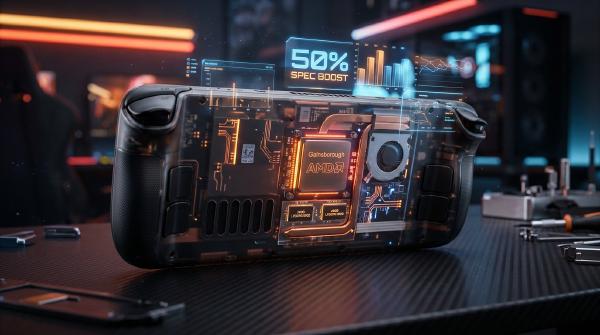
Rumors surrounding the possible Steam Deck 2 have pointed toward an AMD processor codenamed Gainsborough, reportedly featuring a six-core, 12-thread CPU and 24GB of LPDDR5-9600 memory.
The exact CPU and GPU architectures remain unclear, and Valve has not confirmed that Gainsborough will power a retail Steam Deck successor.
For more background, see KAD’s coverage of the Steam Deck 2 Gainsborough APU leak and its reported specifications.
There is also a broader question about AMD’s handheld processor roadmap. Rumors surrounding the Ryzen Z3 family point toward a six-core design and RDNA 4m graphics for future handheld gaming systems. You can read more in KAD’s report on AMD Ryzen Z3 rumors and its potential RDNA 4m configuration.
These reports illustrate that AMD may be developing several solutions for the next generation of portable gaming hardware. A custom Sony SoC does not necessarily define the architecture available to every other manufacturer.
Would the Steam Deck 2 be left behind? #
If Project Canis launches with RDNA 5 while the next Steam Deck uses an earlier graphics architecture, Sony could enjoy an architectural advantage.
But that would not automatically make the PlayStation handheld the faster gaming device.
The Steam Deck and PlayStation handheld would serve different software ecosystems. Valve’s platform focuses on PC games and SteamOS, while Sony could optimize its hardware around a more tightly controlled console environment.
Their performance priorities may also differ. Valve has historically emphasized efficiency, compatibility, and sustained handheld gaming rather than simply maximizing peak graphics throughput.
A newer GPU architecture could offer better rendering capabilities, but the final experience would depend on power consumption, memory bandwidth, software optimization, and the games each platform supports.
For another example of how AMD handheld hardware is evolving, PUDN’s coverage of the GPD WIN 5 and its Ryzen AI Max+ 395 processor illustrates a different approach: using a much higher-power processor to bring substantial PC performance into a portable form factor.
🔍 The Bigger Picture: Custom Silicon Could Reshape Handheld Gaming #
The Project Canis rumor highlights a potentially important change in the handheld market: custom silicon may become an increasingly significant competitive advantage.
A manufacturer that can commit to millions of devices may have more leverage when negotiating dedicated processor designs. Such arrangements can provide tighter integration between CPU architecture, GPU resources, memory configuration, power management, and software.
For Sony, a custom AMD chip could allow the company to optimize the handheld around PlayStation games rather than adapting a general-purpose PC processor.
For Valve and other PC handheld manufacturers, the challenge is different. They need processors that can support a broad range of games, operating systems, and device designs while remaining economically viable across potentially smaller product volumes.
That does not make standardized AMD processors inherently inferior. A broadly available chip can still deliver excellent performance, and a custom design is only valuable when its software and hardware are properly optimized.
The next generation of handheld devices will therefore be shaped by more than GPU architecture alone. Manufacturing scale, memory costs, battery technology, cooling, software support, and game compatibility will all influence which products succeed.
🏁 Conclusion: Sony’s RDNA 5 Advantage Is Interesting, but Unproven #
Sony’s rumored Project Canis could become an important addition to the PlayStation ecosystem. A standalone handheld with a custom Zen 6 CPU, RDNA 5 graphics, and 24GB of memory would represent a substantial step beyond the streaming-focused PlayStation Portal.
The possibility of preferential access to AMD’s RDNA 5 technology is particularly intriguing. If Sony can secure a dedicated chip and bring it to market ahead of competing handhelds, it could gain an early architectural advantage.
However, almost every major detail remains unconfirmed. Sony has not announced Project Canis, AMD has not disclosed an exclusivity agreement, and the leaked hardware specifications have a disputed attribution history. The rumored 2028 launch alongside the PS6 should likewise be treated as speculation rather than an established release schedule.
For Valve, Microsoft, and other handheld manufacturers, Sony’s reported arrangement could create pressure to secure competitive next-generation processors. But it is far too early to conclude that Steam Deck 2 or a future Xbox handheld will necessarily be left behind.
Ultimately, the real comparison will come when shipping hardware is available for testing. Until then, Project Canis is an intriguing glimpse of where portable PlayStation gaming might be headed—not yet a confirmed challenger to the next generation of PC handhelds.