AMD Helion Explained: Open Rack Infrastructure for Agentic AI
AMD Helion is an open rack-level infrastructure blueprint designed to support the diverse computing requirements of agentic AI. Announced at the October 2026 Open Compute Project (OCP) Global Summit, Helion offers two primary configuration paths: a CPU-only architecture for large-scale agent execution and an integrated CPU-GPU design for workloads that combine agent orchestration with accelerated model inference.
The platform reflects a broader shift in AI infrastructure design. As agentic systems expand beyond conventional inference workloads, they require resources for application logic, tool execution, workflow coordination, data processing, and model serving. These tasks place different demands on CPUs, GPUs, memory, networking, and storage.
Rather than treating every AI workload as a GPU-centric problem, AMD Helion provides a configurable rack blueprint that allows infrastructure providers to balance general-purpose computing and accelerator capacity according to workload requirements.
AMD states that its CPU-only configuration can scale to as many as 32,768 cores using sixth-generation AMD EPYC processors. The first partner-developed configurations are expected in November 2026, with broader commercial availability planned for the first half of 2027.
🧠 Why AMD Is Building Helion for Agentic AI #
Agentic AI systems execute multi-step workflows rather than simply generating responses to individual prompts. Depending on the application, an agent may plan a task, retrieve information, invoke APIs, execute code, inspect results, and coordinate with other agents before completing a request.
These operations create a heterogeneous computing profile. Model inference can benefit from GPU acceleration, while orchestration, application logic, tool execution, and many data-processing operations rely heavily on CPU resources.
For infrastructure architects, this distinction matters because provisioning GPUs for every stage of an agent workflow may not be the most efficient approach. Some stages require substantial parallel processing, while others involve control flow, branching logic, service calls, or relatively lightweight computation.
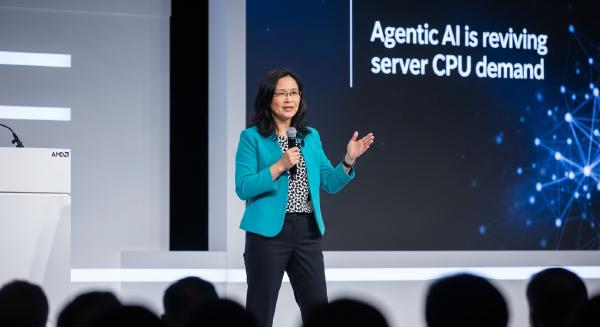
AMD’s Helion strategy reflects the growing importance of CPU resources in agentic AI systems. For further context, see KAD’s analysis of how AMD’s AI strategy is driving demand for CPUs and GPUs.
Helion addresses these requirements through a rack-level architecture that supports different combinations of computing resources. Its central objective is to let system builders align infrastructure capacity with the actual execution characteristics of their workloads.
This approach also reflects an important distinction between AI model computation and AI application execution. As AI systems become more autonomous, the surrounding software infrastructure can become a significant part of the overall computing workload.
⚙️ AMD Helion’s Two Hardware Configurations #
AMD Helion provides two primary configuration paths: a CPU-only design optimized for large-scale agent execution and an integrated CPU-GPU design intended for environments that need both general-purpose processing and accelerated AI computation.
1. CPU-Only Configuration for Large-Scale Agent Execution #
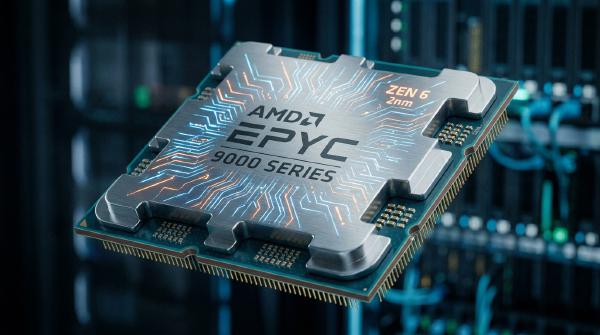
The CPU-only configuration targets hyperscale environments that need substantial general-purpose computing capacity. It is based on sixth-generation AMD EPYC processors associated with the Zen 6 architecture and the Venice product family.
AMD describes a maximum configuration of up to 32,768 CPU cores per rack. This high-density design is intended to support agent execution, application services, orchestration, and other CPU-intensive operations, including deployments in which model inference runs on separate GPU infrastructure.
The maximum core count represents a stated configuration ceiling, not a guarantee that every Helion rack will ship with that capacity. The achievable density will depend on the selected processor models, system layout, power delivery, cooling capacity, and implementation choices made by hardware partners.
For example, under the assumption of 256 cores per processor, reaching 32,768 cores would require 128 processors:
32,768 cores / 256 cores per processor = 128 processorsThis calculation is illustrative rather than a confirmed bill of materials for a production Helion rack. Actual processor core counts and supported system configurations must be verified against the final hardware specifications.
A CPU-oriented rack can be useful when thousands of concurrent agents need to execute application logic, process data, invoke tools, or coordinate workflows without requiring a dedicated GPU for every operation.
Potential deployment scenarios include:
- Agent orchestration: Running control loops, task scheduling, routing, and coordination services.
- Tool execution: Hosting application code, API integrations, and CPU-oriented execution environments.
- Data processing: Performing preprocessing, retrieval-related operations, transformation, and other general-purpose workloads.
- Distributed application services: Supporting the software components that connect agents to enterprise systems and external services.
The suitability of a CPU-only deployment depends on the workload. GPU-intensive inference and other highly parallel numerical operations may still require accelerator infrastructure elsewhere in the data center.
2. Integrated CPU-GPU Configuration for Enterprise AI #
The integrated configuration combines general-purpose CPU resources with GPU acceleration in a shared rack-level design. It is intended for enterprise and service-provider environments where agent execution and model inference are both important parts of the workload.
The principal components include:
- AMD EPYC CPU nodes: Support application logic, orchestration, general-purpose computation, and agent execution.
- AMD Instinct MI350P GPU nodes: Provide accelerated computing resources for supported AI workloads, including model inference.
- General-purpose compute resources: Accommodate additional infrastructure services and application requirements.
Bringing CPU and GPU resources into a coordinated rack architecture gives infrastructure teams more flexibility when allocating resources across an AI application stack. CPU nodes can handle control flow and tool execution, while GPU nodes serve inference requests and other workloads that benefit from accelerator parallelism.
The design can also simplify capacity planning by providing a common infrastructure framework for workloads that would otherwise run on separate systems. However, physical proximity alone does not guarantee lower latency or higher throughput. Those outcomes depend on networking, communication patterns, memory architecture, software integration, and workload placement.
The optimal CPU-to-GPU ratio will vary by deployment. An environment running many lightweight agents may prioritize CPU capacity, while a system serving large models or high volumes of inference requests may require a greater allocation of GPU resources.
Infrastructure teams should evaluate at least the following factors when sizing an integrated configuration:
- Compute balance: The ratio of CPU capacity to accelerator throughput required by the workload.
- Memory capacity and bandwidth: The memory requirements of application services, model serving, and intermediate data.
- Networking: The bandwidth and latency needed for communication between nodes and services.
- Power and cooling: The rack’s electrical capacity, thermal limits, and cooling infrastructure.
- Software integration: Support for scheduling, observability, resource management, model serving, and application deployment.
These considerations determine whether a particular CPU-GPU configuration can deliver the expected performance and operating efficiency.
🏗️ OCP-Based Rack Architecture and Open Hardware #
AMD Helion follows the Open Compute Project approach to infrastructure design. According to the announced reference specifications, the platform uses a standardized 21-inch OCP rack supporting 44 OpenU trays, with air-cooling and direct-liquid-cooling options.
The blueprint provides a common rack-level foundation for hardware partners to develop different system configurations. Instead of requiring each manufacturer to begin with an entirely proprietary rack architecture, the design establishes a shared framework for integrating compute nodes and supporting infrastructure.
This approach can give system builders flexibility to adapt the configuration to customer requirements, including workload profiles, data-center layouts, power availability, and cooling capabilities.
AMD also plans to contribute Helion to the OCP community, allowing ecosystem participants to evaluate, develop, and adopt the design.
Open hardware specifications, however, do not automatically guarantee complete interoperability. Production deployments still require validated components, compatible firmware, tested power and thermal designs, integrated networking, and reliable system management.
The practical value of Helion’s open architecture will therefore depend on the maturity of partner implementations and the degree to which independently developed systems can meet consistent operational requirements.
For a broader look at how CPUs, GPUs, and other processors fit into modern infrastructure, see KAD’s technical overview of CPU vs. GPU vs. NPU vs. DPU architectures.
Cooling, Power, and Rack Density #
High-density AI infrastructure requires coordinated engineering across compute, power delivery, thermal management, and networking.
Air cooling can be suitable for systems that remain within the thermal capabilities of the target facility. Direct liquid cooling can support higher heat-removal requirements, but it introduces additional considerations involving coolant distribution, facility compatibility, maintenance, and operational procedures.
The availability of both cooling approaches gives system partners options for adapting Helion-based configurations to different data-center environments. It does not establish that every configuration can support the same processor density or power envelope.
Similarly, the number of available OpenU trays describes a mechanical integration framework rather than a direct measure of computing performance. Actual rack capacity depends on the dimensions and power requirements of the selected components, along with the space needed for networking, power distribution, cooling, and serviceability.
For infrastructure architects, the relevant evaluation is therefore not simply the number of cores or trays per rack. It is the amount of useful workload capacity that can be delivered within the facility’s power, cooling, and operational constraints.
🔍 AMD Helion vs. AMD Helios #
AMD Helion and AMD Helios are related to the company’s broader direction in open, rack-scale AI infrastructure, but they emphasize different deployment priorities.
| Area | AMD Helion | AMD Helios |
|---|---|---|
| Primary emphasis | Agent execution and configurable CPU-intensive AI workloads | Large-scale accelerated computing |
| Compute architecture | CPU-only or integrated CPU-GPU configurations | Rack-scale infrastructure centered on accelerated computing |
| Target workloads | Agent orchestration, enterprise workflows, and mixed computing tasks | Large AI training and inference deployments |
| Configuration philosophy | Flexible allocation of CPU and GPU resources for agentic workloads | Scaling high-performance accelerated infrastructure |
| Infrastructure role | Supporting diverse stages of agent execution | Supporting demanding accelerator-centric AI workloads |
The distinction is one of emphasis rather than an absolute division of capabilities. Agentic AI systems can require substantial GPU acceleration, while large training and inference platforms also rely on CPUs for orchestration, data handling, and general-purpose processing.
Helion’s defining characteristic is its explicit focus on configurable infrastructure for the varied execution requirements of agentic AI.
The two approaches can therefore be complementary within a larger AI infrastructure strategy. An organization may need accelerator-dense systems for model training and inference alongside CPU-rich infrastructure for agent orchestration, application services, and other supporting workloads.
For additional context, KAD’s overview of the AMD Helios rack-scale AI platform explores AMD’s broader approach to integrating CPUs, GPUs, networking, and software into a unified infrastructure design.
Actual product comparisons should be based on verified system specifications, workload benchmarks, supported software, and total cost of ownership rather than platform positioning alone.
📅 AMD Helion Availability and Partner Ecosystem #
AMD’s announced rollout plan calls for the first partner-developed Helion configurations to be ready in November 2026, followed by broader commercial availability in the first half of 2027.
These milestones describe the planned rollout rather than confirming that every configuration will be available at the same time. Actual availability will depend on system development, qualification, manufacturing, and customer deployment schedules.
Hardware partners will play a central role in translating the open reference design into validated production systems. Their implementations will determine the specific processor configurations, supported accelerators, networking options, cooling designs, and management capabilities available to customers.
Enterprise buyers should distinguish between a published rack blueprint and a fully qualified product. The blueprint establishes an architectural direction, while production systems require detailed specifications, compatibility validation, software support, and operational testing.
Before selecting a Helion-based system, infrastructure teams should assess:
- Availability: Confirmed product release dates, delivery schedules, and supported configurations.
- Workload performance: Benchmarks that reflect the intended agent, inference, and application workloads.
- Software compatibility: Support for existing orchestration, deployment, monitoring, and management tools.
- Facility readiness: Power, cooling, rack integration, and networking requirements.
- Operating economics: Acquisition costs, energy consumption, utilization, maintenance, and ongoing support.
The partner ecosystem will be particularly important in determining how consistently the open blueprint translates into deployable products. Customers should look for validated configurations and workload-specific performance data rather than relying solely on theoretical rack capacity.
🚀 What AMD Helion Means for AI Infrastructure #
AMD Helion reflects a broader change in the design of AI infrastructure. As agentic systems become more capable, their computing requirements extend beyond model inference to include tool execution, workflow coordination, application logic, data processing, and interactions with enterprise services.
A rack blueprint that supports both CPU-only and integrated CPU-GPU configurations gives system builders more ways to match hardware resources to those requirements. Its OCP-based approach also creates an opportunity for partners to develop systems around a shared infrastructure framework rather than a single fixed configuration.
For infrastructure architects, the most important consideration is workload-level efficiency. A high core count does not necessarily translate into better agent throughput, just as a larger GPU allocation does not guarantee improved end-to-end application performance. The result depends on the balance between computation, memory, networking, software overhead, and resource utilization.
Helion’s open and configurable design provides a foundation for exploring these trade-offs, but the blueprint alone does not establish real-world performance, energy efficiency, or cost advantages.
The planned partner configurations and commercial rollout in 2026–2027 should provide a clearer basis for evaluating the platform. Until production systems and representative benchmarks are available, assessments of Helion should distinguish announced capabilities from demonstrated results.
Ultimately, AMD Helion’s value will depend on whether its configurable, open rack architecture helps organizations deploy and operate agentic AI workloads more effectively than less specialized alternatives.