Solid-State Transformers: Powering 800V AI Data Centers
The rapid scaling of AI infrastructure is exposing a fundamental bottleneck: power delivery and distribution. As GPU clusters push rack-level power from kilowatts to megawatt-class densities, traditional electrical systems—designed decades ago—are reaching their physical and economic limits.
The industry’s response is not incremental. It is architectural.
At the center of this transition is the Solid-State Transformer (SST)—a power-electronics-driven system that enables 800V DC distribution, dramatically improving efficiency, control, and scalability.
This article provides a deep technical analysis of SST, covering:
- Architecture and operating principles
- System-level advantages over legacy power systems
- Role in AI data centers and 800V DC infrastructure
- Industrial ecosystem and supply chain dynamics
- Market trajectory from 2026–2028
⚡ The Power Wall in AI Infrastructure #
AI compute has outpaced improvements in power infrastructure:
- Rack density: 5–10 kW → 100 kW → 1 MW+
- Cluster scale: thousands to millions of GPUs
- Load dynamics: highly variable, bursty, and latency-sensitive
Traditional architectures rely on:
- AC distribution + UPS
- Multi-stage conversion (AC → DC → AC → DC)
These introduce:
- Efficiency loss (4–10%)
- High thermal overhead
- Complex infrastructure layers
- Limited dynamic response
This creates a “power wall”, where scaling compute is constrained by:
- Energy efficiency
- Physical space
- Cooling capacity
- System complexity
🔮 What Is a Solid-State Transformer (SST)? #
A Solid-State Transformer (SST) is not an incremental upgrade to traditional transformers—it is a complete redefinition.
From Passive Device to Intelligent Energy Node #
| Traditional Transformer | SST |
|---|---|
| Passive electromagnetic device | Active power-electronic system |
| Fixed voltage ratio | Programmable, dynamic control |
| Slow response (line frequency) | Fast response (µs–ms) |
| No intelligence | Fully software-controlled |
SST replaces:
- Copper windings
- Iron cores
With:
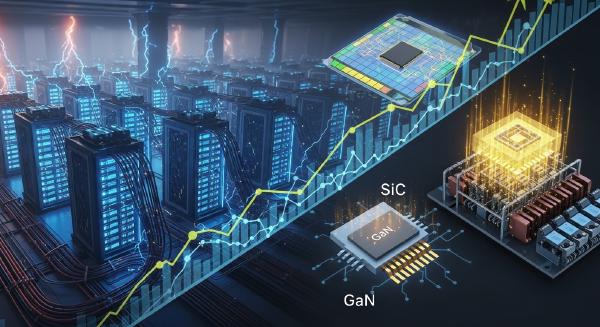
- Wide-bandgap semiconductors (SiC, GaN)
- High-frequency conversion
- Digital control systems
SST acts as an “energy router”, managing power flow with the same flexibility that networks manage data.
🔧 SST Architecture: Three-Stage Power Conversion #
The performance of SST comes from its multi-stage modular topology.
Stage 1: Medium-Voltage AC → DC #
- Input: 10kV+ AC grid
- Uses multi-level converters
- Functions:
- Rectification
- Power factor correction
- Harmonic suppression
Stage 2: High-Frequency Isolation (Core Stage) #
- Uses dual active bridge (DAB) topology
- High-frequency transformer (kHz range)
- Provides:
- Electrical isolation
- Voltage conversion
- Bidirectional power flow
This stage enables:
- Compact size (vs 50/60 Hz transformers)
- Precise control of power direction and magnitude
Stage 3: DC Output / Inversion #
- Outputs:
- 800V DC (preferred for AI servers)
- Or 400/480V AC (if required)
Key benefit:
Direct DC delivery eliminates multiple internal PSU conversions inside servers.
💡 Why 800V DC Matters for AI Data Centers #
Modern AI clusters increasingly adopt 800V DC distribution because:
- GPUs natively operate on DC rails
- Fewer conversion stages → higher efficiency
- Reduced power supply complexity
Efficiency Comparison #
| Architecture | Typical Efficiency |
|---|---|
| Traditional UPS | <96% |
| HVDC | 94–96% |
| Advanced hybrid | ~97% |
| SST (800V DC) | >98.5% |
Even a 2% improvement at scale yields:
- Massive energy savings
- Lower PUE (~1.15–1.2 achievable)
🚀 Core Advantages of SST #
1. Ultra-High Efficiency #
- End-to-end: >98.5%
- DC-DC path: >99%
Direct impact:
- Lower electricity cost
- Reduced cooling requirements
2. Extreme Power Density #
- 5–10× higher than traditional transformers
-
60% reduction in physical footprint
Critical for:
- High-density AI clusters
- Edge data centers
3. Intelligent Power Control #
- µs–ms response time
- Tracks GPU workload fluctuations
Supports:
- Dynamic load balancing
- Grid stabilization
- Real-time optimization
4. Native Multi-Energy Integration #
SST enables seamless integration of:
- Solar (PV)
- Wind
- Battery storage
Via:
- Bidirectional DC bus
- Plug-and-play energy routing
5. Reliability and Safety #
- No oil → no fire risk
- Fast fault isolation
- Modular redundancy (N+X)
Supports:
- Hot swapping
-
99.999% availability
🧱 Technology Stack and Cost Structure #
Key Cost Components #
| Component | Share |
|---|---|
| Power semiconductors (SiC/GaN) | 40–50% |
| Control + cooling systems | 25–30% |
| Magnetic components | 15–20% |
| Others | 5–10% |
Critical Technologies #
- SiC (Silicon Carbide) → high voltage, low loss
- GaN (Gallium Nitride) → high frequency, compact design
- High-frequency magnetics → size reduction
The semiconductor layer is the primary innovation bottleneck and value center.
🏢 SST in AI Data Centers #
SST is the foundation of:
10kV AC → 800V DC direct distribution
This architecture is being adopted by:
- Hyperscalers
- AI infrastructure providers
- National computing projects
Why SST Is Mandatory for Future AI #
- Supports MW-scale racks
- Matches GPU power dynamics
- Reduces conversion overhead inside servers
Without SST:
➡️ Power inefficiency becomes the dominant bottleneck
🌐 Beyond Data Centers: Expanding Ecosystem #
1. Smart Grids and Microgrids #
- Dynamic energy routing
- Load balancing
- Grid resilience
2. Renewable Energy Integration #
- Direct DC coupling
- Eliminates redundant conversions
- +3–5% system efficiency gain
3. Industrial and Manufacturing #
- High power quality
- Precision voltage control
4. Electrified Transportation #
- Ultra-fast EV charging
- Port electrification
- Heavy industry applications
🏁 Industry Landscape and Competition #
The SST ecosystem spans:
- Power electronics
- Semiconductor manufacturing
- Data center infrastructure
- Energy systems
Key trends:
- Rapid investment in SiC supply chains
- Increasing collaboration between:
- Cloud providers
- Power equipment vendors
- Semiconductor companies
The industry is shifting from:
Vertical integration → platform-based energy ecosystems
📈 2026–2028: The Commercial Inflection Point #
The timeline is becoming clear:
- 2024–2025: Pilot deployments
- 2026–2028: Large-scale commercialization
- Post-2028: Standardization across AI infrastructure
Drivers:
- AI power demand explosion
- Falling SiC/GaN costs
- Maturing system integration
🔮 Conclusion: From Copper to Silicon #
The Solid-State Transformer represents a fundamental shift in power infrastructure:
- From passive → programmable
- From AC-centric → DC-native
- From static → intelligent
This is not just a component upgrade—it is a system-level rearchitecture aligning energy flow with compute flow.
For AI infrastructure, the implication is clear:
The next scaling limit is not compute—it is power delivery efficiency.
SST removes that constraint.
And in doing so, it opens a multi-trillion-dollar transformation across:
- Data centers
- Energy systems
- Semiconductor ecosystems
The transition from “copper to silicon” has already begun.