UALink 2.0 Explained: Open AI Interconnect Challenging NVLink in 2026
🧭 Overview #
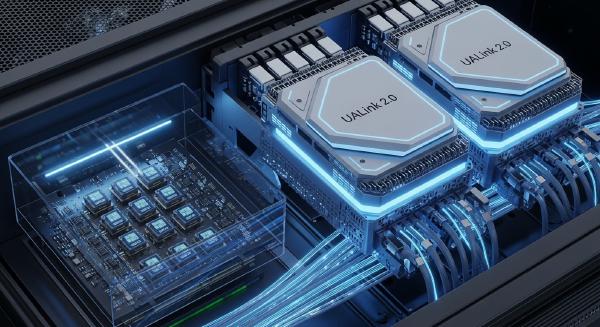
As of 2026, UALink (Ultra Accelerator Link) has evolved from a consortium proposal into a ratified industry standard, positioning itself as the first credible open alternative to proprietary AI interconnects.
Often described as a direct challenge to NVIDIA’s NVLink ecosystem, UALink introduces a vendor-neutral, scalable fabric for next-generation AI clusters. Its rapid progression from specification to silicon marks a pivotal shift in how hyperscale infrastructure is designed.
🗺️ Ratification and Roadmap #
UALink’s development has accelerated significantly over the past two years, moving from concept to implementation-ready standard.
UALink 1.0 (2025) #
- Ratified on April 8, 2025
- Establishes baseline interconnect architecture
- Delivers 200 Gbps per lane bandwidth
- Defines memory-semantic communication model
UALink 2.0 (2026) #
- Announced April 7, 2026
- Introduces In-Network Compute capabilities
- Enables switches to perform limited data processing
- Reduces latency for large-scale distributed workloads
Ecosystem Expansion #
- Founding members: AMD, Intel, Meta, Microsoft, Google, AWS
- Expanded membership: includes Apple, Alibaba, Synopsys
- Total participation: 85+ organizations
This scale reflects broad industry alignment around open AI infrastructure.
⚙️ Technical Comparison: UALink vs NVLink #
| Feature | UALink 1.0 / 2.0 | NVIDIA NVLink (Blackwell Generation) |
|---|---|---|
| Architecture | Open, multi-vendor | Proprietary |
| Max Scale | Up to ~1,024 accelerators | Rack-scale (hundreds of GPUs) |
| Bandwidth | 200 Gbps per lane | Higher per-GPU aggregate bandwidth |
| Memory Model | Direct load/store semantics | Memory pooling via NVSwitch |
| Availability | Pre-production silicon (2026) | Mature, production-ready |
Key Differentiator #
- UALink: prioritizes openness and interoperability
- NVLink: prioritizes vertical integration and peak performance
The trade-off is between ecosystem flexibility and optimized single-vendor performance.
🧱 Scale-Up vs Scale-Out Strategy #
UALink is part of a broader architectural shift toward disaggregated AI infrastructure.
Scale-Up (Within a Pod) #
- UALink connects up to 1,024 accelerators
- Provides near-memory-speed communication
- Enables tightly coupled training clusters
Scale-Out (Across Pods) #
- Complemented by Ultra Ethernet
- Connects multiple pods into hyperscale fabrics
- Supports distributed training across thousands of nodes
Unified Fabric Vision #
Together, these technologies enable:
- Fully open AI cluster fabrics
- Reduced dependency on proprietary interconnect stacks
- Greater flexibility in hardware selection
🧪 2026: Transition from Spec to Silicon #
While 2025 established the standard, 2026 is defined by hardware realization.
Silicon Development #
- UALink switches and retimers entering tape-out phase
- Early implementations from emerging silicon vendors
- Focus on interoperability validation
OEM Integration #
- Major vendors developing UALink-ready systems
- Early chassis and platform demonstrations underway
- Commercial availability expected by late 2026
Hyperscaler Adoption #
- Next-generation AI accelerators integrating UALink natively
- Designed for large-scale model training
- Emphasis on avoiding proprietary lock-in
⚔️ Strategic Implications #
UALink represents a coordinated industry effort to rebalance power in AI infrastructure.
Breaking Vendor Lock-In #
- Enables mixing GPUs, CPUs, and switches across vendors
- Reduces dependency on a single supplier
- Improves cost control and supply chain resilience
Competitive Pressure #
- Challenges NVIDIA’s vertically integrated model
- Forces innovation in both hardware and software ecosystems
- Encourages standardization across the industry
⚠️ The Software Factor #
Despite hardware advancements, software remains a decisive advantage.
NVIDIA Ecosystem Strength #
- Mature CUDA platform
- Extensive developer tooling
- Deep integration across AI frameworks
UALink Challenge #
- Must build or integrate with competitive software stacks
- Requires ecosystem-wide adoption
- Success depends on more than hardware parity
🔮 Future Outlook #
UALink’s long-term success depends on several factors:
- Availability of production-grade hardware
- Interoperability across vendors
- Maturity of supporting software ecosystems
If these align, UALink could become the default interconnect for open AI infrastructure.
✅ Conclusion #
UALink 2.0 marks a turning point in AI system design, introducing an open, scalable alternative to proprietary interconnect technologies.
By combining:
- High-bandwidth communication
- Multi-vendor interoperability
- Emerging in-network compute capabilities
UALink lays the foundation for a more flexible and competitive AI hardware ecosystem.
However, the ultimate outcome will depend not just on hardware performance, but on whether the broader ecosystem can match the software maturity of established platforms.