Eaton and the AI Data Center Power Bottleneck: The Hidden Infrastructure Layer
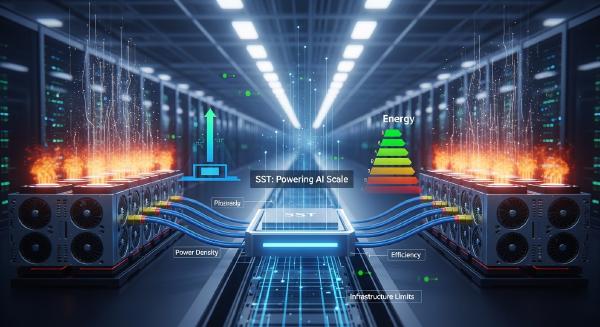
Modern AI infrastructure is often discussed through the lens of GPUs, accelerators, and high-speed interconnects. However, the true scaling constraint in hyperscale AI systems is increasingly shifting downward in the stack: power delivery and distribution.
As compute density rises and AI workloads become more power-intensive, electrical infrastructure has evolved from a background utility into a primary architectural bottleneck. In this environment, Eaton has emerged as a key industrial player positioned across the critical intermediate power layer that connects the electrical grid to high-density AI compute clusters.
⚡ The AI Power Gap and Rack Density Explosion #
Traditional cloud data centers were designed around relatively stable workloads with predictable power profiles. In contrast, AI training and inference clusters introduce:
- Highly bursty, multi-megawatt load patterns
- Extreme rack densities driven by GPU scaling
- Continuous high-utilization compute cycles
- Rapid transient power fluctuations
These characteristics place unprecedented stress on legacy power systems, which were not designed for sustained high-density AI workloads.
As a result, power delivery infrastructure has become a limiting factor in AI scalability, often constraining deployment speed as much as silicon availability.
Eaton operates in the intermediate layer of this system, managing the transformation, conditioning, and distribution of electrical power from grid input to rack-level delivery:
Power Grid → Transformers → Switchgear → UPS Systems & Busways → Rack Distribution → AI Compute RacksThis positioning places Eaton directly within the critical path of AI infrastructure deployment.
📊 Structural Growth Driven by AI Infrastructure Expansion #
Eaton’s recent performance reflects accelerating demand from data center buildouts:
- Strong year-over-year revenue growth in electrical systems
- Expanding backlog visibility driven by hyperscaler orders
- Increasing allocation of capital expenditure toward power infrastructure upgrades
Unlike compute hardware cycles, power infrastructure demand tends to be more stable and tied to long-duration deployment timelines. This creates a backlog-driven revenue profile with multi-quarter visibility.
The key driver is not cyclical demand, but structural expansion of AI compute capacity across global hyperscalers.
🧱 Four Structural Moats in Power Infrastructure #
Eaton’s competitive position is shaped by layered structural advantages rather than purely technological differentiation.
1. Certification and Regulatory Barriers #
High-voltage electrical systems require compliance with strict safety and reliability standards. Certification processes are lengthy and capital-intensive, creating a high barrier to entry for new competitors.
2. System-Level Integration Advantage #
Eaton provides end-to-end electrical infrastructure spanning:
- Power distribution systems
- Backup and UPS architectures
- Intelligent monitoring platforms
This integrated stack allows coordinated management of dynamic AI workloads and reduces system-level failure risk.
3. Deployment and Service Scale #
Large-scale data center power systems require deep engineering expertise and global service capabilities. Established vendors benefit from long-standing relationships with hyperscalers and enterprise operators.
4. Co-Design with Next-Generation Architectures #
The transition toward higher-voltage architectures, including 800V-class DC power systems, is reshaping data center electrical design.
Eaton’s involvement in next-generation power architecture development with major compute ecosystem players positions it within early-stage standard formation rather than downstream adoption.
These architectures aim to:
- Reduce conversion losses
- Improve rack-level efficiency
- Support higher compute densities
- Enable faster deployment of AI clusters
⚙️ Neutral Positioning in the AI Hardware Stack #
One of Eaton’s defining characteristics is its neutrality across the AI compute ecosystem.
Regardless of whether a data center deploys:
- NVIDIA GPUs
- AMD accelerators
- Custom ASICs from hyperscalers
The underlying requirement for power distribution remains constant.
This makes Eaton structurally independent from specific semiconductor cycles while still fully exposed to overall AI infrastructure expansion.
In effect, it functions as a “picks-and-shovels” provider for the entire AI buildout cycle.
⚖️ Structural Strengths and Constraints #
While Eaton benefits from strong structural tailwinds, its business model also carries inherent constraints.
Structural Advantages #
- Stable, long-duration infrastructure demand
- High switching costs once deployed
- Deep integration with hyperscaler ecosystems
- Strong visibility through backlog-driven revenue
Structural Constraints #
- Lower margin profile compared to semiconductor firms
- High capital intensity and engineering complexity
- Competitive pressure from established industrial peers
- Sensitivity to data center capex cycles and standardization timelines
Competitors such as Schneider Electric and Vertiv operate in adjacent segments, reinforcing a highly competitive but structurally growing market.
🌐 The Long-Term AI Infrastructure Cycle #
Eaton’s growth trajectory is closely tied to three overlapping macro trends:
- Construction of new hyperscale AI data centers
- Retrofitting legacy facilities for higher power density
- Broader electrification of industrial and computing infrastructure
As AI systems scale toward increasingly dense compute clusters, the importance of power infrastructure will continue to rise relative to individual compute components.
🧩 Conclusion #
The evolution of AI infrastructure is revealing a fundamental shift in where system bottlenecks reside. While compute and networking often dominate public discussion, the underlying constraint is increasingly the physical delivery of stable, high-density electrical power.
Eaton’s position within this intermediate layer of the AI stack makes it a structurally significant participant in the ongoing expansion of global data center capacity.
In this context, power infrastructure is no longer a passive utility layer—it is a core enabling technology for the next generation of compute systems.