From Optical Interconnects to Optical Computing: The Photonics Era
The rapid expansion of artificial intelligence has pushed modern computing systems into a new architectural phase, where traditional transistor scaling alone is no longer sufficient to sustain performance growth. Instead, system-level constraints—particularly data movement, memory bandwidth, and interconnect efficiency—have become the dominant bottlenecks.
In response, photonics has emerged as a foundational technology layer that is expanding far beyond its original role in long-haul telecommunications. Today, optical technologies are increasingly integrated across every level of the computing stack, from intra-rack interconnects to chip packaging and, in emerging cases, computation itself.
This shift marks the beginning of a broader transition toward photonics-centric computing architectures designed to meet the extreme demands of AI workloads.
🚀 From Moore’s Law to Cluster Scaling #
For decades, computing performance improvements were primarily driven by transistor density scaling on individual chips. This paradigm defined traditional interpretations of Moore’s Law.
However, modern AI workloads have fundamentally altered this model.
Large-scale systems built for training and inference of large language models no longer operate as isolated processors. Instead, they function as distributed compute clusters composed of thousands of accelerators working in coordination.
In this environment:
- Performance is determined by interconnect efficiency rather than single-chip compute density.
- Communication overhead becomes a primary limiter of scalability.
- System synchronization increasingly defines overall throughput.
As a result, the unit of computation has shifted from individual chips to full-scale distributed systems.
🌐 The Rising Importance of Optical Interconnects #
As AI clusters scale, accelerators must exchange large volumes of data continuously, including:
- Model weights
- Activation tensors
- Key-value cache data
- Intermediate computation states
Maintaining high utilization across large clusters requires minimizing idle time caused by communication delays.
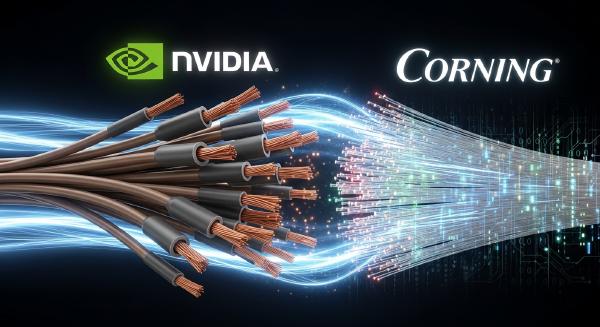
While copper interconnects remain effective for short distances, they encounter fundamental limitations as bandwidth and distance requirements increase:
- Signal attenuation
- Power inefficiency
- Thermal constraints
- Layout complexity
- Limited scalability at extreme data rates
Optical interconnects address these constraints by enabling higher bandwidth density and lower power consumption over longer distances.
As AI systems grow in size, optical networking becomes increasingly essential for sustaining compute efficiency.
🔮 Memory as the New Performance Frontier #
Memory bandwidth and capacity have become central constraints in modern AI systems, particularly for:
- Long-context inference
- Multi-step agent workflows
- Retrieval-augmented generation systems
- High-throughput training pipelines
When memory access becomes a bottleneck, systems are forced to:
- Reduce context length
- Increase storage hierarchy dependence
- Limit concurrency
- Degrade output quality
These trade-offs directly impact both performance and cost efficiency.
Disaggregated Memory Architectures #
Traditional architectures tightly couple memory with compute devices such as GPUs or AI accelerators. While this reduces latency, it also constrains scalability.
To overcome these limitations, the industry is moving toward disaggregated memory systems that separate compute and memory resources while maintaining coherent access.
Technologies such as Compute Express Link (CXL) enable this model by allowing shared memory pools across multiple devices.
When combined with optical interconnects, CXL-based architectures enable:
- Low-latency memory pooling across servers and racks
- Dynamic allocation of memory resources
- Improved utilization of high-bandwidth memory (HBM)
- Reduced hardware fragmentation
This effectively transforms memory from a localized resource into a shared, system-wide infrastructure layer.
⚡ Optical Computing: Beyond Communication #
While optical communication focuses on transporting data using light, optical computing extends photonics into the computation layer itself.
Certain workloads—particularly those involving linear algebra—map naturally to optical systems.
These include:
- Matrix multiplication
- Vector transformations
- Signal processing pipelines
Optical systems can perform these operations with extremely high parallelism and potentially lower energy consumption compared to electronic implementations.
Workload-Oriented Hybrid Architectures #
Rather than replacing electronic computing entirely, the emerging model is hybrid:
- Electronics handle control logic, branching, and general-purpose computation
- Photonics accelerate high-throughput linear algebra operations
This workload-oriented approach ensures that each type of computation runs on the most efficient physical substrate.
As a result, future systems are expected to integrate:
- Electronic CPUs and GPUs
- Photonic accelerators
- Shared memory fabrics
- Optical interconnect networks
🔒 Physical and Security Advantages of Photonics #
Beyond performance and efficiency, optical systems provide unique physical advantages that are increasingly relevant in modern infrastructure design.
Immunity to Electromagnetic Interference #
Optical signals are immune to electromagnetic interference (EMI), making them highly reliable in environments with:
- Industrial equipment
- Dense electronic systems
- High-frequency signal noise
This improves signal integrity and system stability in large-scale deployments.
Reduced Signal Leakage #
Unlike copper-based electrical interconnects, optical systems do not emit electromagnetic radiation that can be passively intercepted.
This property provides advantages in:
- Secure computing environments
- Defense systems
- Financial infrastructure
- Medical and scientific instrumentation
While not a replacement for encryption, it adds an additional physical layer of signal containment.
🌐 A Unified Optical System Stack #
Modern optical technologies are not evolving in isolation. Instead, they form a layered ecosystem addressing different bottlenecks in the compute stack:
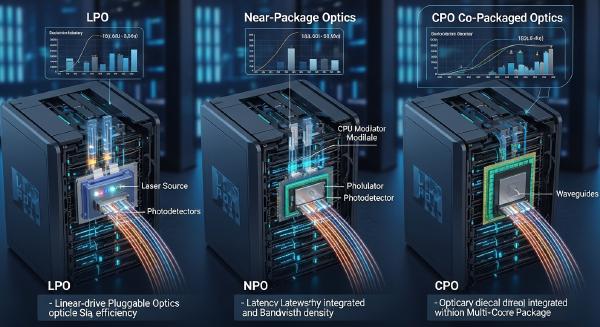
- Pluggable optics address traditional high-speed I/O
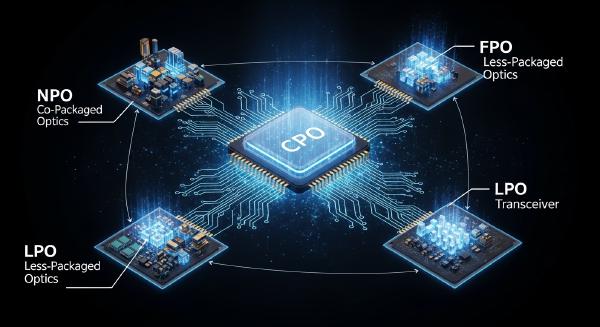
- Co-packaged optics (CPO) reduces package-level interconnect overhead
- Optical circuit switching enables dynamic network topologies
- CXL-enabled optical fabrics support distributed memory architectures
- Optical computing accelerates specific compute-intensive workloads
Together, these technologies form a unified response to the limitations of purely electronic scaling.
🧩 The New System Bottleneck Landscape #
As AI workloads continue to expand, system performance is increasingly constrained by:
- Data movement costs
- Memory access latency
- Interconnect bandwidth
- Power efficiency of communication
These constraints are now more significant than raw transistor density improvements.
Photonic technologies directly target these bottlenecks by reducing the energy and latency cost of moving data within and between compute systems.
🎯 Conclusion #
The evolution of computing infrastructure is entering a new phase defined by the integration of photonics across the entire system stack. What began as a solution for long-distance data transmission is rapidly becoming a foundational layer for intra-system communication, memory architecture, and specialized computation.
As AI workloads continue to scale beyond the capabilities of traditional electronic interconnects, photonics is emerging as a critical enabler of next-generation systems.
Rather than replacing electronic computing, the future will likely be defined by hybrid architectures that combine electronic logic, photonic interconnects, and optical acceleration into a cohesive, system-level design.
In this emerging paradigm, performance is no longer determined solely by how fast individual chips compute, but by how efficiently entire systems move, store, and transform data.