The Future of Optical Communication: From Fiber to CPO
The explosive growth of artificial intelligence has transformed optical communication from a niche infrastructure technology into one of the most strategically important sectors in modern computing. As AI clusters scale from thousands to potentially millions of interconnected accelerators, demand for bandwidth, energy efficiency, and low-latency communication continues to rise at an unprecedented pace.
This shift has accelerated investment in next-generation optical technologies, including Co-Packaged Optics (CPO), Near-Packaged Optics (NPO), Linear Pluggable Optics (LPO), Hollow-Core Fiber (HCF), Multi-Core Fiber (MCF), and advanced coherent optical systems.
Although the terminology can appear overwhelming, the industry’s direction is governed by a relatively simple set of objectives: move more data, move it faster, move it farther, and consume less power while doing so.
Understanding these goals provides a clear framework for interpreting the technological evolution occurring across the optical communication ecosystem.
🚀 The Fundamental Mission of Optical Communication #
At its core, optical communication is a data transmission technology.
Every innovation in the field ultimately seeks to improve one or more of the following metrics:
- Transmission capacity
- Network latency
- Transmission distance
- Power efficiency
- Cost effectiveness
The overarching objective can be summarized as:
Move exponentially larger volumes of data while minimizing energy consumption and operational costs.
This challenge becomes increasingly difficult as network speeds evolve from 400G and 800G toward 1.6T and eventually 3.2T infrastructure.
The industry’s response involves advancements across optical components, transmission media, modulation techniques, and system architectures.
📈 Expanding Transmission Capacity #
Increasing transmission capacity remains the primary driver behind most optical communication research and development efforts.
To understand how capacity scales, it helps to examine the basic optical communication process.
A transmitter converts electrical signals into optical signals using lasers and modulators. These optical signals travel through fiber and are decoded at the receiving end by photodetectors and signal processing systems.
Capacity growth generally follows two primary paths:
Increasing Per-Channel Performance #
The first approach focuses on transmitting more information through each individual wavelength channel.
This strategy relies on two major techniques.
Higher Baud Rates #
Baud rate measures the number of symbols transmitted per second.
Increasing baud rates allows optical systems to send more information within the same wavelength channel.
Modern optical communication systems have already surpassed:
- 120 Gbaud transmission rates
However, pushing beyond this threshold becomes increasingly difficult due to several physical limitations:
- Laser linewidth constraints
- Modulator bandwidth limitations
- Analog-to-digital converter precision
- Fiber nonlinear effects
- Signal distortion
As symbol rates increase, maintaining signal integrity becomes substantially more challenging.
Higher-Order Modulation #
Another way to increase capacity is by encoding more bits into each transmitted symbol.
Examples include moving from:
- QPSK
- 16QAM
- 64QAM
- Advanced PAM signaling schemes
Higher-order modulation significantly improves spectral efficiency by increasing the amount of information carried by each symbol.
The tradeoff is increased sensitivity to noise.
As modulation complexity rises, systems require:
- Higher signal-to-noise ratios
- More sophisticated Digital Signal Processing (DSP)
- Stronger error correction mechanisms
While highly effective, this approach is approaching practical and economic limits.
The Capacity Scaling Challenge #
A useful analogy is highway transportation.
The industry can either:
- Make individual vehicles travel faster
- Increase the amount of cargo each vehicle carries
Both methods improve throughput, but both eventually encounter physical limitations.
This reality has pushed researchers toward a second strategy.
🌐 Expanding the Number of Channels #
When per-channel improvements become increasingly difficult, additional channels can be introduced.
This approach increases total capacity without requiring every channel to operate at extreme performance levels.
Space Division Multiplexing #
Traditional scaling often involved deploying additional fiber strands.
However, increasing fiber counts introduces:
- Higher deployment costs
- Larger cable diameters
- More complex infrastructure management
To address these limitations, researchers developed Multi-Core Fiber (MCF).
Instead of using multiple separate fibers, MCF integrates multiple independent cores within a single fiber strand.
Benefits include:
- Higher aggregate bandwidth
- Improved space efficiency
- Reduced cabling complexity
MCF is widely viewed as a key technology for future ultra-high-capacity optical networks.
Wavelength Division Multiplexing #
Another approach is to increase the number of wavelengths transmitted through the same fiber.
This technique, known as Wavelength Division Multiplexing (WDM), allows multiple optical channels to coexist without interference.
Historically, most systems focused on the C-band spectrum.
The industry is now expanding into:
- C++ bands
- C+L bands
- C+L+S+U bands
These wider spectral regions unlock additional transmission capacity while utilizing low-loss windows within the fiber.
Challenges of Spectrum Expansion #
Adding wavelengths introduces new engineering challenges.
These include:
- Dispersion management
- Nonlinear interference
- Amplifier optimization
- Crosstalk mitigation
To address these issues, advanced amplification technologies are required, including:
- Erbium-Doped Fiber Amplifiers (EDFAs)
- Raman amplification systems
Careful optimization across the entire optical link becomes increasingly important as spectrum utilization expands.
⚡ Reducing Network Latency #
Optical communication already operates at extraordinary speeds.
Even so, reducing latency remains a major focus, particularly for AI workloads, financial trading, and real-time applications.
The industry approaches latency reduction from two directions.
Improving the Transmission Medium #
Light travels more slowly through glass than through air or vacuum.
This observation has driven growing interest in Hollow-Core Fiber.
Unlike conventional fibers that guide light through solid glass, HCF guides light through an air-filled core.
Advantages include:
- Lower propagation delay
- Reduced nonlinear effects
- Improved latency characteristics
These benefits make HCF particularly attractive for:
- Financial trading networks
- High-frequency trading systems
- Ultra-low-latency infrastructure
Optimizing System Architecture #
Latency is not determined solely by the fiber itself.
Significant delays can accumulate as signals pass through network equipment.
Modern architectures therefore seek to reduce:
- Routing complexity
- Processing overhead
- Optical-Electrical-Optical (O-E-O) conversions
This trend has accelerated adoption of technologies such as:
- Optical Circuit Switching (OCS)
- Optical Cross-Connects (OXC)
These systems allow optical signals to remain in the optical domain for longer portions of their journey, reducing conversion-related delays and power consumption.
🌍 Extending Transmission Distance #
Modern submarine cable systems routinely span thousands of kilometers.
The industry’s challenge is no longer merely achieving long distances but maintaining extremely high bandwidth across those distances.
Historically:
- High-capacity links were confined to server racks
- Then expanded to rack-to-rack connectivity
- Later evolved into inter-data-center networks
- Now support national and global backbone infrastructure
As transmission rates increase, maintaining signal quality becomes more difficult.
Higher-order modulation schemes are especially vulnerable to:
- Noise accumulation
- Dispersion
- Signal degradation
The Rise of Coherent Optics #
Coherent optical communication has become one of the industry’s most important technologies for long-haul networking.
Unlike traditional intensity-based transmission, coherent systems utilize:
- Amplitude information
- Phase information
- Polarization states
This dramatically improves spectral efficiency and transmission reach.
Coherent optics now serve as the foundation for:
- Long-haul transport networks
- Submarine cable systems
- High-capacity backbone infrastructure
The industry continues to seek the optimal balance between bandwidth, distance, and cost.
🔋 Improving Energy Efficiency #
As AI infrastructure grows, power consumption has become one of the industry’s most pressing concerns.
A significant portion of system power is consumed not by computation itself but by moving data between components.
Traditional electrical interconnects face several disadvantages:
- High power consumption
- Signal degradation
- Thermal challenges
- Limited scalability
Optical communication offers substantial efficiency advantages.
The logical conclusion is to push optical connectivity deeper into computing systems.
🔬 Why xPO Technologies Exist #
Although long-distance networks are fully optical, a critical electrical bottleneck has historically remained inside servers and networking equipment.
Traditionally, optical signals are converted back into electrical signals before reaching:
- Switch ASICs
- GPUs
- AI accelerators
- Network processors
These short electrical paths consume disproportionate amounts of power at modern bandwidth levels.
The desire to eliminate these inefficiencies has driven the emergence of xPO architectures.
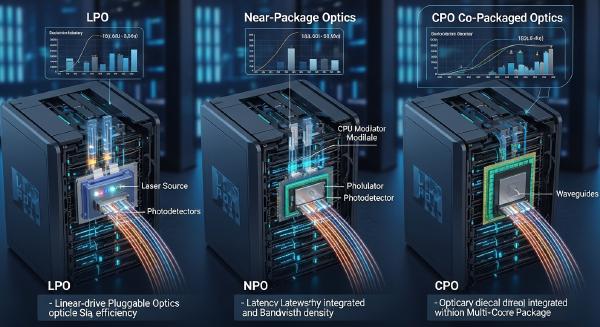
LPO: Linear Pluggable Optics #
LPO removes power-hungry DSP components from optical modules and shifts signal processing responsibilities to host-side SerDes.
Benefits include:
- Lower power consumption
- Reduced latency
- Lower costs
NPO: Near-Packaged Optics #
NPO places optical engines physically adjacent to compute silicon.
Advantages include:
- Shorter electrical paths
- Improved signal integrity
- Better thermal isolation than CPO
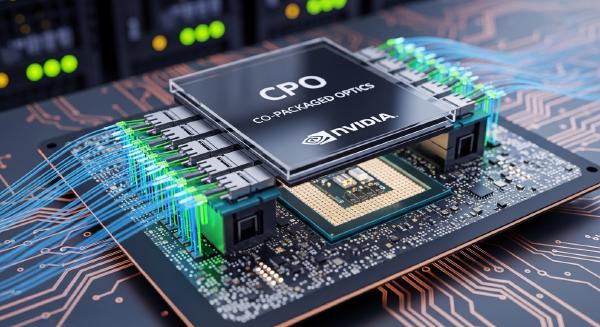
CPO: Co-Packaged Optics #
CPO integrates optical engines directly within the same package as the compute silicon.
This approach offers:
- Maximum bandwidth density
- Lowest power consumption
- Minimal signal loss
- Highest scalability
Many industry observers view CPO as the long-term architecture for future AI supercomputing infrastructure.
🏗️ The Industry’s Long-Term Direction #
The evolution of optical communication is not being driven by a single breakthrough but by multiple complementary technologies working toward the same objective.
Across the industry, several themes are becoming increasingly clear:
- Higher per-channel performance
- Greater wavelength utilization
- More spatial multiplexing
- Lower latency transmission media
- Deeper optical integration
- Reduced energy consumption
Technologies such as:
- Multi-Core Fiber
- Hollow-Core Fiber
- Coherent Optics
- LPO
- NPO
- CPO
are all responses to the same fundamental challenge: the need to move exponentially larger amounts of data in an increasingly power-constrained world.
🎯 Conclusion #
The future of optical communication is being shaped by the relentless growth of AI, cloud computing, and high-performance networking. While the industry often appears fragmented across numerous technologies and acronyms, the underlying direction remains remarkably consistent.
Every major innovation—from higher-order modulation and coherent optics to hollow-core fiber and Co-Packaged Optics—aims to improve one or more of four critical metrics: capacity, latency, transmission distance, and energy efficiency.
As networking speeds advance toward 1.6T and 3.2T infrastructure, traditional electrical interconnects will increasingly become the limiting factor. Optical technologies will therefore continue moving closer to the compute silicon itself, while next-generation fiber technologies expand the boundaries of what can be transmitted across long distances.
For investors, engineers, and technology leaders, understanding these trends provides a clear lens through which to evaluate the future of AI infrastructure, cloud networking, and the broader communications industry.