CPO vs LPO: Which Optical Interconnect Technology Will Shape AI Data Centers?
The rapid growth of artificial intelligence, cloud computing, and high-performance computing (HPC) is pushing data center networking beyond the limits of traditional optical interconnect architectures. As bandwidth requirements move from 400G to 800G and eventually 1.6T and beyond, power consumption, signal integrity, thermal management, and packaging complexity have become critical bottlenecks.
To address these challenges, the industry is increasingly focusing on two next-generation optical technologies: Linear Drive Pluggable Optics (LPO) and Co-Packaged Optics (CPO).
Although both approaches aim to improve efficiency and scalability, they represent fundamentally different philosophies. LPO is an evolutionary step that preserves the familiar pluggable ecosystem while reducing power consumption. CPO is a revolutionary redesign that integrates optics directly alongside switching silicon.
Understanding the strengths and trade-offs of both technologies is essential for data center architects, networking vendors, and PCB manufacturers preparing for the next generation of AI infrastructure.
🚀 Why Traditional Optical Modules Are Reaching Their Limits #
Conventional pluggable optical modules rely heavily on onboard Digital Signal Processors (DSPs) to compensate for signal degradation.
As networking speeds increase, these DSPs become increasingly expensive and power-hungry.
For example:
- A 400G optical module may consume around 8W
- Roughly 4W can be attributed to the DSP alone
- DSPs often account for 20–40% of total module cost
- Thermal management complexity increases dramatically at higher speeds
At hyperscale AI deployments, where tens of thousands of optical links may operate simultaneously, the cumulative impact becomes enormous.
As a result, the industry is exploring new architectures that either reduce or eliminate the DSP bottleneck.
This is where LPO and CPO enter the picture.
🔌 What Is Linear Drive Pluggable Optics (LPO)? #
LPO retains the familiar pluggable optical module form factor while eliminating the traditional DSP.
Instead of using digital signal processing, LPO employs highly linear analog components, including:
- Linear drivers
- Advanced Transimpedance Amplifiers (TIAs)
- Integrated analog equalization technologies
Signal recovery responsibilities are shifted partly to the switch ASIC, which must possess stronger native signal-handling capabilities.
The result is a lower-power optical module that remains fully pluggable and field replaceable.
Key Advantages of LPO #
Improved Power Efficiency #
Removing the DSP significantly lowers power consumption.
Typical examples include:
| Technology | Typical 800G Module Power |
|---|---|
| Traditional DSP-Based Optics | 13W+ |
| LPO Optics | ~8W |
This represents approximately 40–50% lower power consumption.
Lower Latency #
Without DSP processing overhead, LPO reduces transmission latency.
In some deployments, latency reductions of up to 75% have been demonstrated.
Lower Cost #
Since the DSP is one of the most expensive components inside an optical module, removing it lowers the overall bill of materials.
Operational Flexibility #
LPO preserves:
- Hot-swappability
- Existing front-panel designs
- Established operational workflows
This makes adoption relatively straightforward compared to more disruptive technologies.
Challenges Facing LPO #
Despite its advantages, LPO introduces several technical challenges.
Limited Reach #
Without DSP-based signal correction, transmission distances are generally restricted to short-reach data center applications.
Most deployments target distances below 500 meters.
Signal Integrity Sensitivity #
As data rates move toward 224G SerDes and beyond, maintaining acceptable Bit Error Rates (BER) becomes increasingly difficult without digital compensation.
Ecosystem Maturity #
Industry standards remain under development, raising potential interoperability concerns between vendors.
⚡ What Is Co-Packaged Optics (CPO)? #
CPO takes a dramatically different approach.
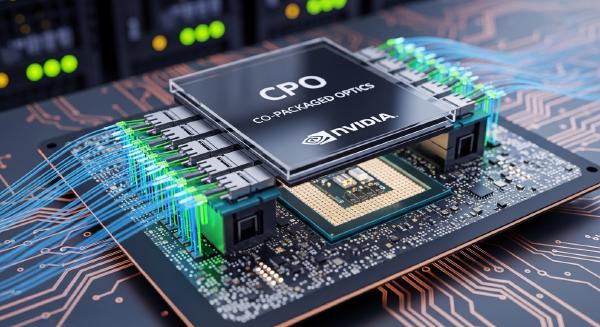
Instead of connecting optics through pluggable modules at the edge of a switch, CPO places optical engines directly alongside the switch ASIC using advanced packaging technologies.
Electrical signal paths are reduced from several centimeters to only a few millimeters.
This fundamental architectural shift dramatically improves signal quality while reducing power consumption.
Typical CPO implementations leverage:
- Silicon photonics
- 2.5D packaging
- 3D integration technologies
- Advanced interposers
- High-density optical engines
The optical and electrical domains effectively become part of a single integrated system.
Key Advantages of CPO #
Exceptional Energy Efficiency #
Because electrical paths are extremely short, signal losses are minimized.
Some implementations achieve energy efficiencies as low as:
- 7 pJ/bit
This can reduce system-level power consumption by 30–50%.
Higher Bandwidth Density #
Removing pluggable cages frees substantial front-panel space.
This enables:
- More ports
- Higher aggregate bandwidth
- Better rack density
Single-package bandwidths exceeding 1.6T are already being targeted.
Superior Signal Integrity #
Short electrical traces dramatically reduce:
- Insertion loss
- Reflection
- Crosstalk
- Equalization requirements
This simplifies operation at extreme data rates.
System-Level Optimization #
Because optics and switching silicon are co-designed, the overall architecture can be optimized for:
- Power delivery
- Thermal efficiency
- Bandwidth scalability
Challenges Facing CPO #
While attractive from a performance perspective, CPO introduces significant operational and manufacturing challenges.
Manufacturing Complexity #
CPO relies on advanced packaging technologies such as:
- Silicon interposers
- Through-Silicon Vias (TSVs)
- Silicon photonics integration
These processes increase manufacturing complexity and cost.
Serviceability Concerns #
Unlike pluggable modules, optical components cannot be replaced individually.
A failed optical engine may require replacement of an entire switch assembly.
Ecosystem Development #
The supply chain remains immature compared to traditional pluggable optics.
Interoperability standards are still evolving.
Thermal Management #
Co-locating optics and high-performance switch silicon creates extremely dense heat concentrations.
Advanced cooling solutions often become mandatory.
📊 CPO vs LPO: Side-by-Side Comparison #
| Category | LPO | CPO |
|---|---|---|
| Architecture | Pluggable Module | Co-Packaged with ASIC |
| DSP Required | No | Typically No |
| Power Consumption | Lower than traditional optics | Lowest overall |
| Latency | Very Low | Extremely Low |
| Hot Swappable | Yes | No |
| Maintenance Simplicity | High | Low |
| Bandwidth Density | Moderate | Very High |
| Manufacturing Complexity | Moderate | Very High |
| Ecosystem Maturity | Emerging | Early Stage |
| Deployment Readiness | Available Today | Gradual Adoption |
🔥 Implications for PCB Designers #
The rise of LPO and CPO is fundamentally reshaping PCB design priorities.
LPO: PCB Design Becomes More Critical #
Without DSP compensation, PCB quality becomes a major determinant of system performance.
Designers must focus on:
- Ultra-low-loss materials
- Tight impedance control
- Precise length matching
- Minimizing discontinuities
- Analog and digital isolation
Popular materials include:
- Megtron 6
- Tachyon 100G
- Other ultra-low-loss laminates
Signal integrity mistakes that might previously have been corrected by a DSP become much harder to tolerate.
CPO: Complexity Moves to Packaging #
For CPO systems, many high-speed signal integrity challenges move off the PCB and into the package.
PCB designers instead focus on:
- Power delivery networks (PDN)
- Thermal architectures
- Cooling integration
- Mechanical support structures
The primary challenge becomes delivering power and removing heat rather than routing ultra-high-speed channels.
❄️ Thermal Management: A Critical Differentiator #
Thermal design strategies differ substantially between the two technologies.
LPO Cooling #
LPO generally requires:
- Traditional airflow cooling
- Standard heatsinks
- Conventional rack thermal designs
Power density remains manageable.
CPO Cooling #
CPO often demands significantly more advanced solutions, including:
- Liquid cooling
- Cold plates
- Microchannel cooling
- Advanced Thermal Interface Materials (TIMs)
Managing localized hotspots becomes one of the most difficult engineering challenges.
🏗️ Deployment Scenarios #
Both technologies address different market needs.
Ideal Applications for LPO #
LPO is well suited for:
- Intra-rack networking
- Short-reach data center interconnects
- AI training clusters
- Cost-sensitive deployments
- Environments requiring easy maintenance
Organizations can deploy LPO while preserving existing operational models.
Ideal Applications for CPO #
CPO excels in:
- Hyperscale AI infrastructure
- Massive GPU clusters
- High-performance computing systems
- Extremely bandwidth-dense networks
- Energy-constrained mega-scale deployments
These environments can justify the added complexity in exchange for maximum efficiency.
📈 Market Outlook #
Industry forecasts suggest that LPO and CPO will coexist for many years rather than one replacing the other.
Several trends are emerging:
- LPO adoption is expected to accelerate rapidly throughout the second half of the decade.
- LPO could capture roughly one-third of the 1.6T optical port market by 2029.
- CPO commercialization is expected to expand significantly between 2026 and 2027.
- The global CPO market could exceed several billion dollars by the early 2030s.
- Silicon photonics adoption will continue increasing across both architectures.
Rather than competing directly, the two technologies are likely to serve different optimization priorities.
🔮 Conclusion #
The debate between CPO and LPO is not about determining a single winner.
Instead, it reflects two distinct approaches to solving the same problem: scaling optical interconnects for the AI era.
LPO offers a practical and evolutionary path forward. It delivers meaningful gains in power efficiency and latency while preserving the flexibility, serviceability, and familiarity of pluggable optics.
CPO, by contrast, represents a transformative redesign of data center networking. By integrating optics directly alongside switching silicon, it achieves unmatched bandwidth density and energy efficiency—but at the cost of significantly greater complexity.
For PCB manufacturers, system architects, and networking vendors, the future will require expertise in both domains. As AI clusters continue expanding toward ever-higher bandwidths, LPO and CPO will likely coexist, each serving the environments where its unique advantages provide the greatest value.
The next decade of AI infrastructure will not be defined by a single optical technology, but by how effectively the industry balances performance, efficiency, cost, and operational flexibility across both approaches.