T-Head Panmai 920: China’s First 400G Smart NIC with PCIe Switch
As large-scale AI training and inference workloads continue to grow, network communication has become one of the most significant bottlenecks limiting cluster-scale computing performance. High-bandwidth, low-latency interconnects are now critical components of modern AI infrastructure, especially in deployments consisting of thousands or even tens of thousands of accelerators.
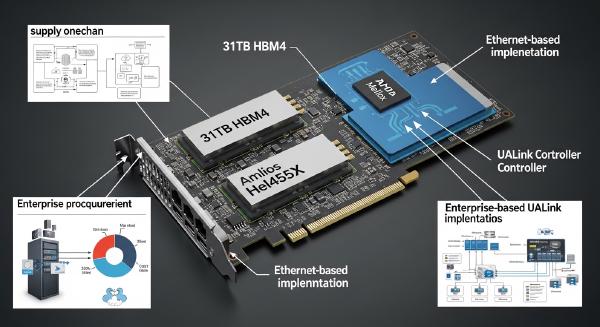
At the 2026 Digital China Construction Summit, Alibaba’s semiconductor division, T-Head, unveiled the Panmai 920, a next-generation 400G Smart NIC that integrates a PCIe Switch directly on the NIC. According to T-Head, this makes the Panmai 920 the first domestically developed 400G Smart NIC in China to incorporate PCIe switching capabilities within the network adapter itself.
Designed for hyperscale AI clusters, general-purpose computing platforms, and high-performance storage systems, the Panmai 920 has already entered mass production and is expected to be deployed initially across Alibaba Cloud data centers.
🚀 Why the Panmai 920 Matters #
The rapid expansion of AI infrastructure has exposed several challenges in traditional server architectures:
- Increasing complexity of GPU interconnect topologies
- Growing dependence on external PCIe switch chips
- Higher hardware costs and power consumption
- Additional latency introduced by multiple switching layers
- Reduced reliability due to increased component count
The Panmai 920 addresses these challenges by combining high-speed networking and PCIe switching functionality into a single device, simplifying server design while improving efficiency and scalability.
⚙️ Panmai 920 Technical Specifications #
| Specification | Details |
|---|---|
| Network Bandwidth | 400 Gbps |
| PCIe Interface | PCIe Gen5 x32 |
| SerDes Technology | 112G PAM4 |
| Network Protocol | High-Throughput Ethernet (ETH+) |
| RDMA Support | Multi-path RDMA |
| Packet Distribution | Packet-level spraying |
| Ecosystem Support | Standard Verbs API compatibility |
| Integrated PCIe Switch | Yes |
🔧 Integrated PCIe Switch Architecture #
One of the most significant innovations of the Panmai 920 is its built-in PCIe Switch.
Traditional AI servers often require separate PCIe switch chips to enable communication among GPUs, SSDs, and network interfaces. While effective, this approach introduces several drawbacks:
- More complex motherboard and server designs
- Additional PCB routing requirements
- Increased latency through extra switching stages
- Higher bill-of-materials (BOM) costs
- More potential hardware failure points
By integrating PCIe switching functionality directly into the NIC silicon, the Panmai 920 enables direct hardware connectivity between:
- GPUs
- SSDs
- Network interfaces
This significantly shortens internal data paths and reduces the number of components required within the server.
According to T-Head’s disclosed performance data:
- Overall hardware BOM costs can be reduced by approximately 30%
- Internal server failure points can be reduced by roughly 40%
These improvements are particularly valuable in hyperscale AI deployments where infrastructure efficiency directly impacts operational costs and cluster reliability.
🌐 High-Performance Ethernet and RDMA Capabilities #
The Panmai 920 is built around a high-throughput Ethernet architecture that combines standard IEEE 802.3 MAC functionality with T-Head’s enhanced ETH+ networking technology.
Key networking capabilities include:
Multi-Path RDMA #
The NIC supports multi-path RDMA communication, allowing traffic to be distributed across multiple network paths simultaneously. This improves both bandwidth utilization and resilience.
Packet-Level Spraying #
Packet-level spraying distributes network packets dynamically across available paths, helping eliminate hotspot formation and improving load balancing in large-scale clusters.
Single QP Multi-Port Transmission #
The architecture allows a single Queue Pair (QP) to transmit traffic across multiple physical ports, increasing flexibility and maximizing network resource utilization.
Selective Retransmission #
Selective retransmission mechanisms improve network efficiency by retransmitting only affected packets instead of entire data streams, reducing recovery overhead and latency.
🏗️ Designed for Large-Scale AI Clusters #
Modern AI training clusters can consist of thousands of GPUs connected through high-speed fabrics. As model sizes and distributed training requirements continue to increase, networking infrastructure must scale without becoming a bottleneck.
The Panmai 920 targets several demanding deployment scenarios:
- 10,000+ GPU AI training clusters
- Large-scale inference platforms
- High-performance computing (HPC) systems
- Distributed storage infrastructures
- Cloud-scale data centers
Its combination of 400Gbps networking, integrated PCIe switching, and advanced RDMA capabilities positions it as a critical component for next-generation AI infrastructure.
🔄 Ecosystem Compatibility #
A common challenge for new networking hardware is software ecosystem adoption. To minimize deployment barriers, the Panmai 920 supports standard Verbs interfaces, allowing existing RDMA applications and frameworks to operate with minimal modification.
This compatibility helps organizations integrate the NIC into existing environments while preserving investments in software, tools, and operational workflows.
📈 Strategic Importance for T-Head #
The launch of the Panmai 920 represents more than a new networking product. It demonstrates T-Head’s continued expansion across key infrastructure domains, including:
- Compute acceleration
- High-speed networking
- Data center storage
- AI cluster architecture
By combining these technologies into a cohesive platform strategy, T-Head is strengthening its position within China’s rapidly evolving AI and cloud computing ecosystem.
🏁 Conclusion #
The T-Head Panmai 920 introduces a notable architectural innovation by combining a 400Gbps Smart NIC with an integrated PCIe Switch. This design reduces hardware complexity, lowers deployment costs, and improves reliability for large-scale AI infrastructure.
As AI clusters continue to grow in size and networking demands become increasingly challenging, solutions that tightly integrate networking and interconnect technologies will play a critical role in maximizing system efficiency. With mass production underway and deployment planned across Alibaba Cloud data centers, the Panmai 920 represents an important step toward more scalable and cost-effective AI infrastructure.