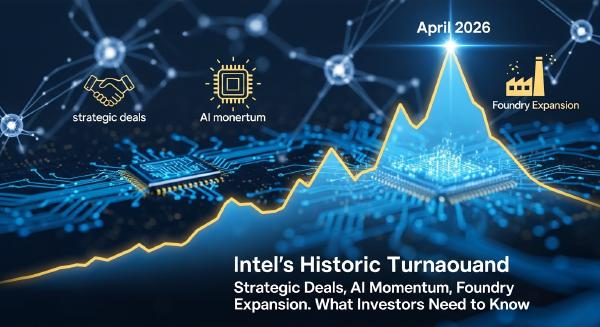
Intel 14A and Terafab: A New Era for AI Manufacturing
As of April 22, 2026, the semiconductor industry has been shaken by a major announcement: Elon Musk confirmed that his ambitious Terafab project will adopt Intel’s 14A (1.4nm-class) process node.
This decision positions Intel’s most advanced manufacturing technology at the center of next-generation systems spanning:
- AI infrastructure
- Robotics (Optimus)
- Space computing (SpaceX)
More importantly, it marks the first confirmed anchor customer for Intel’s 14A node—transforming it from a roadmap promise into a commercial reality.
🚀 What is Intel 14A? #
Intel 14A is the successor to the 18A node and represents a critical milestone in Intel’s push to reclaim process leadership.
It is also the first node designed for full-scale High-NA EUV lithography deployment.
Key Improvements vs. Intel 18A #
| Metric | Improvement |
|---|---|
| Performance | +15–20% |
| Transistor Density | ~30% increase |
| Power Efficiency | 25–35% lower power |
| Core Technologies | High-NA EUV + PowerVia |
Why It Matters #
- High-NA EUV enables finer patterning beyond traditional EUV limits
- PowerVia (Backside Power Delivery) improves power integrity and reduces IR drop
- Combined, they unlock higher frequency scaling with better efficiency
This node is designed not just for performance—but for energy-constrained AI systems.
🏭 Terafab: The $25 Billion AI Factory Vision #
Terafab is not a single chip—it is a vertically integrated AI manufacturing ecosystem based in Austin, Texas.
Musk’s Vision #
- Target output: 1 terawatt of compute annually
- Focus areas:
- AI training clusters (Dojo)
- Autonomous systems (FSD)
- Humanoid robotics (Optimus)
Deployment Strategy #
-
Pilot Line (~$3B)
Tesla will operate an experimental manufacturing line to validate new processes and designs. -
Volume Production
SpaceX is expected to scale production—potentially through collaboration or licensing with Intel.
Long-Term Outlook #
By the late 2020s, Terafab is expected to:
- Reach massive production scale
- Leverage a mature 14A node
- Support millions of edge AI devices and large-scale training infrastructure
📈 Why This Is a Breakthrough for Intel Foundry #
Intel’s IDM 2.0 strategy has long depended on attracting external customers. This deal changes the narrative.
Key Impacts #
-
Validation of Foundry Model
A high-demand customer like Musk’s ecosystem forces Intel to:- Improve yield
- Mature EDA toolchains
- Optimize for third-party designs
-
Demonstration Effect
If Tesla successfully transitions advanced AI silicon to Intel:- Other hyperscalers (Amazon, Microsoft, Meta) may follow
- Confidence in Intel Foundry Services increases significantly
-
Market Confidence
The announcement immediately boosted investor sentiment, signaling renewed belief in Intel’s manufacturing roadmap.
⚙️ Technical Synergy: Why 14A Fits Tesla’s Needs #
Musk highlighted that timing and efficiency make 14A the right choice.
1. Power Efficiency for Edge AI #
- FSD systems and robots operate under strict power constraints
- A 25–35% power reduction directly translates to:
- Longer battery life
- Lower thermal requirements
2. Backside Power Delivery (PowerVia) #
- Reduces voltage drop across the chip
- Enables:
- Higher clock speeds
- More stable high-performance operation
This is especially important for video-based AI training and inference, where sustained throughput is critical.
3. Advanced Packaging (Foveros Direct) #
Intel is expected to pair 14A with Foveros Direct:
- Direct die-to-die stacking
- Ultra-high bandwidth between logic and memory
- Reduced latency compared to traditional interconnects
This enables:
- Faster AI model execution
- More compact, high-performance designs
🌎 Strategic Implications: A US-Centric Shift #
The Intel–Musk alliance signals more than a technology decision—it reflects a broader geopolitical and industrial realignment.
What’s Changing #
- Increased focus on domestic semiconductor manufacturing (USA)
- Reduced reliance on overseas mega-fabs
- Emergence of integrated AI manufacturing ecosystems
Competitive Outlook #
If Terafab scales successfully:
- It could rival the output of leading Asian foundries
- Intel could re-enter the top tier of manufacturing leadership
- The industry may shift toward regionally distributed advanced fabs
🔮 Final Takeaway #
The adoption of Intel 14A by Terafab represents a pivotal moment:
- Intel gains a high-profile validation of its most advanced node
- AI hardware development becomes tightly coupled with manufacturing innovation
- The industry moves toward vertically integrated “AI factories”
By the time 14A matures in 2026–2027, Terafab could become a cornerstone of next-generation computing—reshaping both the technology stack and the global semiconductor landscape.