Google TPU v8: The End of General-Purpose AI Accelerators
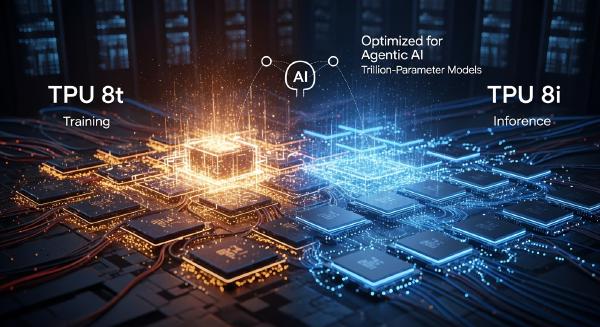
As of April 23, 2026, Google’s eighth-generation TPU (v8) marks a turning point in AI infrastructure design.
By splitting the architecture into:
- TPU 8t (Sunfish) → training
- TPU 8i (Zebrafish) → inference
Google has effectively ended the era of the general-purpose AI accelerator, replacing it with workload-specific silicon optimized for each phase of the AI lifecycle.
🚀 The Great Decoupling: Training vs. Inference #
Modern AI workloads have diverged:
- Training → requires massive throughput and scalability
- Inference → demands low latency, high concurrency, and efficiency
Google’s TPU v8 addresses this split directly.
TPU 8t (Sunfish): The Training Behemoth #
Co-designed with Broadcom, TPU 8t focuses on extreme-scale training.
Key Innovations #
-
Dual-Compute Chiplet Architecture
Separate compute dies paired with a dedicated I/O die improve scalability and efficiency. -
Massive Pod Scale
Up to 9,600 chips per pod, delivering 121 Exaflops (FP4)—roughly a 3× leap over TPU v7 (Ironwood). -
Virgo Network
Enables near-linear scaling across clusters of up to 1 million chips, redefining distributed training limits. -
TPUDirect Data Path
RDMA and storage bypass CPU bottlenecks, significantly improving dataset throughput.
👉 TPU 8t is designed for frontier model training at unprecedented scale.
TPU 8i (Zebrafish): The Inference Specialist #
Co-designed with MediaTek, TPU 8i is optimized for real-time AI systems.
Key Innovations #
-
Memory Wall Breakthrough
With 384MB on-chip SRAM (3× increase), large KV caches remain on-chip—minimizing latency. -
Boardfly Topology
Reduces network diameter by ~50%, enabling faster communication for:- Mixture-of-Experts (MoE) models
- Multi-agent systems
-
Efficiency Leadership
- +80% performance-per-dollar
- +117% performance-per-watt vs TPU v7
👉 TPU 8i targets high-throughput, low-latency inference at global scale.
⚙️ TPU 8t vs. TPU 8i: Side-by-Side #
| Feature | TPU 8t (Sunfish) | TPU 8i (Zebrafish) |
|---|---|---|
| Primary Role | Pre-training | Inference & agentic workloads |
| Precision | Native FP4 / FP8 | Optimized for decoding |
| HBM Capacity | 216 GB HBM3e | 288 GB HBM3e |
| On-Chip SRAM | 128 MB | 384 MB |
| Network Topology | 3D Torus | Boardfly |
| Process Node | TSMC 2nm | TSMC 2nm |
| Cooling | 4th Gen Liquid | 4th Gen Liquid |
The distinction is clear:
- 8t = scale and throughput
- 8i = latency and efficiency
🧑💻 Software Strategy: Opening the TPU Ecosystem #
Historically, TPUs were limited by a relatively closed software stack. TPU v8 changes this with a strong developer-first approach.
Key Changes #
-
Native PyTorch 2.x Support
Eliminates friction fromtorch_xla, enabling seamless use with:- Hugging Face
- Standard ML workflows
-
Pallas Programming Model
A high-level language that allows developers to:- Control on-chip memory (scratchpad)
- Build hardware-aware kernels
- Optimize reasoning and reflection workloads
This shift lowers the barrier to entry and makes TPUs far more accessible to mainstream developers.
📊 Market Context: Redefining Competitive Dynamics #
The TPU v8 launch builds on momentum from late 2025.
Key Developments #
-
Gemini 3 Validation
Google demonstrated that fully TPU-based training can match or exceed GPU clusters. -
Industry Shockwaves
Reports of hyperscalers exploring TPU adoption triggered:- Significant market volatility
- Revaluation of AI infrastructure strategies
-
Full-Stack Independence
With custom Axion ARM CPUs integrated into the TPU stack, Google now controls:- Compute
- Networking
- Software
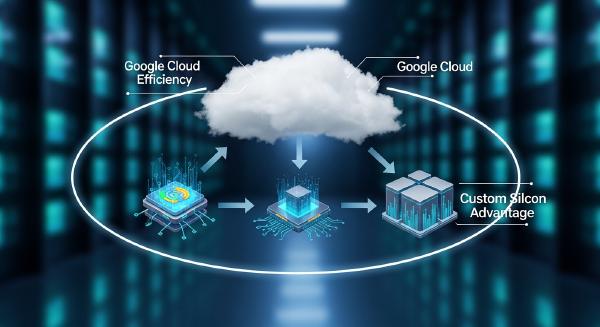
👉 This reduces reliance on external vendors and strengthens vertical integration.
🔮 Final Takeaway: From Chips to AI Factories #
TPU v8 represents more than a hardware upgrade—it’s a paradigm shift:
- AI infrastructure is now task-specialized
- Efficiency matters as much as raw compute
- Systems are designed as end-to-end intelligence pipelines
After an 11-year journey from its early TPU prototypes, Google has arrived at a new model:
The TPU is no longer just a processor—it is an automated production line for intelligence.
In 2026, the future of AI hardware isn’t general-purpose—it’s precisely engineered for every stage of the AI lifecycle.