Nvidia AI Server Prices Could Rise 15%+ on Memory Shortage
Nvidia’s next generation of AI infrastructure could become significantly more expensive as surging memory costs force higher prices for complete accelerator systems.
Nvidia has reportedly notified major customers and server OEM partners that systems containing its flagship AI accelerators could see price increases of more than 15% beginning in early 2027. The increases are primarily attributed to the global shortage of high-bandwidth memory (HBM) and server DRAM.
The impact extends across both current-generation Grace Blackwell platforms and the upcoming Vera Rubin architecture.
For hyperscalers building massive AI clusters, the increase is more than a component-cost issue. Higher accelerator-system prices directly increase data-center capital expenditure, potentially adding billions of dollars to the cost of building gigawatt-scale AI infrastructure.
💰 Nvidia AI Server Prices Could Increase 15%–17% #
According to reports from Bloomberg and industry sources, server OEMs supplying major cloud companies—including Microsoft, Google, AWS, and Oracle—have begun communicating price increases in the range of 15% to 17%, depending on accelerator generation and memory configuration.
The affected systems reportedly include:
- Grace Blackwell 300 platforms
- Vera Rubin 200 platforms
- Large-scale NVL72 rack configurations
- Systems with high HBM and server-memory requirements
A 72-GPU Vera Rubin rack that previously carried an estimated price of approximately $7 million could approach $8 million under the reported increases.
Nvidia’s margin structure #
Nvidia operates with exceptionally high gross margins, reportedly around 75%.
Rather than absorbing the entire increase in memory and component costs, the company is reportedly passing a substantial portion of those expenses through to enterprise and hyperscale customers.
For smaller systems, a double-digit price increase may be manageable. At hyperscale, however, even a few percentage points can translate into hundreds of millions or billions of dollars in additional infrastructure spending.
🧠 HBM Shortage Is the Primary Cost Driver #
The central problem is not the GPU itself.
It is the amount of memory required to build modern AI accelerators.
High-bandwidth memory has become a critical component of AI infrastructure because large language models require enormous memory bandwidth to keep compute accelerators fed with data.
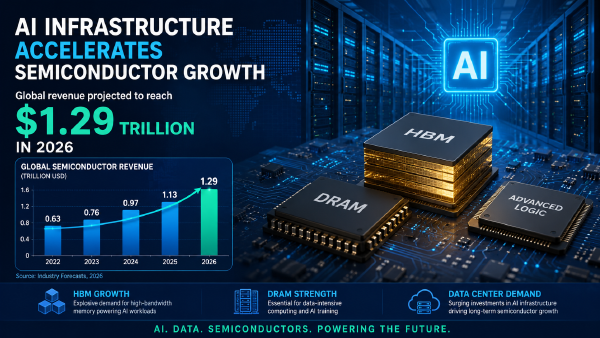
The combination of rapidly increasing AI accelerator shipments and extremely large memory footprints has created an unprecedented demand cycle for HBM.
HBM capacity is increasingly constrained #
The three major memory manufacturers—SK Hynix, Samsung, and Micron—have reportedly committed most of their available HBM production capacity for 2026.
Industry executives have also warned that memory supply constraints could persist well beyond 2027 and potentially extend toward the end of the decade.
This creates a structural challenge for AI infrastructure manufacturers: accelerator production cannot scale independently of the availability of advanced memory.
HBM consumes significantly more wafer capacity #
HBM is substantially more resource-intensive to manufacture than conventional commodity DRAM.
Producing a comparable amount of HBM can require several times the wafer capacity associated with conventional DRAM, depending on the generation and manufacturing process.
As memory manufacturers redirect fabrication capacity toward higher-margin HBM products, less capacity remains available for conventional server DRAM.
The resulting supply imbalance can push up prices across the broader memory market.
🧩 Vera Rubin’s Massive Memory Footprint #
The Vera Rubin platform illustrates why memory has become such a significant component of AI-system economics.
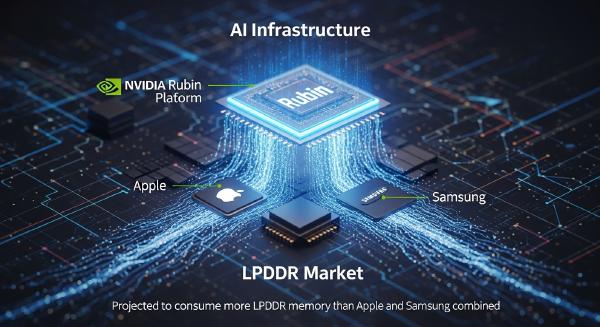
A next-generation Vera Rubin package can incorporate up to 288GB of HBM4, while additional LPDDR memory is associated with the Vera CPU platform.
At the rack level, an NVL72 configuration can therefore contain more than 20TB of high-speed memory.
This enormous memory footprint means that even modest increases in HBM pricing can have a material impact on the final system cost.
Memory is becoming a first-order AI infrastructure constraint #
Historically, discussions about AI accelerator costs focused primarily on GPU compute capacity.
That equation is changing.
The economics of a modern AI server increasingly depend on the complete memory subsystem, including:
- HBM capacity
- HBM bandwidth
- HBM generation
- DRAM availability
- CPU-attached memory
- Advanced packaging
- Interconnects
- Memory power consumption
As accelerator performance increases, memory must scale alongside it. This makes HBM supply a strategic constraint on the entire AI infrastructure market.
📈 Server DRAM Prices Are Also Rising #
The HBM boom is creating a secondary effect across the broader memory market.
Because HBM production requires substantial wafer capacity, reallocating manufacturing resources toward HBM reduces the supply available for conventional server DRAM.
Contract prices for server memory have reportedly increased by more than 50% year over year in some segments.
This creates a compounding cost effect for AI servers.
The system builder is not simply paying more for HBM attached to the accelerator. Other memory components throughout the server can also become more expensive as the same semiconductor manufacturing capacity is redirected toward AI-specific memory products.
🏢 Billions of Dollars at Data-Center Scale #
The impact becomes much larger when viewed through the economics of hyperscale AI infrastructure.
| Metric / Domain | Estimated Impact |
|---|---|
| 1GW Data Center | Server hardware estimated at approximately $21.2B of a ~$37.9B total build |
| 15% Server-Cost Increase | Potentially billions in additional upfront capital expenditure |
| Big Tech 2026 CapEx | Approximately $730B across Microsoft, Amazon, Google, Meta, and Oracle |
| Vera Rubin Efficiency | Potentially up to 10× lower inference cost per token |
| AI Infrastructure Effect | Higher upfront capital requirements despite better compute efficiency |
Epoch AI estimates that server hardware represents approximately $21.2 billion of the cost of a 1GW data center with an overall cost of roughly $37.9 billion.
A 15% increase in server hardware costs would therefore create an enormous additional capital requirement at this scale.
The exact incremental cost depends on the configuration, but the underlying conclusion is straightforward: memory inflation can materially change the economics of large AI infrastructure projects.
⚖️ Efficiency Gains vs. Rising Capital Costs #
Vera Rubin is designed to substantially improve AI inference economics.
Nvidia has positioned the platform as capable of delivering dramatically lower cost per token compared with previous generations, with potential improvements of up to 10× in certain inference scenarios.
However, lower operating cost does not eliminate the initial capital barrier.
AI infrastructure operators increasingly face two competing economic forces:
Higher upfront investment → lower long-term cost per token
This favors companies capable of financing enormous infrastructure projects and operating the systems at high utilization.
For customers with sufficient workloads, improved inference efficiency can justify higher hardware prices over the lifetime of the infrastructure.
🏦 The AI Market Could Become More Capital Intensive #
Rising accelerator and memory prices could accelerate the divide between large technology companies and smaller AI organizations.
Hyperscalers such as Microsoft, Amazon, Google, Meta, and Oracle have the balance sheets and financing capacity required to absorb major infrastructure investments.
Smaller AI startups face a different economic reality.
Hyperscalers #
Large cloud providers can spread infrastructure costs across enormous customer bases and workloads.
They can also negotiate directly with Nvidia, memory manufacturers, and server OEMs, potentially securing long-term supply agreements.
AI startups #
Smaller companies generally lack the purchasing power and capital required to build comparable infrastructure independently.
As accelerator prices and memory costs rise, these organizations may become increasingly dependent on cloud providers rather than owning large GPU clusters themselves.
This could reinforce the concentration of AI infrastructure around a relatively small number of hyperscale operators.
🌐 Memory Supply Is Becoming a Strategic AI Constraint #
The reported Nvidia price increases highlight a broader structural issue in the AI semiconductor market.
The limiting factor for AI infrastructure is no longer simply how many GPUs manufacturers can produce. Modern accelerators require enormous quantities of specialized memory, advanced packaging, high-speed interconnects, and supporting server components.
HBM has consequently become a strategic resource.
If memory manufacturers cannot expand production quickly enough, the resulting shortage can propagate through the entire AI infrastructure stack—from semiconductor fabrication and packaging to complete server systems and data-center construction.
🚀 What the Price Increase Means for AI Infrastructure #
Nvidia’s reported 15%–17% system price increases illustrate the growing economic tension within the AI hardware market.
Accelerators are becoming dramatically more capable and potentially more efficient on a per-token basis, but each generation also demands more advanced memory, packaging, and infrastructure.
For Nvidia’s Grace Blackwell and Vera Rubin platforms, the cost of that hardware evolution is increasingly being reflected in system-level pricing.
The long-term outcome will depend on whether memory manufacturers can expand HBM and DRAM capacity fast enough to satisfy AI demand.
Until then, the AI industry faces an unusual contradiction: the cost of computation per token may fall rapidly while the cost of building the infrastructure required to deliver that computation continues to rise.