NVIDIA FY2027 Q3: Vera Rubin Shipments and Supply Chain Expansion
NVIDIA released its FY2027 third-quarter financial results on November 17, 2026, alongside a new round of supply chain commitments. The results show that demand for AI infrastructure remains exceptionally strong: Data Center revenue reached $107.6 billion, Vera Rubin NVL72 systems began volume shipments, and NVIDIA raised its fourth-quarter revenue outlook to $130 billion.
But the more interesting development is happening beyond GPU production. NVIDIA is expanding capacity across ABF substrates, advanced packaging, semiconductor testing, optical engines, and complete system manufacturing. These investments address a growing challenge: delivering an AI factory requires far more than producing enough GPU dies. Every stage—from wafer fabrication and package assembly to networking and rack integration—must scale at a compatible rate.
NVIDIA’s approach relies on long-term supplier agreements, prepayments, multibillion-dollar funding commitments, and dedicated production capacity. The objective is to secure manufacturing resources across several platform generations rather than compete for available capacity every time a new product enters production.
📊 Data Center Remains NVIDIA’s Main Growth Engine #
NVIDIA reported $115.8 billion in total revenue for FY2027 Q3, compared with $57.0 billion in the same quarter a year earlier and $96.2 billion in the preceding quarter.
That represents 103% year-over-year growth and 20% sequential growth. Operating income increased 115% year-over-year, while GAAP operating expenses rose 57%. Revenue is therefore growing considerably faster than the company’s operating expense base, producing strong operating leverage.
The segment breakdown makes the source of that growth clear:
| Business Segment | Q3 FY2027 Revenue | Quarter-over-Quarter | Year-over-Year |
|---|---|---|---|
| Data Center | $107.6 billion | +21% | +110% |
| Edge Computing | $8.2 billion | +14% | +42% |
| Total | $115.8 billion | +20% | +103% |
Data Center contributed approximately 93% of total revenue. Its 110% year-over-year growth also exceeded both company-wide growth of 103% and Edge Computing growth of 42%.
The sequential increase tells a similar story. NVIDIA added approximately $19.6 billion in revenue compared with the previous quarter. Data Center’s 21% sequential growth outpaced Edge Computing’s 14%, making it the primary contributor to the latest expansion.
This is not a case of every business line growing at the same rate. NVIDIA’s revenue growth is increasingly concentrated in large-scale AI infrastructure.
What NVIDIA Includes in Edge Computing #
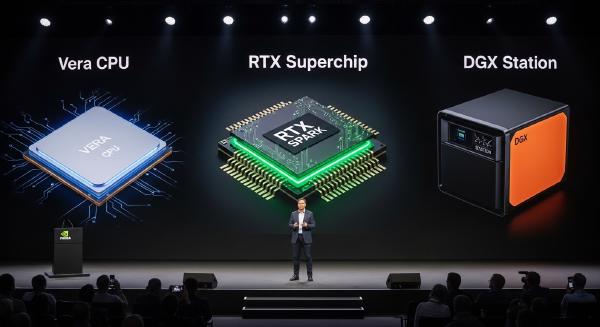
The Edge Computing category is broader than traditional PC gaming. NVIDIA’s Q3 reporting places several different product areas under this heading, including RTX Spark laptops, GeForce products, DGX Spark local AI systems, autonomous-driving platforms, robotics, and AI-RAN infrastructure.
The quarter’s announcements also covered:
- RTX Spark laptops from ASUS, Dell, HP, Lenovo, Microsoft Surface, and MSI.
- GeForce RTX 50 Series features and GeForce NOW.
- A new 64GB DGX Spark desktop AI system.
- Autonomous-driving development tools and partnerships with Mercedes-Benz and Volvo.
- Isaac robotics tools and Jetson Thor platforms.
- Cosmos world-model development.
- AI-RAN deployments with Nokia and telecom operators.
This broader category makes it harder to isolate the contribution from traditional gaming hardware using the headline segment figure alone. It also reflects NVIDIA’s effort to extend accelerated computing beyond hyperscale data centers into PCs, local AI, robotics, vehicles, and telecommunications.
Vera Rubin NVL72 Enters Volume Shipments #
The most significant product milestone is the start of volume shipments for Vera Rubin NVL72 and Vera CPUs.
NVIDIA describes Vera Rubin NVL72 as the fastest product ramp in its history. During Q3, racks were already operating at several cloud and infrastructure partners:
- CoreWeave
- Google Cloud
- Microsoft Azure
- Oracle Cloud Infrastructure (OCI)
- Nebius
The cloud rollout is also progressing. Vera Rubin NVL72 systems and Vera CPUs became generally available on OCI, while Google Cloud introduced its Vera Rubin-powered A5X instances.
Beyond the NVL72 system, NVIDIA announced a rack-scale Vera CPU platform for high-performance computing and introduced Rubin HPC for scientific modeling, simulation, and data processing. Its DSX POD reference design extends the platform further by providing a blueprint for complete Vera Rubin AI factories that partners can integrate and validate before delivery.
The direction is clear: NVIDIA is selling increasingly complete infrastructure platforms rather than treating the GPU as an isolated component. CPUs, GPUs, networking, racks, and facility-level designs are becoming parts of one coordinated system.
Margins, Operating Expenses, and Q4 Guidance #
Despite rapid expansion, NVIDIA’s gross margins remain high.
| Financial Metric | Q3 FY2027 |
|---|---|
| GAAP gross margin | 74.8% |
| Non-GAAP gross margin | 74.9% |
| GAAP operating expenses | $9.2 billion |
| GAAP operating income | $77.5 billion |
| Non-GAAP operating income | $77.9 billion |
GAAP gross margin declined slightly from 75.0% in the previous quarter but improved by 1.4 percentage points year-over-year. Operating income grew 115% year-over-year, faster than revenue growth of 103%.
For Q4 FY2027, NVIDIA expects:
- Revenue of $130 billion, plus or minus 3%.
- GAAP and non-GAAP gross margins between 71% and 72%.
- GAAP operating expenses of approximately $11.0 billion.
- Non-GAAP operating expenses of approximately $10.7 billion.
The fourth quarter includes an additional fiscal week. NVIDIA also stated that its outlook assumes no Data Center compute revenue from China. The published guidance should therefore be read with that geographic exclusion in mind.
The lower projected gross margin range and higher operating expenses suggest that rapid growth will require continued spending and manufacturing investment. The margin outlook is not a direct measure of any single supply constraint, but it shows that scaling production does not automatically preserve the previous quarter’s profitability.
A Change to NVIDIA’s Non-GAAP Reporting #
There is also an accounting detail worth keeping in mind when comparing current and historical results.
Beginning in FY2027 Q1, NVIDIA’s non-GAAP financial measures no longer exclude stock-based compensation (SBC). Historical non-GAAP figures have been updated to include SBC as well.
The company continues to adjust for items such as acquisition-related costs, legal settlements, and gains or losses from equity securities. This reporting change matters when comparing NVIDIA’s current non-GAAP results with figures published before FY2027. The updated historical numbers provide a more consistent basis for comparison.
Share Repurchases #
NVIDIA’s board approved an additional $150 billion share repurchase authorization in September 2026, with no expiration date.
During Q3, the company returned $28.1 billion to shareholders through share repurchases and cash dividends. Approximately $227.3 billion remained under the authorization at quarter-end.
These figures show the scale of NVIDIA’s cash generation, even as the company commits substantial resources to manufacturing capacity and its next platform generations.
The full financial results are available in NVIDIA’s FY2027 Q3 earnings release.
🏭 Expanding Advanced Packaging and System Manufacturing #
The supply chain announcement released alongside the earnings report is arguably as significant as the revenue figures.
NVIDIA is expanding manufacturing capacity across several stages, including substrates, advanced packaging, wafer fabrication, and contract manufacturing. The November 17 announcement names Amkor, Foxconn, Kinsus Interconnect Technology, Samsung Electro-Mechanics, Siliconware Precision Industries (SPIL), and TSMC as key partners.
The investments are intended to support both current accelerated-computing products and future platform generations.
Mapping the Supply Chain #
Different manufacturing stages perform different jobs. A shortage at any one of them can delay complete accelerator systems, even when the other components are available.
| Supply Chain Stage | Role in AI Hardware | Highlighted Vendors / Partners |
|---|---|---|
| Wafer fabrication | Produces CPU, GPU, and other silicon dies | TSMC |
| Packaging substrates | Routes power and signals between chip packages and system boards | Kinsus, Samsung Electro-Mechanics, IBIDEN, Unimicron |
| Advanced packaging | Integrates compute dies, HBM, and other components | TSMC, Amkor, ASE / SPIL |
| Semiconductor testing | Validates chip and package functionality, performance, and reliability | KYEC, ASE / SPIL |
| Optical engines | Supports high-speed optical interconnects and networking | SPIL |
| System manufacturing | Produces GPU systems, networking platforms, and AI infrastructure | Foxconn |
The November announcement adds new commitments at several stages, while earlier agreements announced in October provide additional detail about testing and optical-engine capacity.
ABF Substrates: Kinsus and Samsung Electro-Mechanics #
One of the clearest capacity targets comes from Kinsus Interconnect Technology.
Under its new agreement with NVIDIA, Kinsus plans to expand advanced ABF package-substrate capacity dedicated to NVIDIA by more than 3.5 times its current level at its Youth campus in Taoyuan, Taiwan.
The expansion is scheduled to begin production in the second half of 2027, with the additional capacity targeted for the third quarter of 2028.
ABF substrates sit between the semiconductor package and the system PCB. They provide the dense electrical connections needed to carry power and signals between the chip package and the rest of the system.
As AI accelerators grow in package size and complexity, substrate requirements become more demanding:
- Higher routing density for large numbers of signals.
- More layers to accommodate complex electrical connections.
- Larger package dimensions.
- Higher power-delivery requirements.
- Tighter reliability and manufacturing-yield requirements.
This makes substrates a potential production bottleneck. Even if GPU dies and advanced packaging capacity are available, insufficient substrate supply can still delay completed products.
Samsung Electro-Mechanics is also expanding its collaboration with NVIDIA. The companies amended an existing substrate supply agreement to improve operational capacity at current factories. The work builds on earlier multiyear agreements covering compute and high-speed networking substrates in Sejong and Busan, South Korea.
These commitments extend NVIDIA’s earlier relationships with IBIDEN and Unimicron, which are also investing in advanced substrate manufacturing.
Advanced Packaging: Amkor and SPIL #
Advanced packaging is another major focus.
NVIDIA is supporting Amkor as it expands advanced packaging capacity in Arizona and South Korea. The multiyear agreements announced in July and October 2026 total nearly $3 billion and include prepayments to support manufacturing expansion.
These commitments are designed to serve several generations of AI platforms rather than a single product launch.
NVIDIA and SPIL, meanwhile, have entered a multiyear agreement backed by multibillion-dollar funding to expand advanced packaging operations in Taiwan. The additional contracted capacity dedicated to NVIDIA is targeted for mid-2029.
The SPIL project includes production capabilities spanning:
- Bumping.
- Interposer wafer fabrication.
- Package assembly.
- Testing.
These processes support products with demanding requirements for bandwidth, computing performance, power efficiency, and system integration.
The distinction between wafer fabrication and advanced packaging is important. A leading-edge process node produces the silicon dies, while advanced packaging brings those dies and other components together into a high-bandwidth package. Neither replaces the other; both are required to build modern AI accelerators.
TSMC, Vera Rubin, and CoWoS #
NVIDIA confirmed that Vera Rubin NVL72 and Vera CPUs began volume shipments in Q3 using TSMC’s 5nm and 3nm process technologies alongside CoWoS advanced packaging.
CoWoS enables high-density integration of compute silicon and other components, including high-bandwidth memory. It helps address the bandwidth, power-efficiency, and integration requirements of large AI accelerator packages.
This is why NVIDIA’s manufacturing strategy cannot focus on GPU wafer capacity alone. Increasing the number of compute dies is only one part of the production equation. Those dies must also be packaged, connected, tested, and integrated into complete systems.
Semiconductor Testing and Optical Engines #
NVIDIA’s October 21 supply chain announcement also outlined capacity targets for semiconductor testing and optical engines.
The company plans to:
- Double semiconductor testing capacity between 2026 and 2027.
- Increase SPIL optical-engine capacity by 15 times by mid-2027.
- Double optical-engine capacity again by the end of 2028.
Testing capacity is essential as accelerator shipments increase. Each die and completed package must pass functional and reliability checks before entering a production system. A shortage of test equipment or qualified test capacity can delay shipments even when fabrication and packaging are progressing as planned.
Optical engines address a different requirement: moving large amounts of data between GPUs, switches, and other infrastructure components. As AI clusters scale, network bandwidth and power consumption become increasingly important system-level constraints.
The October announcement also included King Yuan Electronics (KYEC), which plans to expand semiconductor testing operations, including new facilities in the United States. NVIDIA announced a $1.1 billion capacity-reservation advance to support KYEC’s expansion.
These are earlier commitments, not all newly announced on November 17. Taken together, however, the October and November agreements show how NVIDIA is coordinating capacity across more of the manufacturing chain.
Foxconn and Complete System Manufacturing #
At the system level, Foxconn is deepening its collaboration with NVIDIA on next-generation GPU and networking platforms.
Foxconn’s manufacturing network spans Asia, North America, and Europe. That footprint can support the transition from initial product shipments to larger production volumes while accommodating different regional delivery requirements.
This stage is especially important for rack-scale systems such as Vera Rubin NVL72. A complete AI platform requires more than assembled GPUs: it also needs CPUs, networking equipment, power infrastructure, cooling systems, racks, and integration testing.
Foxconn’s role connects semiconductor supply with the production of finished infrastructure.
The full partner announcement is available in NVIDIA’s November 17 supply chain update. The earlier October 21 capacity announcement provides additional details on testing, optical engines, and substrate expansion.
🔍 What the Supply Chain Investments Tell Us #
The most important takeaway from NVIDIA’s latest announcements is that AI infrastructure production is becoming a coordinated manufacturing problem.
For earlier accelerator generations, discussions often focused on GPU availability and leading-edge wafer capacity. Those remain important, but the manufacturing chain is much broader:
- Wafer fabrication produces the compute dies.
- ABF substrates provide dense electrical connections between packages and system boards.
- Advanced packaging integrates compute dies, memory, and other components.
- Semiconductor testing verifies that dies and packages meet production requirements.
- Optical engines and networking connect processors across large systems.
- System manufacturing integrates the components into deployable AI infrastructure.
A shortage at any stage can restrict final system output. Expanding one part of the chain without increasing the others may simply move the bottleneck downstream.
NVIDIA’s agreements address this problem through a combination of long-term supply commitments, prepayments, dedicated capacity, and direct funding support. The arrangements also extend across multiple platform generations, giving suppliers more visibility into future demand and a stronger basis for investing in facilities and equipment.
There is a broader strategic implication. NVIDIA is not only securing enough manufacturing capacity for Vera Rubin. It is trying to establish a supply foundation that can support subsequent accelerated-computing platforms as AI infrastructure demand continues to expand.
Vera Rubin NVL72’s first volume shipments mark an important production milestone. The supplier agreements show what has to happen next: substrates, packaging, testing, optics, and complete systems must all scale together if NVIDIA is to turn strong demand into sustained delivery growth.