NVIDIA Q2 FY2027 Revenue Hits $96.22B as AI Demand Surges
NVIDIA’s artificial intelligence infrastructure business continued to accelerate in the second quarter of fiscal year 2027, pushing quarterly revenue to $96.22 billion and bringing the company within striking distance of a $100 billion quarterly revenue milestone.
Revenue increased 106% year over year and 18% sequentially, while GAAP net income reached $59.69 billion, up 126% year over year. Data Center remained the dominant business, generating approximately $89 billion and accounting for more than 92% of total quarterly revenue.
The results reflect several converging trends: continued hyperscaler capital expenditure, rapidly expanding AI inference workloads, the transition to the Vera Rubin platform, increasing demand from enterprise and sovereign AI customers, and growing revenue density per gigawatt of deployed data-center capacity.
At the same time, NVIDIA’s growth is increasingly constrained by the physical supply chain. Memory, wafers, power, racks, and data-center capacity are becoming limiting factors as customer demand continues to exceed the company’s ability to deliver.
📊 Record Revenue and Profit Growth #
NVIDIA reported the following results for Q2 of fiscal year 2027:
| Metric | Q2 FY2027 | YoY Change | QoQ Change |
|---|---|---|---|
| Revenue | $96.22B | +106% | +18% |
| GAAP Net Income | $59.69B | +126% | +2% |
| Data Center Revenue | ~$89B | +117% | +18% |
| Edge Computing Revenue | $7.20B | +27% | +13% |
For the first half of FY2027, NVIDIA generated $177.84 billion in revenue, representing 96% year-over-year growth. Net income reached $118.01 billion, up 161% year over year.
If the current trajectory continues, full-year revenue could exceed $350 billion.
NVIDIA CEO Jensen Huang characterized the broader AI transition as an inflection point in which AI systems are increasingly performing economically valuable work. The implication for infrastructure suppliers is significant: AI compute is shifting from an experimental cost center toward a direct revenue-generating asset.
H200 shipments to China remain limited #
NVIDIA CFO Colette Kress disclosed that, under U.S. government licensing requirements, shipments of Hopper H200 products to Chinese customers represented less than 1% of total Data Center revenue during the quarter.
Using the approximately $89 billion Data Center revenue figure, this implies shipments worth less than roughly $890 million.
Importantly, NVIDIA’s Q3 revenue guidance does not assume any Data Center compute revenue from China.
Q3 guidance points to a $100 billion quarter #
NVIDIA expects Q3 FY2027 revenue to reach approximately $108 billion.
That guidance would put NVIDIA above the $100 billion quarterly revenue threshold for the first time if achieved, marking a significant milestone not only for NVIDIA but also for the semiconductor industry.
NVIDIA also expects the Vera Rubin platform to contribute approximately 20% of Data Center revenue during the quarter.
🏢 Data Center Becomes an $89 Billion Business #
Data Center revenue reached approximately $89 billion, increasing 117% year over year and 18% sequentially.
The segment now represents roughly 92.5% of NVIDIA’s total quarterly revenue, making AI infrastructure the overwhelming driver of the company’s financial performance.
The customer mix included:
| Customer Category | Q2 FY2027 Revenue |
|---|---|
| Large Cloud Hyperscalers | $48.71B |
| AI Cloud, Industrial, and Enterprise | $40.31B |
| Total Data Center | ~$89B |
The composition demonstrates that NVIDIA’s growth is no longer dependent exclusively on a small group of hyperscalers. AI cloud providers, enterprises, industrial customers, and sovereign AI initiatives are increasingly contributing to demand.
Hyperscaler capital expenditure accelerates #
NVIDIA said cloud-industry backlogs now exceed $2 trillion.
Capital expenditure from the five largest hyperscalers is expected to approach approximately $800 billion in 2026 and potentially reach $1.3 trillion in 2027.
This spending provides an important demand foundation for NVIDIA’s accelerated computing, networking, and rack-scale infrastructure businesses.
The expansion is also changing the economics of AI infrastructure. As each generation delivers more compute and inference capacity per unit of power, customers can justify increasingly large infrastructure investments when the resulting AI services generate sufficient revenue.
🚀 Vera Rubin Enters Full Mass Production #
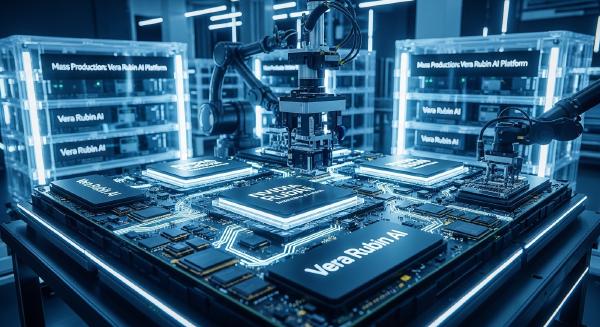
One of the quarter’s most important product milestones was the transition of the Vera Rubin platform into full mass production.
NVIDIA said Vera Rubin racks are already operating at multiple infrastructure partners, including CoreWeave, Google Cloud, Microsoft Azure, Oracle Cloud Infrastructure, and Nebius.
The transition represents a new stage in NVIDIA’s accelerated-computing roadmap, with the company moving from product introduction toward large-scale system deployment.
NVIDIA’s revenue opportunity is also becoming increasingly tied to rack-level performance rather than individual GPU specifications.
Huang estimated revenue generated per gigawatt of deployed infrastructure at approximately:
| Platform Generation | Revenue per Gigawatt |
|---|---|
| Hopper | $18B |
| Blackwell | $25B |
| Vera Rubin | $40B |
The increase reflects higher compute density, more sophisticated networking, larger system configurations, and increasing value per unit of data-center power.
AWS expands NVIDIA deployment #
NVIDIA also announced an expanded partnership with AWS.
AWS plans to deploy an additional 2 million NVIDIA GPUs, together with Vera CPUs, beginning in the current quarter and continuing through Q2 of fiscal year 2029.
Some systems will integrate Vera CPUs with Rubin platforms, while others will be deployed as standalone products.
The companies also plan to collaborate on open-source AI models and physical AI workloads.
⚡ Groq 3 LPX Targets Ultra-Low-Latency Inference #
NVIDIA’s inference strategy is expanding beyond general-purpose GPU acceleration through its Groq technology portfolio.
The Groq 3 LPX interactive AI inference accelerator has entered full mass production and is designed specifically for workloads where token-generation latency and interactivity are critical.
According to benchmark results cited by NVIDIA, Groq 3 LPX running the open-source Gemma 4 31B model with a 100,000-token context achieved approximately 3,400 tokens per second in output throughput.
NVIDIA expects volume shipments to early customers later in the quarter, with Nebius identified as the first AI cloud provider adopting the accelerator.
General-purpose versus specialized inference #
Huang positioned Groq 3 LPX as complementary to NVIDIA’s broader accelerated-computing platform rather than a replacement for Rubin-based infrastructure.
The distinction is primarily workload-driven:
| Platform | Primary Positioning |
|---|---|
| Vera Rubin | Broad AI training and inference |
| NVLink rack-scale systems | Large-scale, flexible AI infrastructure |
| Groq 3 LPX | Ultra-low-latency interactive inference |
Specialized inference accelerators can be attractive for high-value applications where response latency has a direct impact on user experience or service economics.
NVIDIA’s broader platform remains focused on flexibility across the complete AI lifecycle.
🌐 Networking Infrastructure Continues to Scale #
AI infrastructure increasingly depends on networking performance as models become larger and accelerator clusters expand.
NVIDIA reported that Spectrum-6 switches are being deployed globally, supporting both pluggable optics and co-packaged optics architectures.
The company is simultaneously expanding:
- NVLink compute architectures
- Ethernet networking
- InfiniBand
- Rack-scale accelerated computing
- High-bandwidth data-center interconnects
This vertical integration allows NVIDIA to address more of the infrastructure stack rather than competing solely at the GPU level.
🔮 NVIDIA Vera CPU Expands the Platform #
NVIDIA also highlighted its Vera CPU, estimating the addressable server CPU market at approximately $20 billion.
SpaceX has confirmed plans to deploy Vera CPUs for next-generation agentic AI applications.
The CPU is strategically important because modern AI servers require tightly integrated CPU, GPU, memory, networking, and software components.
By extending into server CPUs, NVIDIA can increase the amount of system-level value captured by its platform while optimizing the interaction between general-purpose processing and accelerated AI workloads.
📈 NVIDIA Guides for 70% Growth in FY2028 #
NVIDIA took the unusual step of providing a growth outlook for the following fiscal year.
Based on customer forecasts, NVIDIA said demand could support approximately 70% growth in FY2028, although the company believes supply constraints will limit actual growth to that level.
The distinction is important: NVIDIA does not appear to be signaling that demand is weakening. Instead, the company is increasingly using available manufacturing, power, networking, and data-center capacity to determine how much revenue it can physically deliver.
Huang estimated that 70% FY2028 growth could represent approximately $200 billion of incremental revenue.
AI agents increase inference demand #
One major demand driver is the emergence of AI agents.
According to Huang, agentic workloads can require approximately 15 to 100 times more inference compute than traditional AI usage patterns.
The reason is architectural: an agent may perform multiple reasoning, tool-use, retrieval, planning, and verification steps rather than generating a single response in one inference pass.
As agentic systems become more capable and autonomous, inference becomes a continuous workload rather than an occasional API request.
This creates a potentially much larger long-term market for accelerated inference infrastructure.
🔄 NVIDIA’s AI Factory Strategy #
Huang described the AI lifecycle as increasingly consisting of four major stages:
- Data preparation
- Pre-training
- Post-training
- Agentic inference
Each stage introduces different computational characteristics, but NVIDIA’s strategy is to provide infrastructure that can support all of them.
The company’s NVLink-based rack-scale systems are therefore positioned as general-purpose AI factories rather than specialized inference machines.
This flexibility is a major part of NVIDIA’s competitive strategy because customers can continue using the same infrastructure as their AI workloads evolve.
Why flexibility matters to customers #
AI infrastructure represents a significant capital investment.
If an accelerator platform can support only one model architecture, one cloud service, or one inference workload, its utilization can decline as workloads change.
A more flexible platform can potentially support:
- Training new foundation models
- Fine-tuning existing models
- Post-training and reinforcement learning
- High-volume inference
- Agentic workloads
- Enterprise AI applications
- Scientific computing
This flexibility can extend infrastructure useful life and improve the economic return on large-scale deployments.
💰 NVIDIA’s Investment in Frontier AI Labs #
NVIDIA disclosed that it has invested nearly $50 billion across frontier AI companies.
Some portfolio companies, including OpenAI and Anthropic, are simultaneously developing custom AI accelerators, raising questions about whether custom silicon could eventually compete with NVIDIA GPUs.
Huang argued that these technologies occupy different positions in the infrastructure stack.
NVIDIA provides a full-stack accelerated-computing platform spanning processors, networking, software, systems, and AI infrastructure. Custom XPUs, by contrast, are often designed around narrower workloads, services, or cloud environments.
From NVIDIA’s perspective, the growth of frontier AI companies remains a positive development because these companies require substantial compute capacity regardless of whether some workloads eventually move to custom silicon.
Huang described investment in frontier AI laboratories as a potentially once-in-a-century opportunity and said his primary regret was not investing earlier or at a larger scale.
🏭 Supply Chain Becomes NVIDIA’s Primary Constraint #
The largest risk to NVIDIA’s growth trajectory is increasingly physical rather than demand-related.
The company reported pressure across almost every major component of the AI infrastructure supply chain:
- Advanced wafers
- Memory
- Packaging
- Networking components
- Data-center land
- Electricity
- Racks
- System assembly
- Manufacturing capacity
NVIDIA said supply-chain constraints are expected to persist through at least the end of FY2028.
Memory costs are rising #
Memory prices have exceeded NVIDIA’s previous expectations and are expected to increase further next year.
This creates a direct margin challenge because high-bandwidth memory and other memory components represent a significant portion of advanced AI accelerator system costs.
NVIDIA expects gross margin to temporarily decline to approximately 71%–72% in Q4.
Inventory rises ahead of Rubin ramp #
NVIDIA’s inventory increased to approximately $32 billion as the company prepares for higher-volume Vera Rubin shipments.
The inventory buildup should be interpreted in the context of a major platform transition: NVIDIA needs sufficient component availability to support system-level production as Rubin moves into volume deployment.
The company is effectively attempting to secure supply ahead of demand rather than allowing component shortages to delay customer deployments.
💵 Cash Flow and Capital Allocation #
At the end of Q2, NVIDIA held approximately $22.44 billion in cash and cash equivalents.
During the quarter:
| Financial Activity | Amount |
|---|---|
| Cash and Cash Equivalents | $22.44B |
| Investment Activities | $27.46B |
| Share Repurchases | $20B |
| Quarterly Dividend | $6B |
| Total Shareholder Returns | $26B |
The scale of capital returns illustrates the extraordinary cash-generation capacity of NVIDIA’s current business model even while the company continues making substantial investments across AI infrastructure and strategic technology partnerships.
🔮 The Economics of AI Compute #
The most important theme underlying NVIDIA’s results is the changing economics of compute.
Huang argued that AI compute is increasingly tied directly to productive economic activity. As AI models perform useful work, every additional unit of inference capacity can potentially generate measurable revenue.
This changes the investment equation for cloud providers and enterprises.
If an AI infrastructure deployment can generate a return within a sufficiently short period, customers have a strong economic incentive to continue increasing capital expenditure.
NVIDIA indicated that some current AI infrastructure deployments have payback periods of less than one year, reinforcing its view that AI spending is increasingly supported by measurable economic returns rather than purely speculative investment.
🧭 Conclusion: NVIDIA’s Growth Is Now Limited by Supply #
NVIDIA’s Q2 FY2027 results demonstrate how dramatically the company’s business has changed since the emergence of ChatGPT.
Quarterly revenue reached $96.22 billion, with Data Center contributing approximately $89 billion. Net income reached nearly $60 billion, while the company moved closer to crossing the $100 billion quarterly revenue threshold.
The next phase of growth will depend less on whether customers want more AI compute and more on whether NVIDIA and its suppliers can physically deliver it.
Vera Rubin is now entering mass production, Groq 3 LPX is expanding NVIDIA’s low-latency inference portfolio, Spectrum-6 and NVLink are scaling the networking layer, and Vera CPU extends the company’s reach into server infrastructure.
At the same time, AI agents are potentially multiplying inference demand, while hyperscaler, enterprise, sovereign AI, and industrial spending continues to expand.
The central constraint is therefore becoming clear: NVIDIA’s biggest challenge may no longer be generating demand, but converting enormous demand into physical compute capacity.
If NVIDIA can continue expanding wafer, memory, packaging, networking, power, and rack capacity at the pace required by customers, the company’s path toward $100 billion quarterly revenue—and eventually substantially higher annual revenue—remains firmly intact.