Gamescom 2026: NVIDIA DLSS 4.5, RTX Spark & RTX Remix
NVIDIA used Gamescom 2026 to expand several parts of its graphics and AI ecosystem simultaneously, spanning neural rendering, game remastering, ARM-based PCs, in-game AI, and cloud gaming.
The most immediate update is the rollout of DLSS 4.5 Ray Reconstruction, which introduces a second-generation Transformer model and can be enabled through the NVIDIA App without requiring individual game patches. At the same time, NVIDIA is expanding the open-source RTX Remix toolchain, pushing path-traced remastering deeper into emulation and professional content workflows.
The company is also building momentum around RTX Spark, its ARM-based AI PC platform, while NVIDIA ACE brings local AI models into upcoming games and GeForce NOW extends DLSS 4.5 and expands device and storefront support.
Taken together, the announcements show NVIDIA increasingly treating gaming as a stack that spans GPU rendering, neural inference, developer tooling, PC hardware, game AI, and cloud infrastructure.
🚀 DLSS 4.5 Ray Reconstruction and NVIDIA App Enhancements #
The headline graphics update is DLSS 4.5 Ray Reconstruction, which replaces the first-generation Transformer implementation with a more capable second-generation model.
Second-Generation Transformer #
The new Transformer increases parameter count by approximately 20% and model compute capacity by roughly 35% compared with the first-generation implementation used by Preset D.
Despite the larger model, NVIDIA reports that runtime overhead remains unchanged on RTX 40 and RTX 50 GPUs.
The upgrade is designed primarily to improve the reconstruction of sparse ray-traced information. Better spatial and temporal understanding allows the model to recover fine details while reducing flickering, ghosting, and unstable reflections.
DLSS 4.5 Ray Reconstruction remains compatible with GeForce RTX 20 through RTX 50 series GPUs, giving the feature a substantially broader hardware footprint than some newer DLSS technologies.
One-Click Preset F Deployment #
DLSS 4.5 Ray Reconstruction can be enabled through the NVIDIA App using the DLSS Override interface.
Users can select Ray Reconstruction Preset F without waiting for a game-specific patch. More than 30 titles are supported at launch, while additional games such as 007 First Light and Control: Resonance are scheduled to add support.
NVIDIA has also released plugins for Unreal Engine 5 and Streamline, giving developers direct integration paths for the updated technology.
The driver-level deployment model is particularly significant because it allows NVIDIA to distribute neural rendering improvements independently of the traditional game patch cycle.
Per-Application Resizable BAR Controls #
The NVIDIA App is also gaining more granular Resizable BAR controls.
Instead of applying a single global configuration, users can now control Resizable BAR behavior on a per-game or per-application basis.
This provides a practical workaround for titles where aggressive memory mapping can create allocation or stability issues. NVIDIA specifically cites workloads such as Microsoft Flight Simulator 2024 as examples where application-level control can be useful.
Integrated G-SYNC Pulsar Controls #
NVIDIA is also bringing G-SYNC Pulsar configuration directly into the NVIDIA App.
G-SYNC Pulsar combines variable refresh rate technology with backlight strobing to improve motion clarity while retaining adaptive synchronization.
The integrated controls include ULMB2 pulse-width adjustment and fixed 60 Hz strobing modes, allowing users to tune display behavior without relying exclusively on external monitor controls.
🛠️ RTX Remix Ecosystem and Toolchain Overhaul #
NVIDIA’s open-source RTX Remix platform continues to evolve beyond its original role as a path-tracing modding framework.
The platform has now powered more than 240 remastered games, with nearly 100 titles added during 2026 alone, including projects based on Dino Crisis, Prototype, and Fallout 4.
The latest ecosystem updates focus heavily on making asset conversion and content creation less manual.
New RTX Remix Integrations #
| Tool / Integration | Functionality and Workflow Impact |
|---|---|
| InstaMAT2Remix | Connects InstaMAT procedural PBR material generation directly with RTX Remix for automated texture upgrades. |
| PCSX2 Remix | Extends Remix path-tracing interception to the PCSX2 PlayStation 2 emulator. |
| Blender Plugin | Uses Remix Toolkit REST APIs for one-click asset import/export and automated version management. |
These integrations address one of the biggest bottlenecks in game remastering: asset preparation.
Path tracing can expose shortcomings in legacy textures and materials that were never designed for physically based rendering. Automated PBR generation can therefore reduce manual authoring work while producing assets that behave more naturally under modern lighting.
InstaMAT2Remix #
InstaMAT2Remix connects InstaMAT’s procedural material-generation pipeline directly to RTX Remix.
The integration automates portions of the process involved in upgrading legacy textures to physically based materials. This is important for path-traced games because incorrectly authored roughness, normal, or material properties can produce exaggerated or physically implausible reflections.
By connecting procedural material generation directly to Remix, modders can iterate on large asset libraries more efficiently.
PCSX2 Remix #
PCSX2 Remix extends RTX Remix technology beyond native Windows game executables by adding path-tracing interception capabilities to the PCSX2 PlayStation 2 emulator.
This opens a new class of legacy titles to modern rendering techniques. Classic console games can potentially receive path-traced lighting, reflections, and other modern rendering effects without requiring the original engine to support those technologies.
The approach effectively turns the emulator into another integration layer for RTX Remix.
Blender Integration #
The new Blender plugin uses the Remix Toolkit REST APIs to streamline asset exchange between Blender and RTX Remix.
Automated import/export and version management reduce repetitive operations that traditionally require manual handling of scale, normals, and asset versions.
For larger community projects, this type of pipeline integration can be more important than any individual rendering feature because it reduces the friction involved in maintaining hundreds or thousands of modified assets.
Painkiller RTX #
NVIDIA also highlighted Painkiller RTX, which is available free to original owners on GOG for the first 15 levels.
The remaster includes full path tracing, Neural Radiance Cache, dynamic particles, and RTX IO compression.
RTX IO reduces the game’s storage footprint from approximately 57 GB to 45 GB, demonstrating how NVIDIA’s ecosystem extends beyond lighting and image reconstruction into asset streaming and data compression.
The Elder Scrolls III: Morrowind RTX #
The community-driven The Elder Scrolls III: Morrowind RTX project is also approaching a public demonstration.
The project by GokuwasHere incorporates upgraded assets, improved foliage, volumetric clouds, and enhanced water reflections.
Morrowind is a useful showcase for the RTX Remix ecosystem because its aging rendering pipeline leaves substantial room for modern lighting and material reconstruction.
💻 RTX Spark: ARM-Based AI PCs Build Momentum #
Another major Gamescom theme is NVIDIA’s push toward ARM-based AI PCs through RTX Spark.
The platform is positioned as a compact local AI and gaming solution rather than simply another discrete-GPU configuration.
Hardware and Local AI #
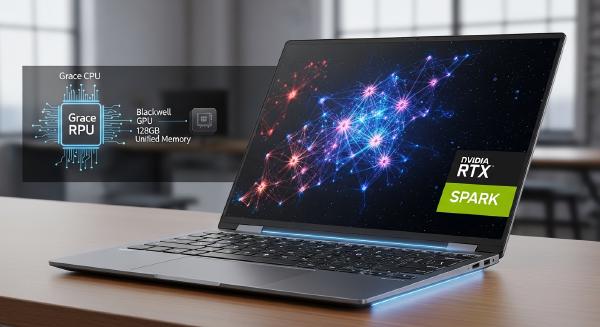
RTX Spark systems are expected in both ultra-thin laptop and compact mini-desktop configurations.
Laptop designs can reach approximately 14 mm thickness while targeting all-day battery life, while the platform is capable of running models with up to 120 billion parameters locally with a reported 1 million-token context length through the Windows Agent Framework.
This combination of local model capacity and relatively compact hardware represents one of the more ambitious aspects of the RTX Spark platform.
Instead of treating AI as a cloud-dependent feature, NVIDIA is targeting local execution for increasingly large models.
Gaming Performance #
RTX Spark is not limited to AI workloads.
NVIDIA reports approximately 100 FPS at 1440p with path tracing and DLSS enabled, positioning the platform as a viable gaming system in addition to its AI capabilities.
The combination of ARM CPU infrastructure and RTX-class graphics acceleration could become increasingly relevant if developers continue to optimize Windows applications and games for the architecture.
OEM Support #
NVIDIA has announced support from several major hardware partners, including:
- ASUS ProArt
- Dell
- Microsoft
- HP
- Lenovo
- Gigabyte
Broad OEM adoption will be important for RTX Spark because the platform’s long-term success depends on achieving enough hardware diversity to establish ARM-based Windows PCs as a mainstream alternative rather than a niche form factor.
Anti-Cheat and Publisher Support #
One of the traditional barriers to ARM gaming has been software compatibility, particularly kernel-level anti-cheat systems.
EA has now ported its Javelin Anti-Cheat technology to ARM and RTX Spark, covering games including Apex Legends and the F1 series.
Other supported games include Anno 117: Pax Romana, Arc Raiders, and The Finals.
NVIDIA also reports backing from more than 20 major publishers, including Epic, Riot, miHoYo, NetEase, and Tencent.
This is strategically important because game compatibility requires cooperation across multiple layers: the game engine, middleware, anti-cheat system, launcher, drivers, and publisher infrastructure all need to support the new architecture.
🤖 NVIDIA ACE and AI-Powered Game Characters #
NVIDIA is also expanding NVIDIA ACE, its technology stack for integrating AI-driven characters and interactions into games.
Imo and Local AI Companions #
Pawprint Studios announced Imo, an open-world RPG scheduled for 2027 featuring AI companions known as Aniimo.
The companions are designed to use local RTX AI models for natural voice and text interactions as well as adaptive behavior.
This represents a different application of local AI from conventional chatbot workloads. Instead of simply generating responses, the model becomes part of the game’s interactive simulation.
For developers, the challenge is significantly more complex: AI inference must coexist with rendering, animation, audio, game logic, and networking while maintaining predictable latency.
Local inference can help by removing round-trip cloud latency and keeping interaction data on the player’s machine.
☁️ GeForce NOW Expands Its Platform #
NVIDIA is also extending its cloud gaming platform with DLSS 4.5, storefront integration, and additional client platforms.
DLSS 4.5 Cloud Deployment #
DLSS 4.5 is scheduled to roll out to GeForce NOW Ultimate members in September 2026.
Bringing the latest neural rendering pipeline to the cloud is significant because the rendering hardware is centrally controlled. NVIDIA can deploy the same technology across compatible server infrastructure without requiring end users to upgrade local GPUs.
GOG Library Integration #
Native GOG library synchronization is scheduled to launch on August 27.
Supported games include:
- Baldur’s Gate 3
- Kingdom Come: Deliverance II
- Clair Obscur: Expedition 33
The integration reduces friction for users who maintain game libraries across multiple storefronts.
Day-One Game Releases #
GeForce NOW is also expanding its day-one release lineup with titles including:
- Metro 2039
- Gears of War: E-Day
- Onimusha: Way of the Sword
- Control: Resonance
- A Plague Tale: Legacy
The strategy continues NVIDIA’s effort to position cloud gaming as an immediate alternative to local hardware rather than merely a fallback for low-end PCs.
Expanded Device Support #
GeForce NOW is adding support for Steam Machine, the new Steam Controller, Fire TV 4K, and Firefox.
With Firefox support, NVIDIA is effectively completing broader browser coverage, further lowering the hardware and software requirements for accessing the service.
🔬 What the Gamescom Updates Signal #
The most important aspect of NVIDIA’s Gamescom 2026 announcements is not any individual feature. It is the increasing integration between NVIDIA’s graphics, AI, software, and platform layers.
DLSS 4.5 improves the neural rendering pipeline.
RTX Remix makes those rendering technologies available to legacy games through an expanding creator ecosystem.
RTX Spark brings RTX AI acceleration into ARM-based personal computers.
NVIDIA ACE extends local inference into interactive game characters.
GeForce NOW moves the same rendering technologies into NVIDIA’s cloud infrastructure.
These initiatives address different parts of the gaming stack, but they share a common architecture: use dedicated neural computation to improve rendering, interaction, content creation, and software execution while hiding much of the underlying complexity from users and developers.
The RTX ecosystem is therefore becoming less about the GPU as a standalone piece of hardware and more about a vertically integrated platform spanning local AI, neural rendering, game remastering, ARM computing, developer tools, and cloud gaming.
For developers, the most significant trend may be the expanding number of integration points. RTX technologies are increasingly available through driver-level overrides, engine plugins, open-source tools, emulators, Blender workflows, AI frameworks, and cloud services.
That broader software ecosystem could ultimately matter more than any single GPU generation because it gives NVIDIA multiple paths to keep its neural rendering and AI technologies embedded across the gaming industry.