NVIDIA RTX Spark: Has the Ultimate AI Laptop Finally Arrived?
At COMPUTEX 2026, NVIDIA CEO Jensen Huang unveiled what may become one of the most disruptive products in personal computing since the introduction of the modern laptop. While the previously announced DGX Spark targeted AI developers and researchers, the newly launched RTX Spark brings many of those capabilities into a portable form factor.
Built around a unified architecture that combines a Grace CPU, Blackwell RTX GPU, and up to 128GB of LPDDR5X unified memory, RTX Spark is designed specifically for the emerging era of AI agents. NVIDIA’s vision extends far beyond faster laptops—it aims to transform the PC from a passive tool into an intelligent digital teammate capable of understanding, reasoning, and acting on behalf of users.
If NVIDIA delivers on its promises, RTX Spark may represent one of the most significant shifts in PC design in decades.
🚀 RTX Spark: A Superchip Built for Personal AI #
The RTX Spark platform, internally known as N1X, is not a single processor but a family of AI-focused SoCs designed for laptops and compact desktops.
At the top of the stack sits the flagship N1X 675, a chip engineered to provide workstation-class AI performance within a thin-and-light system.
Flagship N1X 675 Specifications #
The highest-end RTX Spark configuration includes:
- Up to 1 petaflop of FP4 AI compute performance
- 128GB LPDDR5X unified memory
- Blackwell RTX GPU with 6,144 CUDA cores
- Fifth-generation Tensor Cores
- 48 Streaming Multiprocessors (SMs)
- 20-core Grace CPU
- NVLink-C2C chip-to-chip interconnect
- 45W–80W configurable TDP
The Grace CPU was co-developed with MediaTek and manufactured using TSMC’s advanced 3nm process technology.
Its configuration consists of:
- 10 Cortex-X925 performance cores
- 10 Cortex-A725 efficiency cores
- ARMv9 architecture
- Data-center-class interconnect capabilities
The result is a highly integrated architecture that blurs the traditional distinction between CPUs and GPUs.
💻 Multiple Product Tiers for Different Users #
NVIDIA plans to address multiple market segments with several RTX Spark variants.
N1X 675 #
The flagship model targets:
- AI developers
- Professional creators
- Power users
- High-end gaming enthusiasts
N1X 650 #
The second-tier model includes:
- 18 CPU cores (9P + 9E)
- 5,120 CUDA cores
- 40 SMs
- Up to 128GB unified memory
Mainstream N1 Series #
More affordable models are expected to feature:
- 10–12 CPU cores
- 2,048–2,560 CUDA cores
- Up to 64GB LPDDR5X memory
- 45W TDP
This broader product lineup suggests NVIDIA intends to compete across multiple PC segments rather than limiting RTX Spark to premium systems.
🪶 Thin-and-Light Design Without Traditional Compromises #
One of the most impressive aspects of RTX Spark is the form factor NVIDIA claims it can support.
Launch systems are expected to offer:
- Thickness as low as 14mm
- Weight starting around 1.36kg
- 14-inch to 16-inch displays
- Tandem OLED panels
- NVIDIA G-SYNC support
Early hardware partners include:
- ASUS
- Dell
- HP
- Lenovo
- Microsoft Surface
- MSI
Additional systems from Acer and GIGABYTE are expected shortly afterward.
The presence of premium vendors such as Dell’s XPS division strongly suggests RTX Spark will initially target the high-end ultrabook market.
🤖 Why 128GB Unified Memory Changes Everything #
The most significant feature of RTX Spark may not be its GPU performance but its memory architecture.
Traditional AI workloads often encounter memory limitations before they hit compute limits.
For comparison:
| Hardware | Memory Capacity |
|---|---|
| RTX 5070 Laptop GPU | Typically 8–12GB |
| RTX 5090 Laptop GPU | 24GB |
| RTX Spark | Up to 128GB Unified Memory |
This enormous memory pool enables workloads previously impossible on portable devices.
Running 120B Parameter Models Locally #
NVIDIA demonstrated support for:
- 120-billion-parameter large language models
- One-million-token context windows
- Fully local inference
Under FP4 or INT4 quantization, a 120B model may consume approximately 60–70GB of memory, leaving substantial capacity for:
- KV cache
- Operating system resources
- Additional applications
- Agent frameworks
This makes RTX Spark one of the first laptop-class platforms capable of hosting truly large AI models without relying on cloud infrastructure.
One Million Tokens of Context #
A context window of one million tokens enables:
- Entire code repositories to be loaded at once
- Full-length novels to be analyzed in a single session
- Large legal document collections
- Medical archives
- Research datasets
For developers, researchers, and enterprise users, this dramatically changes how AI assistants can interact with large bodies of information.
⚡ AI Agents Move from Experiments to Daily Tools #
RTX Spark was designed around the assumption that AI agents will become a core part of future computing.
Open-source projects such as OpenClaw and Hermes Agent have demonstrated growing demand for autonomous AI systems capable of executing real-world tasks.
OpenShell Security Framework #
One major challenge with AI agents has been trust.
Users understandably hesitate to grant unrestricted access to personal files and applications.
NVIDIA’s OpenShell framework addresses this through:
- Fine-grained permission controls
- Folder-level access restrictions
- Application sandboxing
- Policy-based execution rules
Users can define precisely:
- Which files an agent may access
- Which applications it can control
- Which system resources remain protected
Even if an agent encounters malicious prompts or external attacks, OpenShell aims to limit potential damage.
Privacy-Aware AI Processing #
OpenShell also introduces privacy-focused routing.
Sensitive workloads can remain entirely local, while cloud requests are automatically sanitized by removing:
- Personal information
- Corporate data
- Sensitive identifiers
This hybrid architecture allows organizations to balance privacy, performance, and capability.
🎨 Professional Content Creation on a Laptop #
RTX Spark is positioned as a serious platform for creators rather than simply an AI development device.
Massive 3D Scenes #
The 128GB memory pool enables:
- Entire 90GB+ scenes loaded in memory
- Interactive viewport rendering
- Near-final-quality previews
Combined with:
- OptiX
- DLSS 4.5 Ray Reconstruction
- Blackwell GPU acceleration
artists can work with assets previously reserved for desktop workstations.
Blender Integration #
Blender 5.3 is expected to integrate DLSS 4.5 Ray Reconstruction directly into the viewport pipeline.
Benefits include:
- Real-time denoising
- Faster iteration cycles
- Improved visual feedback
This integration further validates RTX Spark as a professional production platform.
Video Production Workflows #
Blackwell’s media engine introduces support for:
- HEVC 4:2:2 hardware encoding
- HEVC 4:2:2 hardware decoding
- Multiple 12K video streams
- High-resolution AI video generation
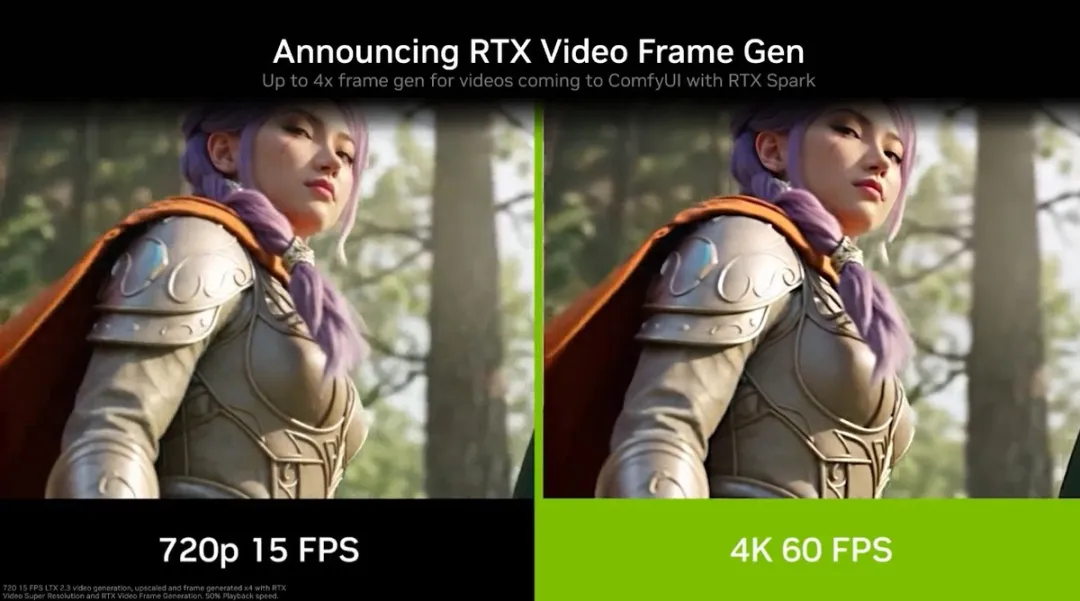
Creators can potentially work with massive video projects without relying on proxy workflows.
📸 Adobe Rebuilds for RTX Spark #
Adobe has become one of NVIDIA’s most important ecosystem partners.
Both Photoshop and Premiere have reportedly undergone significant architectural changes to take advantage of:
- Unified memory
- TensorRT acceleration
- Blackwell GPU compute
Expected benefits include:
- Up to 2× faster AI workflows
- Accelerated image generation
- Improved video editing performance
- Faster visual effects processing
AI-powered features such as Generative Fill and Generative Expand are expected to become deeply integrated throughout Adobe’s creative suite.
🎮 Gaming Performance Comparable to Dedicated Gaming Laptops #
Although AI receives most of the attention, RTX Spark also targets gamers.
The flagship GPU configuration is reportedly comparable to a GeForce RTX 5070 Laptop GPU.
Supported technologies include:
- Full ray tracing
- DLSS 4.5
- Dynamic Multi Frame Generation
- Transformer-based Super Resolution
- NVIDIA Reflex
NVIDIA claims many AAA titles can exceed:
- 100 FPS
- 1440p resolution
- High graphics settings
This level of performance in a 1.3kg ultrabook would have been difficult to imagine only a few years ago.
AI-Powered Gaming Experiences #
The platform also supports:
- NVIDIA ACE AI NPCs
- Local language models for game characters
- AI-generated content pipelines
- NVIDIA Remix workflows
The large memory pool enables significantly more sophisticated AI-driven gaming experiences than traditional laptop platforms.
👨💻 A Portable AI Development Workstation #
Developers may be among the biggest beneficiaries of RTX Spark.
The platform supports popular AI and machine learning frameworks, including:
- PyTorch
- Hugging Face
- llama.cpp
Potential workloads include:
- Local model fine-tuning
- Repository-scale code analysis
- Automated bug fixing
- AI-assisted development workflows
- Multi-agent software engineering
Combined with million-token contexts, coding agents can reason across entire projects rather than isolated files.
For many developers, RTX Spark could eliminate the need for cloud-based AI infrastructure during day-to-day work.
🌟 Why RTX Spark Matters #
RTX Spark is not simply another Windows-on-Arm experiment.
It combines several trends that have been evolving independently for years:
- Local AI inference
- Unified memory architectures
- Agent-based computing
- High-efficiency Arm CPUs
- GPU-accelerated productivity
- Portable workstation-class performance
By integrating all of these capabilities into a thin-and-light form factor, NVIDIA is attempting to redefine what users expect from a laptop.
🏁 Conclusion #
RTX Spark represents one of the boldest attempts yet to create a truly AI-native personal computer. By combining a Grace CPU, Blackwell GPU, 128GB of unified memory, and a security-focused agent framework, NVIDIA is building a platform designed specifically for the next generation of AI-driven workflows.
Whether users are running 120-billion-parameter language models, editing 12K video, rendering large-scale 3D scenes, gaming at high frame rates, or deploying autonomous AI agents, RTX Spark aims to deliver capabilities that traditionally required a workstation or cloud infrastructure.
The technology is still awaiting its commercial debut, and many questions remain regarding pricing, software maturity, and real-world performance. Nevertheless, if NVIDIA’s vision becomes reality, RTX Spark may mark the beginning of a new category of personal computing—one where thin-and-light laptops become powerful AI workstations capable of acting as intelligent partners rather than simple productivity tools.