SpaceX AI Infrastructure: 13GW Compute Ambition and $350B Expansion
SpaceX is transforming its AI computing infrastructure into a major commercial business, combining hyperscale NVIDIA GPU clusters with dedicated power generation, battery storage, and an aggressive data center construction program.
The company’s Superintelligence division, previously known as xAI and SpaceXAI, has expanded beyond supporting internal AI development. New cloud agreements with Anthropic, Google, Reflection AI, and other customers are creating a substantial external revenue stream, while internal workloads such as Grok and Cursor continue to compete for computing resources.
According to SpaceX disclosures and estimates published by Measured AI in October 2026, the company had approximately one million NVIDIA GPUs distributed across its Colossus infrastructure, with a potential expansion to 1.44 million GPUs and approximately 2.7 gigawatts of compute capacity by the end of 2026.
The longer-term ambition is considerably larger. SpaceX aims to deploy approximately 10 GW of additional computing capacity during 2027, bringing its total to approximately 13 GW by year-end. Achieving that target would require millions of GPUs, extensive power and cooling infrastructure, and substantial capital investment.
The strategy rests on three interconnected advantages: bringing large GPU clusters online quickly, monetizing scarce compute capacity through high-value contracts, and building electricity infrastructure alongside the computing systems themselves.
However, the scale of the plan introduces significant execution risks. GPU availability is only one constraint; electricity generation, transmission, cooling, advanced packaging, high-bandwidth memory, financing, and customer demand must all grow in parallel.
💰 1. Commercial Strategy: Turning Scarce GPU Capacity into Revenue #
SpaceX’s AI computing business is increasingly operating as a commercial infrastructure provider rather than merely an internal resource for developing its own models.
Its advantage is the ability to offer large, tightly interconnected GPU clusters to customers that need substantial computing capacity without waiting for their own data centers to become operational.
Anthropic’s $120.5 billion computing commitment #
Anthropic’s IPO filing, released on October 26, 2026, disclosed infrastructure agreements with SpaceX involving up to $120.5 billion in aggregate spending through 2029.
According to the filing, monthly payments could reach approximately $3.1 billion once all contracted capacity is delivered, which Anthropic expects in December 2026. During the ramp-up period, fees differ from the fully deployed monthly rate.
At the maximum stated monthly rate, the arrangement corresponds to an annualized payment run rate of approximately $37.2 billion. This is an annualized rate, not the total contract value or a guarantee that the same amount will be recognized as revenue throughout an entire year.
The agreements cover approximately 325,000 NVIDIA GPUs across the Colossus I and Colossus II campuses, supported by server CPUs, storage, and high-speed networking.
Following the initial non-cancellable periods, the respective agreements allow termination with 90 days’ advance notice, according to the disclosed terms. This flexibility is important when evaluating the difference between headline contract commitments and the durability of future revenue.
The original agreement announced by SpaceX in May 2026 was structured around approximately $1.25 billion per month for the contracted computing capacity. Subsequent amendments expanded the aggregate commitment and increased the potential monthly payment as additional capacity became available.
Five contracts and a broader revenue opportunity #
Measured AI’s analysis identifies five cloud agreements covering more than 700,000 NVIDIA GPUs, representing over 1.2 GW of compute power and approximately $54.5 billion in annualized contract revenue.
That figure implies:
| Metric | Reported estimate |
|---|---|
| Contracted GPUs across five agreements | More than 700,000 |
| Associated compute capacity | More than 1.2 GW |
| Annualized contract revenue | $54.5 billion |
| Annualized revenue per GPU | Approximately $76,494 |
| Equivalent revenue per GPU-hour | Approximately $8.73 |
| Revenue per watt annually | Approximately $44 |
These calculations describe the contract portfolio and its implied economics. They should not be treated as realized revenue, operating profit, or cash flow.
Measured AI also projects that SpaceX’s total monthly computing lease revenue could reach $8.3 billion by the end of December 2026, implying an annualized run rate of approximately $100 billion.
That projection includes additional customer demand and projected agreements beyond the figures associated with the five disclosed contracts. The $54.5 billion annualized contract figure and the approximately $100 billion projected run rate therefore have different scopes and should not be treated as directly interchangeable measures.
Why newer GPUs command a premium #
The reported contract mix indicates substantial differences in revenue per GPU, depending on hardware generation and contract terms.
Anthropic’s original May agreement covered approximately 325,000 GPUs and was associated with roughly $15 billion in annual revenue for SpaceX under the initial contract structure.
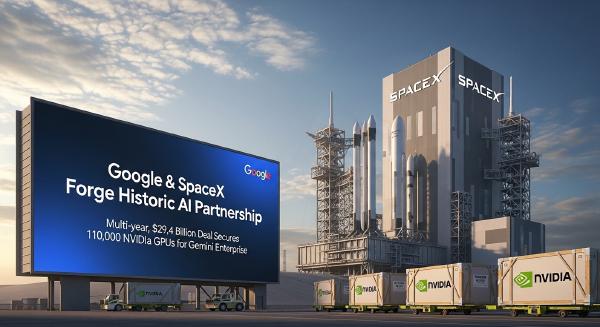
Google’s June 2026 agreement covered approximately 110,000 newer NVIDIA GPUs and was associated with approximately $11 billion in annual revenue.
Measured AI estimates that the four non-Anthropic agreements account for a smaller share of contracted GPUs than of annualized revenue. This suggests that newer GPU systems and different service arrangements can command a higher price per unit of compute capacity.
Anthropic’s initial allocation largely consists of H100 and H200 systems at Colossus I, together with capacity across Colossus II. SpaceX has been deploying newer Blackwell systems for its own workloads and external customers.
The economic implication is that GPU count alone is an incomplete measure of infrastructure value. Hardware generation, system configuration, interconnect bandwidth, availability, contract duration, and the ability to provide capacity immediately all influence the price customers are willing to pay.
For broader context on the commercial relationship, see KAD’s analysis of SpaceX’s $29.4 billion AI compute agreement with Google.
🏗️ 2. Colossus I and II: Scaling Data Centers at Gigawatt Scale #
SpaceX’s deployment strategy combines industrial building conversions with purpose-built AI facilities. The approach seeks to shorten initial deployment timelines while creating room for denser systems, dedicated power generation, and future expansion.
Measured AI identifies five operational or under-construction data center locations in the Memphis, Tennessee, and Southaven, Mississippi, area, with additional industrial properties available for potential redevelopment.
From one million GPUs to 1.44 million #
As of October 2026, the disclosed and estimated GPU inventory across Colossus I and Colossus II totals approximately one million devices.
| Location | Approximate GPU inventory | Primary deployment characteristics |
|---|---|---|
| Colossus I | 230,000 | H100, H200, and GB200 systems in a converted industrial facility |
| Macrohard | 330,000 | GB200 and GB300 systems in a renovated logistics warehouse |
| Macroharder | 220,000 | GB300 systems in a renovated warehouse |
| Minihard | 220,000 | GB300 systems in a purpose-built facility |
| Total | 1,000,000 | Combined Colossus infrastructure |
SpaceX plans to expand the fleet through additional GB300 deployments.
The reported schedule includes approximately 220,000 additional GPUs expected in November 2026 and another 220,000 potentially operational by late December. If completed as projected, these deployments would increase the combined fleet to approximately 1.44 million GPUs by year-end.
Measured AI estimates that the corresponding Colossus I and II installations could reach around 2.7 GW of compute capacity.
These figures describe a projected deployment trajectory rather than a guarantee that every announced GPU shipment will become fully operational on schedule. Installation, network commissioning, power availability, cooling capacity, and system validation all affect the time required to turn delivered hardware into usable compute.
Colossus I: The industrial retrofit model #
Colossus I occupies a former Electrolux appliance manufacturing facility in Memphis.
Renovation began in April 2024, computing operations started in July 2024, and the site reportedly reached full capacity in July 2025.
The facility houses approximately 230,000 NVIDIA H100, H200, and GB200 GPUs, corresponding to roughly 294 MW of compute capacity under the reported equipment assumptions.
Its original industrial building allowed SpaceX to reuse existing floor space rather than wait for an entirely new data center to be constructed.
The site receives grid electricity through the Tennessee Valley Authority (TVA) and Memphis Light, Gas and Water, with approximately 150 MW of grid capacity initially available and a potential increase to 300 MW following completion of an additional substation.
On-site natural gas generation adds approximately 247 MW of nameplate generating capacity through 15 Solar Turbines SMT-130 units, each rated at 16.5 MW.
Additional infrastructure includes Tesla Megapack battery storage and a solar photovoltaic installation.
The network architecture uses NVIDIA Spectrum-X Ethernet, 400GbE BlueField-3 SuperNICs, and SN5600 switches.
This combination demonstrates the system-level requirements of a large AI cluster. GPU performance depends not only on the accelerators but also on high-speed networking, electricity delivery, cooling, and the ability to maintain stable operation under sustained workloads.
Colossus II: A distributed data center campus #
Colossus II is a collection of facilities and supporting infrastructure distributed across the Memphis–Southaven area rather than a single building.
Its development combines renovated industrial properties with purpose-built AI data centers and a dedicated power plant in Southaven.
The model allows computing deployments to expand across nearby sites while sharing major infrastructure resources, including generation equipment and battery storage.
Macrohard #
Macrohard occupies a former logistics warehouse in Memphis, with a reported floor area of approximately 93,000 square meters.
Renovation began in February 2025, and the facility became operational in January 2026.
The site houses approximately 330,000 NVIDIA GPUs, comprising 110,000 GB200s and 220,000 GB300s, corresponding to about 634 MW of compute capacity.
Its electricity is supplied substantially through the dedicated Southaven Power Plant, allowing the facility to rely less heavily on incremental utility-grid capacity.
Macroharder #
Macroharder is a converted logistics warehouse in Southaven, Mississippi, with approximately 75,000 square meters of space.
Renovation reportedly began in December 2025. The facility houses approximately 220,000 GB300 GPUs, corresponding to around 443 MW of compute capacity.
The system uses 800 Gbps network interfaces, reflecting the increasing bandwidth requirements of newer GPU deployments.
The comparison with Macrohard illustrates how established industrial buildings can provide a rapid route to expanding compute capacity.
However, a converted warehouse must still accommodate the electrical distribution, cooling systems, floor loading, network infrastructure, and operational controls required by modern AI systems.
Minihard: Purpose-built construction #
Minihard represents the transition from retrofitting existing buildings to constructing facilities specifically for dense AI hardware.
The approximately 29,000-square-meter building was reportedly permitted in March 2026 and became operational in October 2026.
It houses approximately 220,000 GB300 GPUs, corresponding to roughly 443 MW of compute capacity.
Its smaller floor area relative to Macroharder illustrates the increased density possible with purpose-built layouts.
The deployment also reflects a different construction strategy. Rather than adapting existing logistics infrastructure, SpaceX can optimize the building’s layout around electrical distribution, airflow, cooling, network cabling, and equipment access from the beginning.
High-density deployment still requires careful validation of heat removal, power delivery, and maintenance access. Reducing building area does not eliminate the need for supporting infrastructure.
Southaven Gun Range Datacenter #
Another development consists of two purpose-built data center buildings in Southaven, near the dedicated power plant.
As of October 2026, the project was under construction following design approval in September.
The two buildings total approximately 60,000 square meters and include provisions for additional battery storage.
The site extends the pattern established by Minihard: construction specifically optimized for AI infrastructure rather than retrofitting a general-purpose industrial building.
Why the retrofit-plus-new-build strategy matters #
The two construction methods serve complementary purposes.
Retrofitting can bring facilities online quickly when suitable buildings are available. Purpose-built projects can optimize physical layouts, power delivery, cooling, and equipment density around the target GPU configuration.
SpaceX is combining both approaches while acquiring additional industrial properties and land for potential future expansion.
The rate at which these sites become operational will depend on more than construction progress. Large utility connections, dedicated generation, fuel supply, storage systems, and complete commissioning must all align with hardware delivery.
For a technical look at the evolution of the Colossus infrastructure, see KAD’s earlier report on the NVIDIA-powered Colossus AI cluster.
⚡ 3. Power Infrastructure: Building Beyond Grid Availability #
SpaceX’s expansion strategy treats power generation and distribution as core components of the computing business.
At gigawatt scale, obtaining GPUs is not enough. A facility must secure electricity, deliver it reliably to the racks, remove the resulting heat, and manage rapid changes in computing demand.
Traditional grid connections can take years to expand when additional substations and transmission infrastructure are required. SpaceX’s strategy therefore combines utility service with dedicated generation, temporary power equipment, and battery storage.
The distinction between compute capacity and electrical capacity #
Measured AI reports that SpaceX had 1.7 GW of installed nameplate compute capacity as of September 30, 2026.
Its separate estimate of approximately 2.7 GW of year-end compute capacity is derived from disclosed GPU counts and assumed chip-server or rack power requirements.
These figures should not be confused with the capacity of the electrical grid or the total power infrastructure available at the facilities.
A data center requires additional electricity for networking, storage, cooling, power conversion, lighting, and other supporting systems. Facility power consumption is therefore higher than the power attributable to the GPUs alone.
The distinction becomes even more important when comparing computing capacity with nameplate power generation, which represents rated equipment output rather than electricity guaranteed to be available continuously.
Southaven Power Plant #
The permanent Southaven Power Plant has a reported permitted capacity of approximately 1.24 GW, with a mix of gas-turbine generation equipment.
The power strategy is designed to support the Colossus II campus and provide capacity for additional nearby data centers.
A dedicated plant can reduce dependence on new grid transmission capacity, but it introduces its own operational requirements.
Generation assets must be available when needed, and their operation depends on fuel availability, maintenance, environmental approvals, electrical integration, and the performance of the supporting systems.
Gas transportation infrastructure is therefore a necessary component of the expansion.
Reported easements and pipeline-related agreements indicate that the company is developing the physical gas-delivery arrangements required to operate the planned generation fleet.
Temporary generation and retirement deadlines #
SpaceX also deployed temporary trailer-mounted turbines while permanent power infrastructure was being developed.
According to the Mississippi Department of Environmental Quality records summarized by Measured AI, the original temporary fleet totaled approximately 1.88 GW of nameplate generation capacity.
By September 2026, 11 units had reportedly been retired, leaving 57 operating turbines representing approximately 1.53 GW of remaining capacity.
Under an agreement with the environmental regulator, SpaceX committed to retire the remaining temporary units by July 2027.
The retirement schedule creates an important infrastructure dependency. As temporary turbines are removed, the data centers must be supported by permanent generation, utility electricity, or additional generation capacity delivered on schedule.
If replacement capacity is delayed, the company could face a gap between the computing hardware installed and the electricity available to operate it.
Long-term turbine procurement #
SpaceX has also pursued longer-term generation equipment procurement, including orders from South Korean manufacturer Doosan Enerbility.
The reported order book includes 12 DGT6-300H S2 gas turbines rated at approximately 380 MW each, alongside six steam turbine generators rated at roughly 370 MW each.
The supplied estimates attribute approximately 6.78 GW of combined nameplate capacity to this equipment program, with deliveries extending from late 2026 through 2029.
This is a long-term procurement plan, not evidence that the entire generating fleet is already installed or operational.
The distinction between ordered, delivered, commissioned, and continuously available generation is essential when evaluating the feasibility of the 2027 compute expansion.
Fuel infrastructure as a critical dependency #
Natural gas transportation is another component of the power strategy.
Reported pipeline agreements and easements support the development of the delivery infrastructure required by the Southaven plant.
The wider point is that a large AI facility’s power supply depends on a chain of interconnected components: fuel delivery, generating equipment, electrical distribution, control systems, and cooling infrastructure.
Failure or delay in any critical component can limit the capacity available to the GPU fleet, regardless of how many accelerators have been delivered.
🔋 4. Tesla Megapacks and Dynamic AI Power Management #
Battery energy storage is a central component of SpaceX’s power strategy.
Measured AI identifies approximately 1,200 Tesla Megapack units across Colossus I and Colossus II, representing about 4.7 GWh of aggregate storage capacity.
The systems serve two main purposes: providing support during power interruptions or periods of constrained supply, and smoothing rapid variations in computing demand.
Why AI clusters need load smoothing #
AI workloads do not necessarily draw a constant amount of power.
Training and inference activity can change as models move between computation phases, synchronize across accelerators, or vary in request volume.
At hyperscale, these variations can become significant enough to affect generation equipment and the surrounding electrical infrastructure.
Measured AI estimates that synchronized training loads may fluctuate by 10–20 MW multiple times per second.
Battery systems can discharge during rapid increases in demand and recharge during lower-demand periods, reducing the variations seen by the generating equipment.
This is particularly relevant to behind-the-meter systems, where the data center operator manages a larger share of the relationship between compute demand and electricity supply.
Storage capacity versus power capacity #
The distinction between gigawatts and gigawatt-hours matters here.
- Gigawatts (GW) measure instantaneous power capacity.
- Gigawatt-hours (GWh) measure the amount of energy stored or delivered over time.
A battery installation with 4.7 GWh of storage does not necessarily deliver 4.7 GW of power. Its maximum output depends on the equipment’s power rating, configuration, state of charge, and operating constraints.
Similarly, storage cannot replace a permanent generation fleet indefinitely. It can buffer demand fluctuations and supply electricity for a limited duration, but sustained operation requires sufficient energy input and an appropriate recharge strategy.
Expanding battery deployments #
Beyond the reported 1,200 units already deployed, company site plans suggest a further approximately 1,380 Megapacks could be installed as future data centers are developed.
These additional systems remain part of the reported expansion plan rather than confirmed operational capacity.
The overall strategy illustrates a broader shift in AI infrastructure engineering: energy storage is no longer only a backup-power component. It is also becoming a mechanism for managing the dynamic electrical behavior of large computing clusters.
For additional context on power management in dense AI systems, see KAD’s analysis of AI data center power infrastructure and distribution constraints.
📈 5. The 2027 Expansion: A Target of 13 GW #
SpaceX’s stated ambition is to deploy approximately 10 GW of additional compute capacity in 2027, reaching approximately 13 GW in total by year-end.
Measured AI models one possible trajectory using assumed GPU power requirements and projected delivery schedules.
From 1.44 million GPUs to millions more #
The year-end 2026 plan targets a fleet of approximately 1.44 million GPUs.
Adding another 10 GW of compute capacity during 2027 would require several million additional accelerators, depending on the hardware generation and the system-level power assumptions.
The Measured AI projection uses approximately 145 kW per 72-GPU GB300 system and 200 kW per 72-GPU Vera Rubin system, excluding facility overhead.
Under those assumptions, the proposed trajectory requires approximately 3.8 million GPUs to reach the target.
The model assumes that GB300 deployment continues at approximately 220,000 GPUs per month from January through April 2027, followed by a transition toward NVIDIA Vera Rubin systems.
The projection includes a 440,000-GPU Vera Rubin training cluster targeted for completion by the end of the second quarter.
The precise equipment mix and deployment schedule remain subject to supply availability, infrastructure readiness, and execution.
The monthly deployment challenge #
To reach 10 GW of incremental compute capacity within 2027, the deployment rate would need to average more than 800 MW per month.
The modeled trajectory becomes more aggressive in the second half of the year.
According to Measured AI’s estimate, Vera Rubin deployment would need to rise from approximately 220,000 GPUs in June to around 570,000 GPUs in December.
That would represent approximately 1.6 GW of compute capacity coming online in a single month under the model’s assumptions.
Such a ramp introduces several interconnected constraints:
- Availability of GPUs and supporting CPUs.
- High-bandwidth memory supply.
- Advanced packaging and system integration capacity.
- Data center building completion.
- Electrical distribution and power generation.
- Cooling infrastructure and commissioning.
- Network deployment and validation.
Even if the buildings are ready, shortages in memory, packaging, equipment, or electricity can delay the conversion of purchased hardware into operational capacity.
Building power and cooling ahead of the GPUs #
SpaceX has stated an ambition to build approximately 20 GW of additional power and cooling infrastructure ahead of the corresponding compute deployment.
This reflects the company’s strategy of developing infrastructure in parallel with hardware procurement.
The company has also discussed using its metal-casting capabilities, developed for its rocket business, to accelerate the production of gas-turbine components such as blades and vanes.
Such components can have long lead times. Internal production could help reduce some supply constraints if the manufacturing process meets the required quality, throughput, and qualification requirements.
However, power infrastructure is a complex system. Turbine component availability alone does not guarantee that fuel supply, electrical controls, substations, cooling, and other facility systems will be ready on the same schedule.
The proposed 2027 ramp is therefore an ambitious execution target rather than an assured outcome.
💵 6. Capital Requirements and the Six-Month Payback Claim #
The investment required to expand AI computing capacity by 10 GW is enormous.
Measured AI estimates that a fully equipped AI data center can cost approximately $40–$50 billion per gigawatt, including GPUs, servers, network equipment, buildings, electrical infrastructure, and cooling.
Under a more aggressive cost assumption of $30–$35 billion per gigawatt, adding 10 GW would still imply $300–$350 billion in capital investment.
These figures are estimates, not audited projections of SpaceX’s final expenditure. Actual cost depends on hardware pricing, equipment generation, construction strategy, infrastructure reuse, financing, and how compute capacity is defined.
The economics of compute rental #
SpaceX’s commercial thesis is based on monetizing scarce GPU capacity at high prices.
The supplied analysis cites short-term compute rental pricing above $50 per watt annually for newer systems.
Under the aggressive $30–$35 billion per GW capital-cost scenario, this translates to approximately $30–$35 of upfront capital for each watt of compute capacity.
At $50 per watt per year in gross rental revenue, simple gross-revenue payback would be approximately 7.2–8.4 months, assuming all capacity is delivered, fully contracted, and continuously earns the stated rate.
That calculation excludes operating expenses, financing costs, taxes, downtime, and the time required to bring equipment online.
Gross revenue is not operating cash flow #
The economics change substantially when operating costs are included.
Measured AI uses an illustrative 70% site cash operating margin. Under that assumption, $50 per watt of annual gross revenue translates into approximately $35 per watt of annual operating cash contribution before financing costs and taxes.
At $30–$35 of initial capital per watt, simple operating-cash payback becomes roughly 10–12 months.
The distinction is essential:
| Metric | What it measures |
|---|---|
| Gross-revenue payback | Initial capital divided by gross rental revenue |
| Operating-cash payback | Initial capital divided by operating cash contribution |
| Return on invested capital | Returns relative to the capital employed over time |
| Free cash flow | Cash remaining after operating costs and relevant capital expenditures |
A six-month payback target would require stronger economics than the illustrative assumptions above suggest, or different treatment of the capital and revenue inputs.
The calculation also assumes that capacity is fully utilized and that the relevant rental rate applies throughout the period. Real-world utilization and contract structure can materially affect the result.
Why immediate availability commands a premium #
SpaceX’s strategy depends on customers paying for computing capacity that is available when they need it.
A customer building a new AI data center must coordinate equipment procurement, network installation, electrical supply, cooling, and system commissioning. Renting from an operational cluster avoids some of those delays.
This can be particularly valuable when a model training schedule or product launch depends on obtaining compute capacity quickly.
The premium is therefore partly a function of scarcity and deployment speed, rather than simply the price of the GPU hardware itself.
The longer-term challenge is whether that premium persists as competitors bring additional AI infrastructure online and customers gain more alternatives for obtaining compute.
🏦 7. Financing a $300–$350 Billion Infrastructure Program #
A 10 GW compute expansion would require financing on a scale that substantially exceeds ordinary data center investment programs.
SpaceX’s strategy combines operating cash flow, debt, equipment financing, and customer commitments to reduce the amount of capital that must be raised through any single channel.
Existing financing arrangements #
The reported financing measures include:
- A $25 billion investment-grade bond offering in June 2026, described primarily as refinancing existing debt.
- Approximately $12.9 billion in GPU-specific financing through Valor Equity Partners using a sale-leaseback structure.
- A proposed $40 billion GPU financing facility backed by an Apollo Global Management-managed entity.
These arrangements have different purposes and financial implications. A refinancing transaction does not necessarily provide an equivalent amount of new expansion capital, while sale-leaseback arrangements and equipment financing create future payment obligations.
The distinction between available financing, committed financing, and capital already deployed is important when evaluating the actual resources available for expansion.
The proposed Apollo GPU financing facility #
On October 24, 2026, SpaceX reportedly signed a binding commitment letter with an Apollo-managed entity for a $40 billion GPU financing facility.
Under the proposed structure, Apollo would purchase GPU racks and related equipment and lease them back to SpaceX for approximately five years, with quarterly payments covering principal, interest, and fees.
Closing was expected before the end of 2026, with deliveries beginning in the first half of 2027.
The arrangement would allow SpaceX to obtain computing equipment without funding the entire purchase price upfront. However, it would also create contractual payment obligations over the lease term.
The facility’s proposed size is substantial but relatively small compared with a projected $300–$350 billion investment requirement. At $40 billion, it would cover approximately 11%–13% of that estimated program.
SpaceX would still need to combine equipment financing with additional borrowing, operating cash flow, customer prepayments, or other sources of capital.
Preserving investment-grade credit #
SpaceX has indicated that it intends to maintain its investment-grade credit rating during the expansion.
That objective constrains the financing strategy.
Rapidly increasing debt can provide capital for immediate deployment, but it also creates fixed obligations that must be serviced even if compute pricing falls, deployment is delayed, or utilization is lower than expected.
Customer prepayments and equipment financing can reduce upfront cash requirements, but they do not eliminate the underlying economic cost of the infrastructure.
The financing challenge is to align long-lived infrastructure investment with revenue contracts and hardware deployment schedules while maintaining sufficient liquidity and financial flexibility.
⚠️ 8. The Main Risks to SpaceX’s AI Infrastructure Strategy #
The potential scale of SpaceX’s AI computing business is significant, but the path to 13 GW of compute capacity contains several major execution risks.
Power capacity and generation timelines #
Electricity is one of the most important constraints.
The company must commission permanent generation, secure adequate natural gas deliveries, maintain temporary generation within regulatory requirements, and coordinate grid capacity with the growth of computing demand.
A delay in any of these systems can leave expensive GPU equipment underutilized.
Hardware and supply-chain constraints #
The deployment plan relies on very large quantities of NVIDIA GPUs, advanced memory, packaging, servers, networking, and associated equipment.
The projected shift toward Vera Rubin creates additional dependencies on the availability and commissioning of a new hardware generation.
Even with sufficient capital, SpaceX must obtain the components and integrate them into operational systems at the planned rate.
Construction and commissioning #
Retrofitting existing buildings can accelerate early deployment, but purpose-built facilities are needed to support further scale and density.
Each site requires more than a completed structure. Electrical systems, cooling, network fabric, controls, and operational processes must all be tested and commissioned.
The speed of physical construction therefore does not necessarily match the speed at which usable compute becomes available.
Customer concentration and contract flexibility #
Anthropic is expected to become a major customer of SpaceX’s computing infrastructure.
The disclosed agreement permits termination after initial non-cancellable periods, with advance notice, rather than guaranteeing that every dollar of the maximum stated contract value will be earned.
Changes in demand, contract amendments, or customer decisions could affect future utilization and revenue.
Likewise, the reported annualized contract rates depend on capacity delivery and the applicable pricing structure.
Competition and the durability of rental premiums #
High rental prices reflect the scarcity of readily available AI computing capacity.
As competing cloud providers and hyperscalers bring more systems online, pricing may become more competitive.
SpaceX’s ability to sustain premium rates will depend on deployment speed, system performance, reliability, network integration, and customer demand.
The six-month payback objective is therefore sensitive not only to capital costs but also to future utilization, pricing, and operating margins.
🌌 Conclusion: SpaceX Is Building an Integrated AI Infrastructure Business #
SpaceX’s Colossus expansion illustrates how AI infrastructure is becoming a combined compute, power, construction, networking, and financing challenge.
The company is scaling GPU capacity through a mixture of industrial retrofits and purpose-built facilities, supported by dedicated generation, utility connections, and large battery installations.
Commercial agreements with Anthropic, Google, and other customers offer a way to monetize scarce computing capacity while internal workloads continue to drive demand.
The next stage is considerably more ambitious. SpaceX aims to deploy approximately 10 GW of additional compute capacity in 2027, reaching around 13 GW in total. Under the cost assumptions in Measured AI’s analysis, this could require $300–$350 billion in additional investment.
Whether the plan succeeds depends on more than GPU supply. Electricity generation, fuel infrastructure, cooling, construction, advanced packaging, memory supply, financing, and customer demand must align on an unusually demanding timetable.
The central economic question is also unresolved: can SpaceX maintain premium compute rental rates and high utilization long enough to recover the capital required for such rapid expansion?
The company’s strategy suggests that the competitive advantage in AI infrastructure increasingly lies in integrating the entire deployment chain. GPUs create the computing capacity, networking makes that capacity useful, power systems keep it operational, and commercial contracts determine whether the resulting infrastructure generates attractive returns.
SpaceX has built a substantial position in that market. Turning its 2027 expansion targets into reliable, revenue-producing capacity will be the more demanding test.