SpaceX’s Orbital AI Ambitions Face a Growing GPU Supply Challenge
SpaceX is widely recognized for transforming the economics of spaceflight through reusable rockets, the rapid expansion of the Starlink satellite network, and the development of the Starship launch platform. Yet as artificial intelligence becomes increasingly central to its long-term vision, the company faces a challenge that cannot be solved with rocket engineering alone: access to advanced AI chips.
According to disclosures in SpaceX’s recent IPO filing, the company’s Orbital AI initiative faces significant constraints stemming from limited GPU availability, supply chain vulnerabilities, and uncertainty surrounding a proposed semiconductor manufacturing project known as TeraFab.
The filing highlights a broader reality affecting the entire AI industry: regardless of technological ambition, access to compute infrastructure remains one of the most important determinants of execution capability.
🚀 Orbital AI: A Vision Beyond Traditional Space Infrastructure #
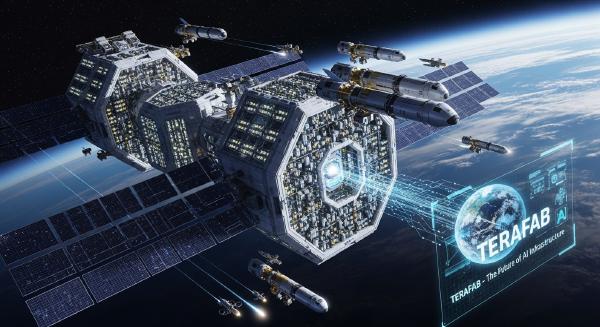
SpaceX’s Orbital AI initiative aims to extend computing capabilities beyond terrestrial data centers.
The broader concept envisions orbital computing infrastructure capable of supporting:
- Global Starlink network optimization
- Autonomous satellite operations
- Real-time AI inference in space
- Deep-space mission processing
- Distributed communications intelligence
- Future space-based cloud services
Such a vision aligns with a growing industry trend toward deploying intelligence closer to where data is generated rather than routing everything through Earth-based infrastructure.
However, unlike conventional cloud computing projects, orbital AI systems face a unique challenge: every unit of computing capacity must first be manufactured on Earth before it can be launched into orbit.
As a result, semiconductor availability becomes a critical dependency.
🔥 GPU Supply Has Become the Primary Constraint #
The most significant risk identified in the filing is the availability of AI accelerators.
Modern AI infrastructure relies heavily on high-performance GPUs and specialized accelerators for:
- Model training
- Inference workloads
- Real-time analytics
- Distributed AI services
Demand for these processors has surged dramatically in recent years as enterprises, cloud providers, research organizations, and governments race to build AI infrastructure.
For SpaceX, this creates a difficult situation.
Reliance on Purchase Orders #
The company currently acquires GPU resources primarily through standard purchase-order procurement.
This approach provides flexibility but offers limited protection against supply disruptions.
Without long-term supply commitments, SpaceX remains exposed to:
- Capacity shortages
- Vendor prioritization changes
- Manufacturing delays
- Logistics disruptions
- Geopolitical instability
When demand exceeds supply, customers with multi-year agreements often receive priority access, while spot-market buyers face greater uncertainty.
Industry-Wide Competition for Capacity #
The challenge is compounded by intense competition across the AI ecosystem.
Large technology companies have committed enormous capital toward securing future AI infrastructure capacity.
As a result:
- Advanced packaging capacity is constrained
- High-end GPU allocation remains limited
- Supply commitments are increasingly concentrated among major hyperscalers
- Lead times for advanced AI hardware remain elevated
For organizations attempting to rapidly scale compute-intensive initiatives, securing sufficient hardware has become nearly as important as developing the software itself.
🏭 TeraFab: A Strategic Attempt to Control Supply #
To reduce dependence on external suppliers, SpaceX is reportedly pursuing a more ambitious strategy: participating in the development of a domestic semiconductor manufacturing facility known as TeraFab.
The proposed facility would aim to manufacture advanced AI chips using next-generation semiconductor processes.
If successful, the project could provide several advantages:
- Greater supply chain control
- Reduced dependence on external foundries
- Improved hardware availability
- Strategic vertical integration
- Enhanced long-term scalability
For a company whose future increasingly depends on computing infrastructure, such a move would represent a logical extension of its broader integration strategy.
SpaceX has historically sought greater control over critical technologies ranging from launch systems to satellite manufacturing. Semiconductor production could become the next frontier in that approach.
⚠️ Significant Risks Surround the Project #
Despite its potential benefits, TeraFab faces substantial uncertainties.
Semiconductor fabrication plants represent some of the most expensive industrial projects in the world.
Building a leading-edge facility requires:
- Tens of billions of dollars in investment
- Multi-year construction schedules
- Advanced manufacturing expertise
- Complex equipment supply chains
- Process qualification and yield optimization
Even under ideal conditions, bringing a modern fab online is an exceptionally difficult undertaking.
Partnership Uncertainty #
One of the most notable concerns is the preliminary nature of the reported agreements supporting the project.
According to disclosures, key participants currently operate under framework arrangements rather than fully binding commitments.
This introduces several risks:
- Strategic priorities may change
- Partners could reduce participation
- Funding commitments may evolve
- Technology roadmaps could shift
Large-scale semiconductor projects typically depend on stable, long-term collaboration among multiple stakeholders. Any significant change in participation could materially alter project economics or timelines.
Technology and Execution Risk #
Even if all parties remain committed, execution remains challenging.
Advanced process nodes require years of refinement before achieving:
- Competitive yields
- Stable production
- Cost efficiency
- Volume manufacturing capability
History shows that semiconductor manufacturing success depends not only on facility construction but also on operational excellence after the facility becomes operational.
🌎 Supply Chains Remain the Ultimate Constraint #
One of the most important lessons from SpaceX’s filing is that even the world’s most innovative engineering organizations remain dependent on broader industrial ecosystems.
SpaceX has demonstrated remarkable success in:
- Rocket reusability
- Satellite production
- Launch operations
- Space logistics
Yet none of these strengths eliminate the need for advanced semiconductor manufacturing capacity.
The semiconductor industry operates according to physical constraints that cannot be bypassed through software innovation alone.
These constraints include:
- Wafer fabrication capacity
- Advanced packaging availability
- Equipment lead times
- Materials sourcing
- Manufacturing yields
Even organizations with significant financial resources must compete for access to these finite resources.
🛰️ Why Orbital AI Requires Massive Compute Resources #
The Orbital AI concept is particularly compute-intensive because of the scale of the intended workloads.
Potential applications include:
Starlink Network Intelligence #
Managing thousands of satellites requires continuous optimization of:
- Routing decisions
- Network balancing
- Traffic prioritization
- Resource allocation
Autonomous Space Operations #
Future spacecraft may increasingly rely on onboard AI for:
- Navigation
- Fault detection
- Resource management
- Mission planning
Real-Time Data Processing #
Space-based sensors generate enormous quantities of data.
Processing information closer to the source can reduce:
- Communication latency
- Bandwidth requirements
- Ground infrastructure dependence
Each of these applications places substantial demands on computing infrastructure, making accelerator availability a foundational requirement rather than a secondary concern.
📈 A Broader Lesson for the AI Industry #
SpaceX’s situation reflects a challenge facing the entire AI sector.
Much public attention focuses on:
- Model architectures
- AI breakthroughs
- Software capabilities
- Agent systems
Yet the ability to deploy these technologies ultimately depends on hardware availability.
As AI workloads continue growing, organizations increasingly compete not only for talent and algorithms but also for:
- GPUs
- Foundry capacity
- Packaging resources
- Energy infrastructure
- Data center construction
In many cases, supply chain execution has become as strategically important as technical innovation.
🔮 Conclusion #
SpaceX’s Orbital AI initiative represents one of the more ambitious attempts to extend AI infrastructure beyond Earth’s surface. However, the company’s IPO disclosures reveal that the path forward is constrained by a challenge shared across the technology industry: limited access to advanced computing hardware.
GPU shortages, intense competition for semiconductor capacity, and uncertainty surrounding the proposed TeraFab facility introduce significant execution risks. Even if SpaceX succeeds in advancing its manufacturing strategy, meaningful increases in chip supply will likely require years of investment and operational development.
The broader lesson is clear. Breakthrough technologies rarely succeed through innovation alone. Whether in artificial intelligence, aerospace, or cloud computing, long-term success ultimately depends on the strength and resilience of the underlying supply chain. For SpaceX’s Orbital AI vision, the availability of advanced semiconductors may prove just as important as rockets and satellites.