A20 Pro Hits 4.93 GHz: Why Apple’s 2nm Chip Is So Fast
Apple’s A20 Pro could deliver a larger CPU performance jump than initially expected.
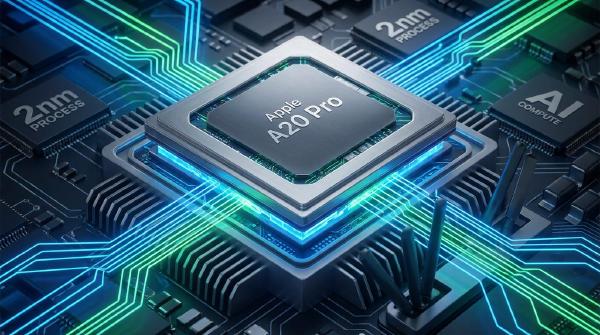
Early, unverified entries in the Geekbench 6 database show Apple’s upcoming 2nm smartphone SoC reaching a CPU clock speed of approximately 4.93 GHz, alongside single-core scores approaching 4,700 points and multi-core scores above 12,500.
If these results are representative of final retail hardware, the A20 Pro could exceed Apple’s stated performance improvement for its redesigned CPU cores.
The A20 Pro is expected to power the iPhone 18 Pro lineup and Apple’s upcoming foldable iPhone Duo, making its efficiency and performance particularly important across both traditional flagship and new form-factor devices.
📊 Early Geekbench Results Point to a Major CPU Jump #
The first benchmark entries reportedly associated with the A20 Pro show impressive theoretical CPU performance.
An iPhone 18 Pro sample recorded approximately:
- Single-core: 4,719
- Multi-core: 12,677
- CPU clock: ~4.93 GHz
A separate iPhone 18 Pro Max entry produced similar results:
- Single-core: 4,725
- Multi-core: 12,575
- CPU clock: ~4.93 GHz
Using approximate A19 Pro results of 3,800 single-core and 10,000 multi-core as a baseline, these figures imply roughly:
| Metric | A19 Pro | A20 Pro | Approx. Gain |
|---|---|---|---|
| Single-core | ~3,800 | ~4,719–4,725 | ~21–25% |
| Multi-core | ~10,000 | ~12,575–12,677 | ~26–28% |
Apple previously announced approximately a 20% performance increase for the A20 Pro’s super cores.
If independent testing eventually confirms these Geekbench results, the overall theoretical CPU uplift could therefore exceed Apple’s initial headline figure.
Why These Numbers Are Still Preliminary #
The benchmark entries should not yet be treated as definitive retail performance data.
Early Geekbench submissions can be affected by factors such as:
- Pre-release system software
- Thermal conditions
- Background processes
- Benchmark configuration
- Power-management behavior
- Engineering-sample hardware
Geekbench is also primarily useful for measuring short-duration CPU workloads. It does not necessarily represent sustained performance during extended gaming, video processing, or other thermally intensive workloads.
The final A20 Pro evaluation will require independent testing on retail devices.
⚡ The 4.93 GHz Clock Speed Is the Biggest Clue #
The most striking detail in the early results is not necessarily the benchmark score. It is the reported 4.93 GHz CPU frequency.
For comparison, the A19 Pro reportedly operates at around 4.26 GHz.
That represents a substantial increase in peak clock speed within a single generation.
Clock frequency alone does not determine CPU performance. Architecture, IPC, cache behavior, memory subsystem performance, compiler optimization, and workload characteristics all contribute to the final result.
However, when a higher clock speed is combined with redesigned CPU cores and a more advanced manufacturing process, the potential performance increase becomes much more significant.
The A20 Pro therefore appears to be benefiting from multiple improvements at once:
2nm process + redesigned CPU cores + higher clock frequency
This combination could explain why early benchmark results appear to exceed Apple’s initial performance claims.
🧬 How the 2nm Process Enables Higher Frequencies #
Moving to a 2nm-class process provides Apple with additional transistor-density and power-efficiency headroom.
A more advanced process can potentially allow Apple to increase performance without proportionally increasing power consumption. Alternatively, the company can use the efficiency gains to raise operating frequencies while keeping power within the thermal limits of a smartphone.
For a mobile SoC, this trade-off is especially important.
Smartphones have extremely limited cooling capacity compared with desktops and servers. A processor can theoretically run at a very high frequency, but maintaining that frequency under sustained workloads is much more difficult.
The A20 Pro’s redesigned performance cores and efficiency cores therefore matter just as much as the process technology itself.
🔮 A20 Pro Combines High-Performance and Efficiency Cores #
According to the announced specifications, the A20 Pro uses a six-core CPU consisting of:
- 2 super cores
- 4 efficiency cores
The architecture is designed to balance peak responsiveness with power efficiency.
The super cores can handle demanding short-duration workloads where maximum performance matters, while the efficiency cores can process lighter background and sustained tasks at lower power.
This asymmetric design is particularly important for mobile devices because most smartphone workloads do not require all CPU resources to operate at maximum frequency simultaneously.
The ability to deliver very high single-threaded performance while keeping everyday workloads efficient remains one of the key characteristics of Apple’s mobile processor strategy.
🎮 GPU and Neural Processing Also Get Major Hardware #
CPU performance is only one component of the A20 Pro.
The SoC also integrates a 7-core GPU with Neural Accelerators, along with a dual 16-core Neural Engine.
Hardware-accelerated ray tracing is also supported.
This combination is designed to handle a broad range of workloads, including:
- Mobile gaming
- Computational photography
- Generative AI
- On-device machine learning
- Graphics rendering
- Camera processing
- Augmented and spatial computing workloads
The Neural Accelerators integrated into the GPU are particularly relevant as more AI workloads move directly onto smartphones.
Rather than relying exclusively on the CPU or dedicated Neural Engine, Apple can distribute workloads across different compute blocks depending on their characteristics.
📱 Which iPhones Will Use the A20 Pro? #
The A20 Pro is expected to appear across Apple’s premium smartphone lineup.
Compatible devices are expected to include:
- iPhone 18 Pro
- iPhone 18 Pro Max
- iPhone Duo, Apple’s foldable model
That makes the A20 Pro an important platform for both Apple’s conventional flagship smartphones and its new foldable form factor.
The foldable device could benefit particularly from the combination of high performance and improved efficiency, as a thinner or more constrained chassis can make thermal management more challenging.
🔬 Geekbench Does Not Tell the Whole Story #
A 4.93 GHz clock speed looks impressive, but it should not automatically be interpreted as meaning that the A20 Pro will deliver a 15% or 20% better real-world experience in every workload.
Peak CPU frequency primarily tells us how quickly the processor can execute work under favorable conditions.
Real-world performance depends on additional factors:
IPC × Clock Speed × Parallelism × Memory Performance × Software Optimization
Sustained workloads introduce another variable: thermal throttling.
A smartphone may be able to reach 4.93 GHz for a short benchmark burst but operate at a lower frequency once the device reaches its thermal limits.
This is why longer gaming tests, sustained CPU workloads, battery measurements, and thermal analysis will be more informative than a handful of early Geekbench submissions.
🗓️ Retail Testing Will Provide the Real Answer #
Apple’s announced launch schedule places the new A20 Pro-powered devices in retail stores on September 18.
Reviews are expected to arrive shortly before the retail launch, providing the first comprehensive look at the processor under controlled independent testing.
Those reviews should answer several important questions:
- Can the A20 Pro sustain its higher clock speeds?
- How much power does the 4.93 GHz configuration consume?
- How large is the real-world CPU performance increase?
- Does the 2nm process meaningfully improve battery life?
- How does the A20 Pro perform during extended gaming?
- How much faster are its AI and graphics capabilities?
Until those tests are available, the leaked Geekbench scores should be treated as an early indication rather than a final verdict.
🔮 Why the A20 Pro Could Be a Major Mobile CPU Upgrade #
The A20 Pro’s reported 4.93 GHz frequency is notable because it suggests Apple is combining architectural improvements with aggressive frequency scaling.
If the early Geekbench results are genuine and representative of retail hardware, the processor could deliver a CPU performance increase beyond Apple’s stated 20% target.
The bigger story, however, is the combination of technologies behind that result.
A 2nm manufacturing process, redesigned CPU cores, higher operating frequencies, upgraded GPU and Neural Engine capabilities, and hardware-accelerated ray tracing give the A20 Pro a broad set of improvements rather than relying on clock speed alone.
The final test will be whether Apple can translate that theoretical performance into sustained performance, better efficiency, and meaningful improvements in everyday workloads.
If it can, the A20 Pro could establish a new performance benchmark for smartphone SoCs while demonstrating just how much headroom Apple’s custom silicon strategy still has.