RX 9070 GRE Emerges as a $550 GPU Value Leader
Rising graphics card prices are reshaping the mid-range GPU market in 2026, and the Radeon RX 9070 GRE has unexpectedly become one of the most compelling options around the $550 price point.
According to market observations from hardware outlet Club386, several mainstream gaming GPUs have experienced substantial retail price increases, particularly models equipped with 16GB of memory. Meanwhile, the RX 9070 GRE has remained close to its official $549 MSRP in U.S. retail listings.
That creates an unusual situation: a graphics card that initially faced criticism for its positioning now offers performance close to the GeForce RTX 5070 while potentially costing around $250 less.
The product itself has not fundamentally changed. Instead, the surrounding market has.
💰 GPU Price Inflation Changes the Value Equation #
Mid-range GPU pricing has become increasingly difficult to evaluate using launch MSRP alone.
Rising memory costs, component allocation, and constrained supply have pushed several popular graphics cards significantly above their original launch prices. As a result, GPUs that once occupied attractive price segments can now overlap with substantially faster products.
The RX 9070 GRE benefits directly from this distortion because its retail price has remained comparatively stable.
Current Price Landscape #
| GPU | Approx. Retail Price | VRAM | Market Position |
|---|---|---|---|
| Radeon RX 9070 GRE | $549.99 | 12GB GDDR6 | Strong $550 value |
| GeForce RTX 5070 | ~$799 | 12GB | ~ $250 premium |
| Radeon RX 9060 XT 16GB | ≥$519 | 16GB | Lower performance tier |
| GeForce RTX 5060 Ti 16GB | Up to ~$788 | 16GB GDDR7 | Severe price inflation |
| GeForce RTX 5060 Ti 8GB | ~$499 | 8GB | Limited VRAM |
| Radeon RX 9070 16GB | ≥$649 | 16GB | Higher tier |
| Radeon RX 9070 XT 16GB | ≥$749 | 16GB | Higher performance tier |
| Intel Arc B580 | ~$309.99 | 12GB | Budget alternative |
The result is a compressed and distorted mid-range market in which the RX 9070 GRE can compete against products that were never originally positioned as direct alternatives.
🧩 RX 9070 GRE Positioning and Specifications #
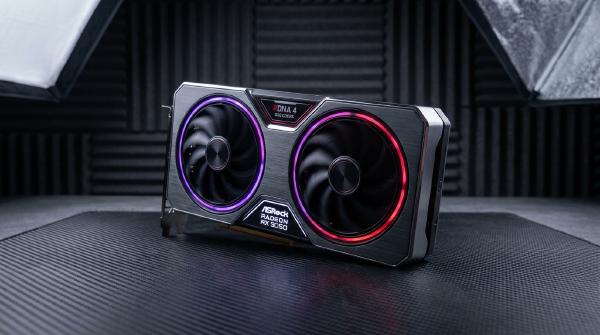
The Radeon RX 9070 GRE is based on AMD’s RDNA 4 architecture and uses the Navi 48 GPU die.
The card features:
- 12GB GDDR6 VRAM
- 192-bit memory bus
- RDNA 4 architecture
- Positioning between the RX 9060 XT and RX 9070
Originally introduced as a China-exclusive model, the RX 9070 GRE received a global launch in June 2026 with an official MSRP of $549.
Its 12GB memory configuration initially made its positioning difficult to justify. The card offered less VRAM than the standard RX 9070 while occupying a relatively narrow price gap.
That calculation changes considerably when competing products become more expensive.
📊 RTX 5070 Performance at a Lower Price #
The biggest advantage of the RX 9070 GRE is its performance relative to the RTX 5070.
Available benchmark data places the RX 9070 GRE approximately 3% to 4% behind the RTX 5070 in average overall performance. In some rasterized workloads, the AMD card can even pull ahead.
At approximately $549.99 versus roughly $799 for the RTX 5070, the price difference is therefore much larger than the performance difference.
| Comparison | RX 9070 GRE vs. RTX 5070 |
|---|---|
| Average performance deficit | ~3%–4% |
| RX 9070 GRE price | ~$549 |
| RTX 5070 street price | ~$799 |
| Approx. price difference | ~$250 |
| Performance gap | Small |
This changes the value proposition substantially. A buyer who prioritizes raw rasterization performance and conventional 1440p gaming may have little reason to spend an additional $250 if the two GPUs deliver broadly similar frame rates.
🎮 1440p Gaming and Ray Tracing Performance #
The RX 9070 GRE is particularly interesting for high-refresh 1440p gaming, where its GPU performance allows it to outperform lower-tier cards with larger memory capacities.
Ray tracing remains an important consideration, however.
In Cyberpunk 2077 using the RT Ultra preset at 1440p, with FSR 4 and DLSS 4 Quality modes and frame generation disabled, the RX 9070 GRE reportedly trails the RTX 5070 by approximately 4 to 5 FPS.
That is a relatively narrow gap considering the substantially different retail prices.
Stronger GPU Performance Can Outweigh VRAM Capacity #
The RX 9070 GRE’s 12GB VRAM configuration is one of its primary compromises.
On paper, 16GB cards such as the RX 9060 XT and RTX 5060 Ti can appear more attractive for long-term use because of their larger memory capacity. However, VRAM capacity alone does not determine gaming performance.
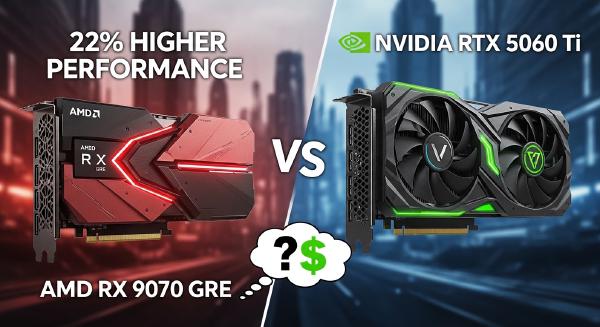
In Final Fantasy XIV: Dawntrail, the RX 9070 GRE reportedly runs approximately 43.5% faster than the 16GB RX 9060 XT and 28% faster than the 16GB RTX 5060 Ti.
The comparison demonstrates the distinction between memory capacity and GPU compute performance: having more VRAM does not compensate for a substantially weaker GPU when the workload remains compute-limited.
🔮 NVIDIA’s Software Advantage Still Matters #
The RTX 5070 retains an important advantage in NVIDIA’s software ecosystem.
NVIDIA’s proprietary technologies, including DLSS, Frame Generation, and Multi-Frame Generation, can provide capabilities that AMD’s Radeon platform does not directly replicate on an equivalent basis.
These features can be decisive when competing products are similarly priced.
However, a roughly $250 price difference changes the calculation. Buyers must decide whether NVIDIA’s software ecosystem and feature set justify paying substantially more for a GPU that delivers only a small difference in conventional rendering performance.
For users who specifically prioritize DLSS-based features, advanced frame generation, or NVIDIA’s broader software stack, the RTX 5070 may remain preferable. For buyers focused primarily on rasterization performance per dollar, the RX 9070 GRE becomes much harder to ignore.
💾 The 8GB GPU Problem Is Becoming More Visible #
The broader market distortion is also exposing the limitations of 8GB graphics cards.
Recent games are increasingly capable of exceeding the practical memory capacity of 8GB GPUs at high-quality settings. Indiana Jones and the Great Circle, for example, can require substantially reduced graphics settings for smooth gameplay on 8GB configurations, while Forza Motorsport can exhibit noticeable performance degradation.
This makes 12GB and 16GB GPUs increasingly attractive for buyers planning to keep a graphics card for several years.
However, the current pricing environment creates a difficult trade-off: some 16GB mid-range cards now cost almost as much as significantly faster 12GB GPUs.
The RX 9070 GRE sits directly in that gap.
⚖️ Why the RX 9070 GRE Suddenly Makes Sense #
The RX 9070 GRE’s improved value is primarily a consequence of market-wide price inflation rather than a change in the GPU itself.
At launch, its 12GB VRAM and relatively narrow price separation from the RX 9070 made the product difficult to position. But after competing GPUs experienced significant price increases, its $549 MSRP became much more competitive.
Three factors now work in its favor:
- RTX 5070 prices have climbed substantially, creating a large price gap.
- 16GB mid-range GPUs have also become more expensive, weakening their traditional value proposition.
- The RX 9070 GRE’s raw performance remains close to the RTX 5070, particularly in rasterized gaming.
This combination turns what was once an awkward product into a compelling mid-range option.
🔭 The $550 GPU Market Has Been Reshaped #
The RX 9070 GRE is a good example of how GPU value can change without any hardware revision.
At its original launch position, the card’s 12GB VRAM and proximity to the RX 9070 created legitimate concerns about its value. In today’s market, however, competing price increases have dramatically changed that equation.
For around $550, the RX 9070 GRE offers performance close to the RTX 5070 while substantially undercutting its current street price. It also provides more GPU performance than lower-tier 16GB alternatives, making it particularly attractive for 1440p gaming.
The main compromises remain its 12GB VRAM capacity and NVIDIA’s stronger proprietary software ecosystem.
Ultimately, the RX 9070 GRE’s current appeal is a product of both hardware capability and market conditions. If its retail price remains close to $549 while competing GPUs stay inflated, it becomes one of the strongest performance-per-dollar options in the mid-range segment.
Because GPU pricing remains volatile, buyers should verify current retail and regional pricing before making a purchase.