AMD RX 9070 GRE Review: Faster Than RTX 5060 Ti, But Is It Worth It?
At COMPUTEX 2026, AMD officially unveiled the Radeon RX 9070 GRE, expanding its RDNA 4 graphics card lineup into the increasingly competitive upper-midrange gaming segment. AMD claims the new card delivers up to 22% higher performance than NVIDIA’s GeForce RTX 5060 Ti while targeting mainstream 1440p gaming workloads.
On paper, the RX 9070 GRE appears to be an attractive addition to AMD’s portfolio. However, its launch pricing has sparked debate among enthusiasts and system builders. While performance is competitive, the card sits uncomfortably close to more powerful alternatives from both AMD and NVIDIA, raising questions about its overall value proposition.
🎮 RX 9070 GRE: Expanding Beyond the Asia-Pacific Market #
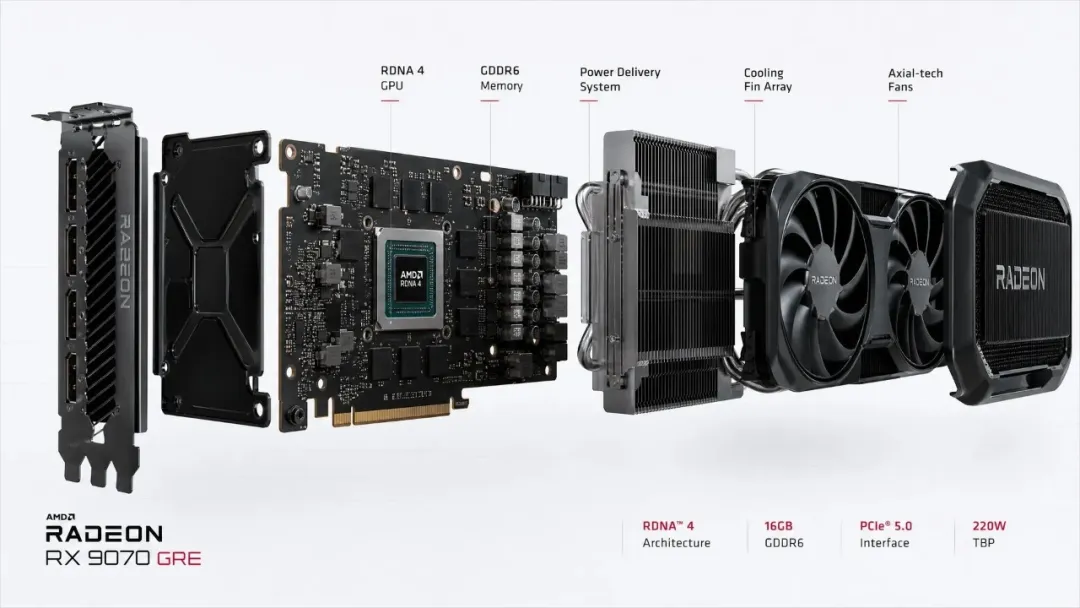
The “GRE” branding stands for Golden Rabbit Edition, a product family previously limited to select Asia-Pacific markets.
For the first time, AMD is bringing the GRE series to a broader global audience, positioning the RX 9070 GRE as a bridge between mainstream and enthusiast-class gaming GPUs.
The card is designed primarily for:
- 1440p high-settings gaming
- Ray-traced gaming workloads
- Entry-level AI acceleration
- Content creation and streaming
Its goal is to fill a performance and pricing gap within AMD’s RDNA 4 product stack.
⚙️ RX 9070 GRE Specifications #
Built on AMD’s RDNA 4 architecture, the RX 9070 GRE incorporates a scaled-down configuration compared to the standard RX 9070.
Key Specifications #
| Specification | RX 9070 GRE |
|---|---|
| Architecture | RDNA 4 |
| Compute Units | 48 |
| Ray Tracing Accelerators | 48 |
| AI Accelerators | 96 |
| Boost Clock | Up to 2.79 GHz |
| Memory | 12GB GDDR6 |
| Memory Bus | 192-bit |
| Memory Bandwidth | 482 GB/s |
| TBP | 220W |
AMD positions the card as a dedicated 1440p gaming solution capable of running modern AAA titles at high settings while supporting next-generation rendering technologies.
📊 How It Compares to the Standard RX 9070 #
Although the RX 9070 GRE belongs to the same family, significant hardware reductions separate it from the standard RX 9070.
RX 9070 GRE vs RX 9070 #
| Specification | RX 9070 GRE | RX 9070 |
|---|---|---|
| Compute Units | 48 | 56 |
| RT Accelerators | 48 | 58 |
| AI Accelerators | 96 | 112 |
| VRAM | 12GB | 16GB |
| Memory Bandwidth | 482 GB/s | 644 GB/s |
| Boost Clock | 2.79 GHz | 2.52 GHz |
The GRE model compensates for reduced hardware resources with a higher boost frequency. However, frequency alone cannot fully offset reductions in:
- Shader resources
- Ray tracing hardware
- AI acceleration capacity
- Memory capacity
- Memory bandwidth
As a result, a noticeable performance gap remains between the GRE and the standard RX 9070.
🚀 Performance Claims Against RTX 5060 Ti #
AMD’s internal benchmarks show impressive results.
According to official testing across more than 40 rasterized and ray-traced titles, the RX 9070 GRE can deliver performance gains of up to 22% over the GeForce RTX 5060 Ti 16GB.
This positions the card favorably for:
- Traditional rasterized gaming
- High-refresh-rate 1440p gaming
- Modern DirectX 12 titles
- Select ray-tracing workloads
For gamers focused primarily on raw frame rates, the RX 9070 GRE appears highly competitive.
💰 Pricing Creates a Difficult Position #
Despite promising performance figures, pricing has become the central point of criticism.
AMD launched the RX 9070 GRE at:
$549 MSRP
The issue is that this price overlaps with several stronger alternatives.
Current Market Positioning #
| GPU | Approximate Price |
|---|---|
| RX 9070 GRE | $549 |
| RTX 5060 Ti 16GB | ~$559 |
| RX 9070 | ~$599 |
| RTX 5070 | ~$619 |
This creates a challenging value proposition.
For roughly:
- $50 more, buyers can obtain a full RX 9070 with 16GB VRAM and significantly stronger specifications.
- $70 more, buyers can move into RTX 5070 territory.
Because of these small pricing gaps, many enthusiasts expected the RX 9070 GRE to launch closer to the $499 range.
🎯 The Importance of VRAM in 2026 #
The decision to equip the RX 9070 GRE with 12GB of GDDR6 memory has also generated discussion.
For most current gaming scenarios:
- 1440p high settings remain comfortable
- Standard ray tracing workloads remain manageable
- Competitive multiplayer titles pose no issues
However, memory demands continue rising rapidly.
Scenarios Where 16GB Matters #
A larger memory pool becomes increasingly beneficial for:
- High-resolution texture packs
- Advanced ray tracing settings
- AI-assisted content generation
- Large creative workloads
- Future AAA game releases
While 12GB remains sufficient today, 16GB provides greater longevity and flexibility.
This is one reason why many buyers may choose to spend slightly more for the standard RX 9070.
🎮 Real-World Gaming Positioning #
The RX 9070 GRE is best suited for gamers seeking:
- Strong 1440p performance
- High frame rates in modern titles
- Competitive rasterization performance
- Better value than some NVIDIA alternatives
Typical gaming expectations include:
- High or Ultra settings at 1440p
- Smooth ray-traced gameplay in supported titles
- Strong performance in esports games
- Support for AMD’s latest upscaling technologies
For users primarily interested in gaming, the card remains capable despite the pricing concerns.
🔥 FSR 4 Ecosystem Continues to Expand #
Alongside the RX 9070 GRE launch, AMD provided an update on the evolution of its FidelityFX Super Resolution ecosystem.
Current FSR 4 Status #
AMD reports that FSR 4 now supports more than:
300 games
This continued expansion significantly strengthens the long-term value of Radeon hardware.
Upcoming Compatibility Roadmap #
July 2026 #
FSR 4.1 support arrives for:
- Radeon RX 7000 Series
- RDNA 3 architecture GPUs
Early 2027 #
FSR 4.1 expands to:
- Radeon RX 6000 Series
- RDNA 2 architecture GPUs
This broader support means many existing Radeon users can benefit from improved image quality and performance without upgrading hardware.
🛒 Buying Recommendation #
The RX 9070 GRE is not a bad graphics card. In fact, its underlying hardware and claimed gaming performance make it a strong 1440p solution.
The challenge lies almost entirely in its pricing.
Who Should Consider It? #
The RX 9070 GRE makes sense for:
- Gamers specifically targeting 1440p
- Buyers who find discounted retail pricing
- Users invested in the Radeon ecosystem
- Those seeking stronger rasterization performance than the RTX 5060 Ti
Who Should Wait? #
It may be worth holding off if:
- The card remains at its launch MSRP
- The standard RX 9070 is available within $50
- The RTX 5070 is available within $70
- Future price reductions appear likely
Many analysts view:
- $499 as a more reasonable launch price
- $449 as the point where the card becomes highly competitive
At those levels, the RX 9070 GRE would occupy a much stronger position in the market.
🏁 Conclusion #
The Radeon RX 9070 GRE introduces RDNA 4 technology to a new segment of the market and delivers impressive performance claims, including up to a 22% advantage over the RTX 5060 Ti in AMD’s internal testing.
From a technical perspective, it offers a compelling blend of modern features, ray tracing capabilities, AI acceleration, and strong 1440p gaming performance. However, the card’s value proposition is undermined by its launch pricing, which places it uncomfortably close to more capable alternatives such as the RX 9070 and RTX 5070.
For now, the RX 9070 GRE is best viewed as a capable but aggressively priced mid-to-high-end GPU. If retail prices decline over the coming months, it could become one of the more attractive options in AMD’s RDNA 4 lineup. Until then, prospective buyers should carefully compare pricing across competing models before making a final purchase decision.