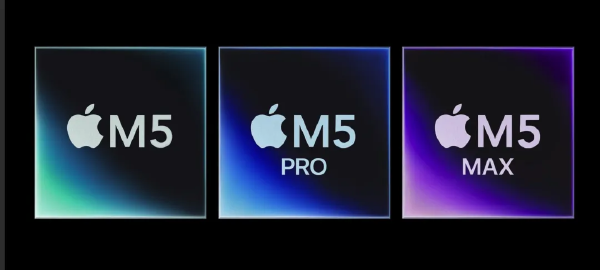
Apple M7 Ultra Rumored to Support Up to 1.5TB Unified Memory
A new supply chain report suggests Apple is making significant changes to its Apple Silicon roadmap, accelerating the transition to the M7 generation while introducing substantial upgrades to memory capacity, memory bandwidth, and on-device AI performance.
Among the most notable claims is that the future M7 Ultra could support up to 1.5TB of unified memory, dramatically expanding the capabilities of Apple’s highest-end workstation-class Macs. Although the roadmap remains unofficial, it provides an early look at how Apple may evolve its silicon strategy over the next several years.
🗓️ Apple May Accelerate Its High-End Silicon Roadmap #
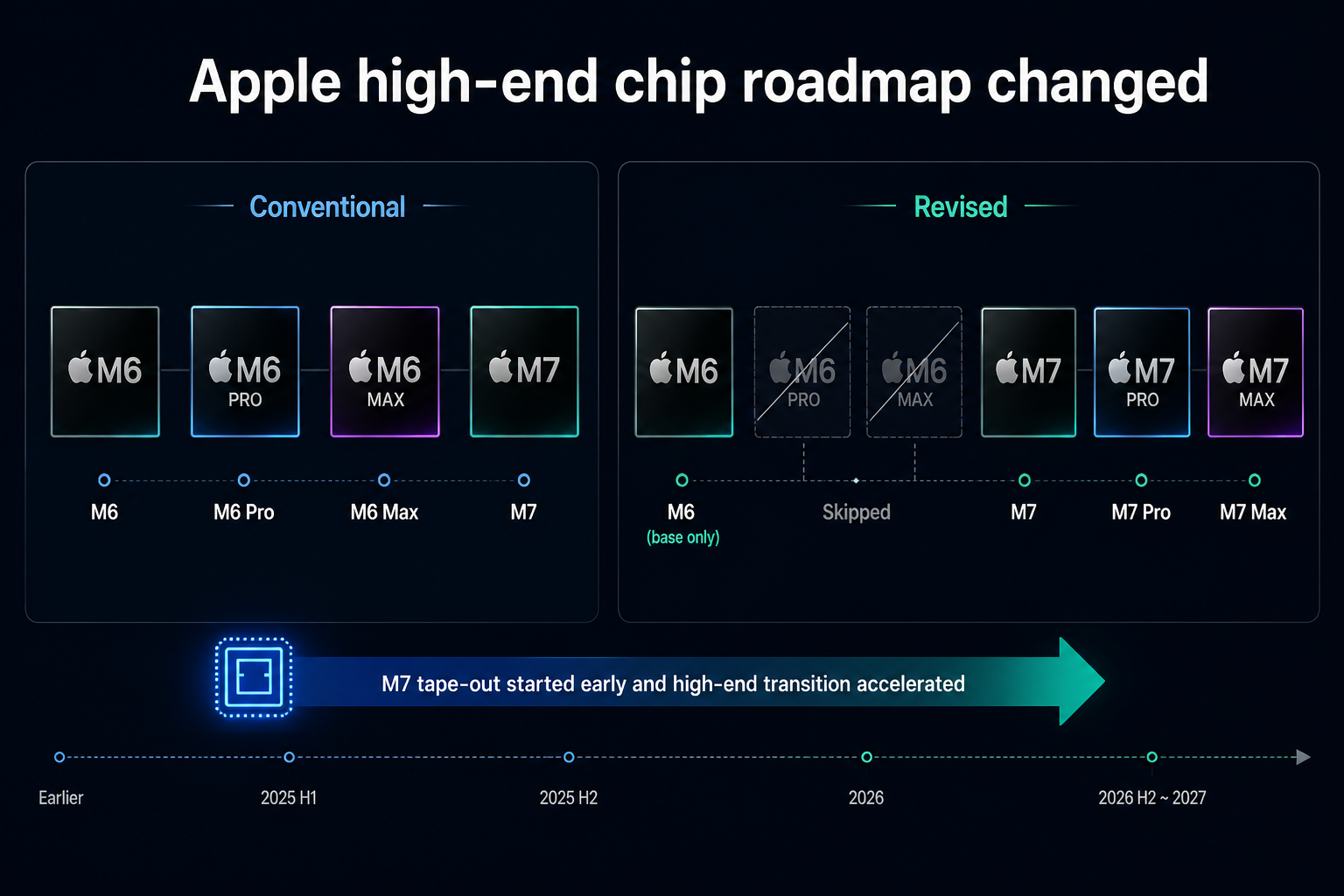
According to the latest rumors, Apple plans to release only the standard M6 processor while skipping the previously expected M6 Pro and M6 Max variants.
Instead, Apple’s premium desktop and notebook processors would transition directly to the M7 family.
The reported release timeline is as follows:
- M6: Expected later this year
- M7: First half of 2027
- M7 Pro and M7 Max: Second half of 2027
- M7 Ultra: Expected in 2028
Reports also indicate that the M7 entered tape-out approximately six months after the M6, suggesting Apple is shortening the development cycle between successive chip generations.
If accurate, this represents a departure from Apple’s traditional release cadence and could accelerate feature adoption across future Mac products.
🚀 Memory Bandwidth and AI Performance Receive Major Upgrades #
The roadmap suggests that Apple will continue prioritizing two areas across upcoming Apple Silicon generations:
- Higher unified memory bandwidth
- More powerful Neural Engine performance
M6 Focuses on Platform Improvements #
The base M6 processor is rumored to introduce:
- A redesigned memory subsystem
- An upgraded GPU architecture
- A next-generation Neural Engine
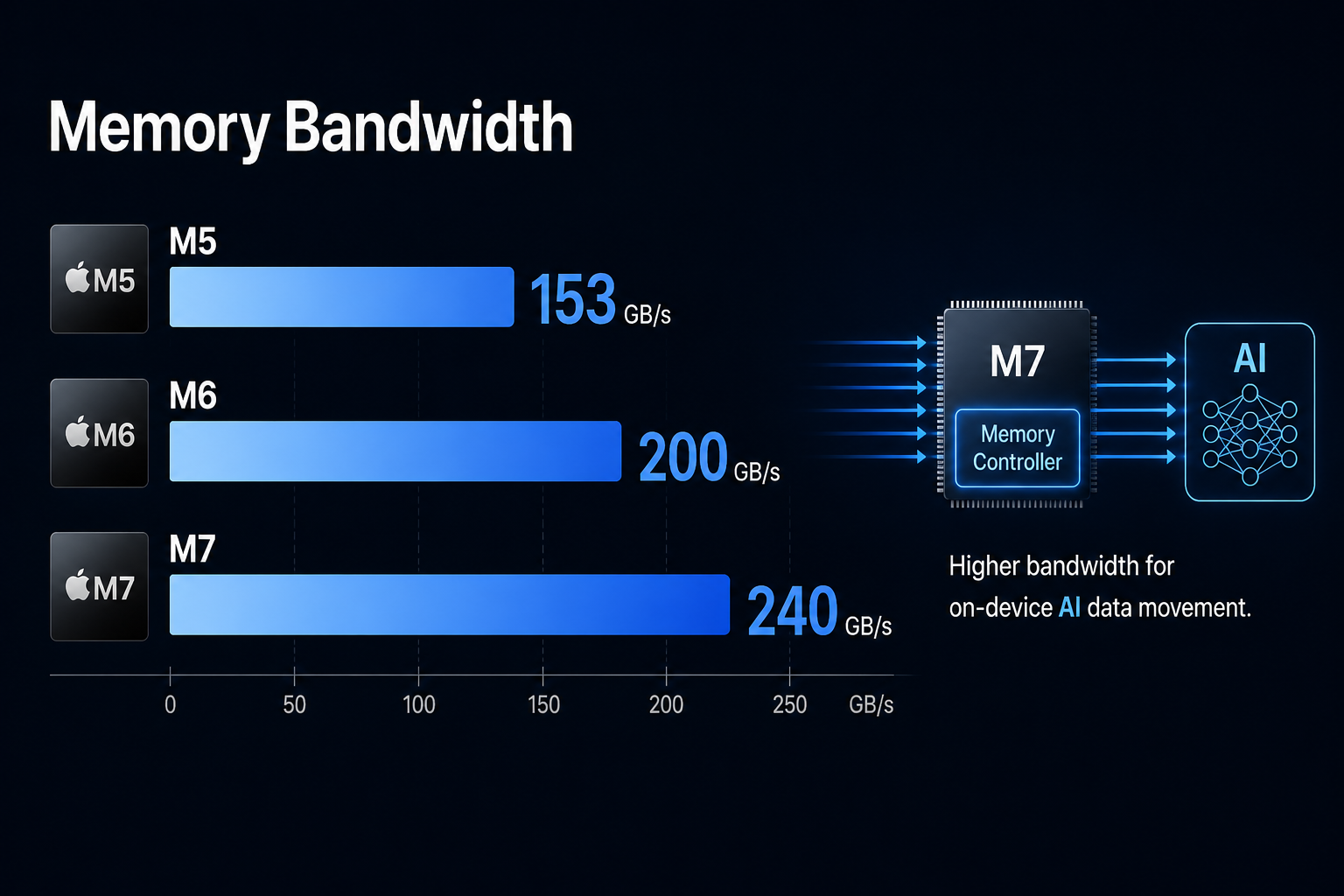
Memory bandwidth is expected to increase to approximately 200GB/s, compared to roughly 153GB/s on the rumored M5 generation.
Higher bandwidth enables the CPU, GPU, and Neural Engine to access shared memory more efficiently, improving performance in workloads such as:
- Professional video editing
- 3D rendering
- Large software builds
- Scientific computing
- AI inference
Because Apple Silicon uses a unified memory architecture, bandwidth improvements benefit every major processing unit on the chip rather than only the graphics subsystem.
M7 Expands Apple’s AI Ambitions #
The M7 generation is expected to place an even stronger emphasis on artificial intelligence.
Reports indicate Apple is developing a substantially more capable Neural Engine alongside increased memory throughput of approximately 240GB/s.
These improvements would better support:
- On-device generative AI
- Large language model inference
- AI-assisted creative applications
- Machine learning workloads
- Apple Intelligence features
As Apple continues expanding local AI capabilities throughout macOS, higher memory bandwidth is becoming increasingly important for maintaining low-latency inference without relying on cloud processing.
💾 M7 Ultra Could Double Memory Capacity Again #
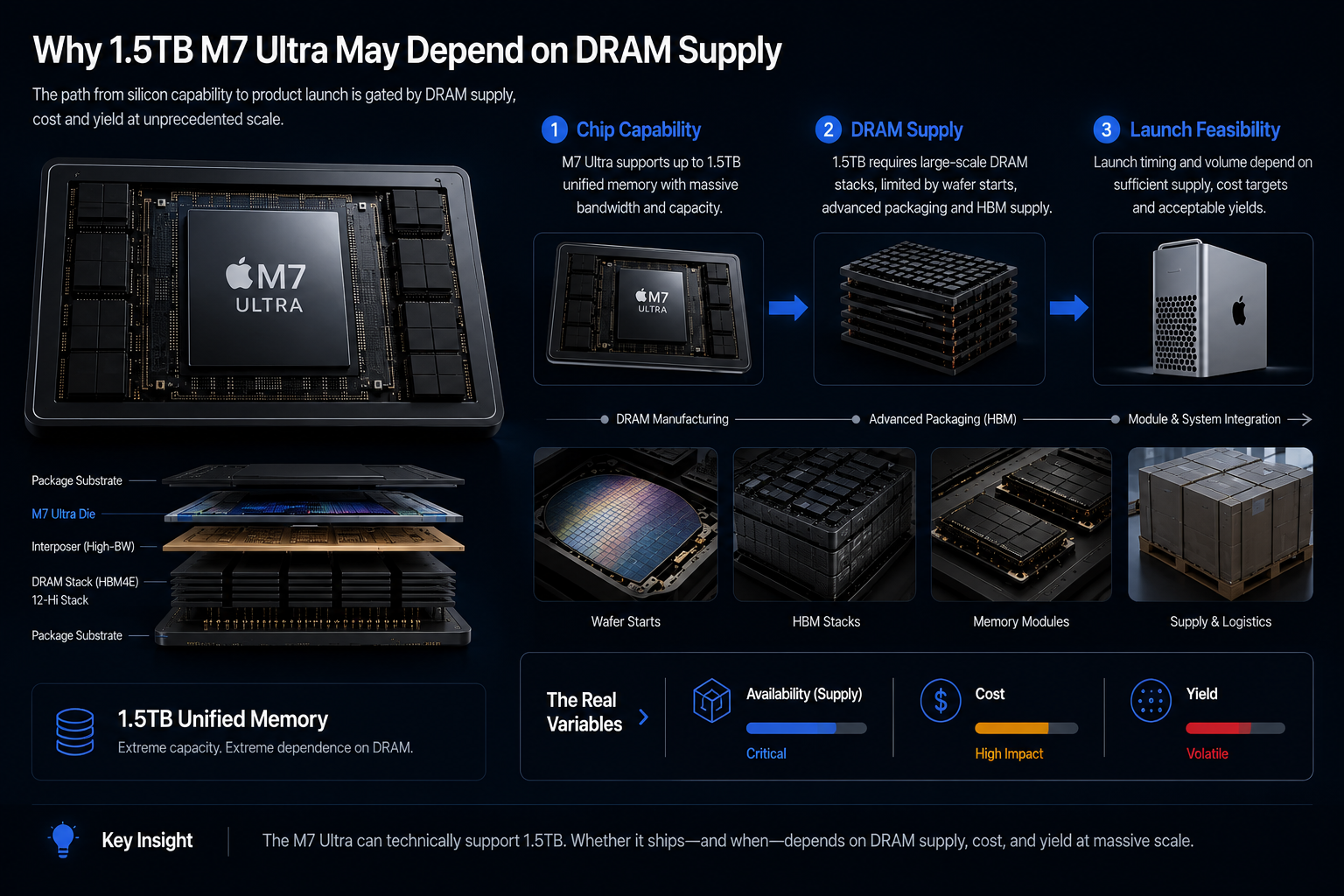
Perhaps the most striking rumor concerns the future M7 Ultra’s maximum unified memory configuration.
Reported capacity increases include:
| Chip | Maximum Unified Memory (Rumored/Current) |
|---|---|
| M3 Ultra | 512GB |
| M5 Ultra (Rumored) | 768GB |
| M7 Ultra (Rumored) | 1.5TB |
If realized, the M7 Ultra would triple the maximum memory available on the M3 Ultra while doubling the projected capacity of the M5 Ultra.
Such an increase would significantly expand the types of workloads that can remain entirely in memory.
Potential beneficiaries include:
- Large-scale AI model development
- Massive language model inference
- Film production pipelines
- Scientific simulations
- Enterprise virtualization
- Complex CAD and engineering projects
- Large 3D scene rendering
Apple’s unified memory architecture already provides exceptionally high bandwidth by allowing the CPU, GPU, and Neural Engine to share a single memory pool. Increasing that pool to 1.5TB would further strengthen Apple’s position in professional workstation computing.
⚠️ High-Capacity Models Remain Uncertain #
Despite the ambitious specifications, the rumored 1.5TB configuration should not be viewed as guaranteed.
Reports indicate that final product availability will depend heavily on the state of the DRAM market closer to launch.
Several factors could influence Apple’s final product lineup:
- Global DRAM supply
- Memory pricing
- Manufacturing yields
- Enterprise demand
- Overall production costs
If memory supply improves by the time the M7 Ultra enters production, Apple may choose to offer the highest-capacity configuration. Conversely, continued shortages or elevated DRAM prices could limit the available memory options.
As with previous Ultra-class processors, Apple may ultimately prioritize configurations that balance performance, manufacturing cost, and expected market demand.
🔬 Looking Beyond the M7 Generation #
The roadmap also references an early successor to the M7 family.
According to current reports, Apple is targeting 2028 for the introduction of the M8 processor, potentially manufactured using a 1.4nm process node.
Although detailed specifications have not yet surfaced, the chip is expected to continue Apple’s broader strategy of improving:
- AI acceleration
- Energy efficiency
- CPU performance
- GPU capabilities
- Memory subsystem performance
Additional technical details will likely emerge as development progresses.
📊 What It Means for Mac Buyers #
For most consumers, the rumored roadmap should not significantly influence near-term purchasing decisions.
The standard M6 is expected to arrive first, while the flagship M7 Ultra remains several years away. Users who need a new Mac today are unlikely to benefit from delaying an upgrade based on products that are still under development.
Professional users, however, may find the roadmap particularly interesting. If Apple successfully delivers workstation-class systems with up to 1.5TB of unified memory, future Ultra-based Macs could become even more compelling platforms for AI development, scientific computing, media production, and other memory-intensive workflows.
As with all early roadmap leaks, the reported specifications should be treated as preliminary until Apple officially announces its next generation of Apple Silicon processors.