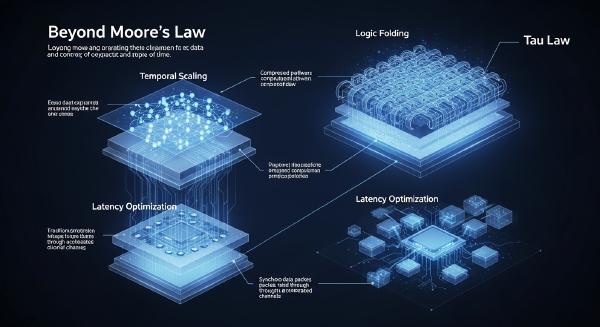
Huawei’s Tau Scaling Theory V2 Introduces an Engineering Roadmap Beyond Moore’s Law

Huawei’s Tau Scaling Theory V2
On July 3, 2026, He Tingbo, President of Huawei’s Semiconductor Business Department, released the second version (V2) of the research paper “A Time Scaling Theory for Multi-Layer Electronic Systems” on ChinaXiv, the Chinese Academy of Sciences’ scientific preprint platform.
The updated paper significantly expands upon the original V1 edition published in May by moving beyond theoretical concepts and introducing engineering methodologies, quantitative validation data, and long-term technology roadmaps. Collectively, these additions present a more comprehensive framework for what Huawei describes as Tau Scaling, a proposed post-Moore’s Law optimization model centered on system-wide latency rather than transistor dimensions.
Shortly after publication, the paper attracted substantial attention within the semiconductor research community, accumulating hundreds of thousands of views and tens of thousands of downloads on ChinaXiv.
⚡ Why Moore’s Law Is No Longer Enough #
The paper begins by addressing one of the semiconductor industry’s most widely recognized challenges: traditional geometric scaling is approaching practical and economic limits.
For decades, Moore’s Law delivered continuous improvements by reducing transistor dimensions, enabling higher transistor density while lowering cost per transistor. However, each new manufacturing node now requires dramatically greater engineering complexity and investment.
Several factors contribute to this shift:
- Escalating fabrication costs
- Increasing process complexity
- Slower improvements in transistor density
- Rising design verification expenses
- Greater power delivery and thermal challenges
According to the paper, leading-edge chip development can now require investments exceeding $1 billion, while the historical reduction in cost per transistor has slowed considerably.
Rather than relying exclusively on continued geometric shrinking, Huawei proposes an alternative optimization framework.
📐 Tau Scaling: A Time-Centric Optimization Model #
The central idea of Tau Scaling is straightforward but ambitious.
Instead of treating transistor area as the primary indicator of technological progress, the framework proposes time as the universal optimization objective.
Specifically, the theory introduces a characteristic time constant—τ (tau)—that serves as a common performance metric across every layer of the computing stack.
This unified metric extends from individual transistor switching events to complete data center workloads, spanning approximately twelve orders of magnitude in execution time.
Under this approach, improvements are evaluated by reducing latency throughout the entire system rather than optimizing isolated components independently.
The paper argues that this represents one of the first comprehensive attempts since Dennard Scaling to establish a single optimization target covering the entire computing hierarchy.
🏗️ A Four-Layer Optimization Framework #
Tau Scaling is built around coordinated optimization across four major engineering layers.
Rather than allowing each discipline to evolve independently, the framework encourages simultaneous improvements that collectively reduce overall execution time.
Transistor Layer #
At the device level, optimization focuses on reducing intrinsic switching delay through semiconductor process innovations.
Representative techniques include:
- Carrier mobility enhancement
- Strain engineering
- High-k dielectric materials
- Metal gate technologies
These improvements seek to increase switching speed while maintaining acceptable power characteristics.
Circuit Layer #
Circuit-level optimization targets signal propagation delays by improving electrical interconnects.
Areas of focus include:
- Lower-resistance conductors
- Low-k dielectric materials
- Three-dimensional integration
- Shorter signal paths
Reducing interconnect latency becomes increasingly important as transistor switching speeds continue to improve.
Chip Architecture Layer #
At the processor level, the framework emphasizes architectural efficiency.
Optimization areas include:
- Pipeline organization
- Cache hierarchy
- Memory subsystem design
- Instruction scheduling
- Compute-to-memory communication
The objective is to minimize the time required for data movement as well as computation.
System Layer #
The highest level addresses end-to-end system latency.
Key optimization targets include:
- Interconnect topology
- Communication protocols
- Distributed computing architecture
- System-level scheduling
- Data center networking
By coordinating improvements across every layer, Tau Scaling aims to reduce total application execution time rather than maximizing performance at only one level of the stack.
🔬 Engineering Validation Moves Beyond Theory #
Perhaps the most significant addition in Version 2 is the inclusion of engineering case studies intended to demonstrate practical implementation.
Instead of presenting Tau Scaling solely as a conceptual framework, the updated paper introduces production-oriented validation examples.
LogicFolding for Mobile SoCs #
One validation focuses on LogicFolding, a design methodology that vertically partitions digital logic, analog circuitry, and memory into multiple active layers.
According to the paper, this approach achieves:
- Approximately 55% higher transistor density
- Around 41% improved energy efficiency
- These gains are achieved while remaining on the same manufacturing process node
Rather than depending exclusively on smaller lithography nodes, LogicFolding seeks additional efficiency through architectural organization and three-dimensional integration.
🤖 AI Systems and Full-Stack Co-Design #
A second validation explores AI infrastructure.
The proposed architecture combines several technologies into a unified design strategy, including:
- Memory-semantic unified bus architecture
- Hi-ONE near-package optical I/O
- Edge-to-face 3D Folding integration
According to the paper’s long-term projections, these combined techniques could increase hardware integration density by more than two orders of magnitude by 2035.
The emphasis is not solely on transistor density but on reducing communication latency between processors, memory, accelerators, and interconnects.
This reflects a broader industry trend in which data movement increasingly dominates overall system performance and energy consumption.
📊 From Device Scaling to System Scaling #
One notable aspect of Tau Scaling is its shift in perspective.
Traditional semiconductor progress has largely focused on individual transistors and manufacturing nodes.
The Tau Scaling framework instead treats computing performance as the result of interactions across multiple levels simultaneously.
This systems-oriented philosophy aligns with several broader industry trends:
- Chiplet architectures
- Three-dimensional packaging
- Advanced interconnect technologies
- Hardware-software co-design
- Heterogeneous computing
- Optical interconnect research
As process scaling becomes more challenging, many semiconductor companies are exploring architectural innovations that deliver meaningful performance gains without relying exclusively on smaller process nodes.
🔮 Looking Ahead #
The rapid evolution from the initial Tau Scaling paper to Version 2 demonstrates Huawei’s intention to present the framework as more than an academic proposal.
By incorporating engineering methodologies, quantitative performance data, and long-term implementation roadmaps, the updated paper outlines a broader vision for semiconductor development in an era where traditional geometric scaling is becoming increasingly difficult.
The next significant milestone will be commercial validation. Future products built around these design principles—particularly upcoming Kirin processors and AI hardware platforms—will provide practical evidence of how effectively Tau Scaling translates from research into real-world systems.
💡 Conclusion #
Huawei’s Tau Scaling Theory V2 proposes a different way of thinking about semiconductor progress in the post-Moore’s Law era.
Rather than focusing exclusively on transistor dimensions, the framework introduces time as a unified optimization objective spanning transistors, circuits, processor architecture, and complete computing systems. By combining architectural innovation with vertical integration and full-stack co-design, the theory seeks to improve overall computational efficiency through coordinated latency reduction.
Whether Tau Scaling ultimately becomes a widely adopted industry methodology remains to be seen. However, the transition from conceptual research to engineering validation makes Version 2 a noteworthy contribution to ongoing discussions about the future direction of semiconductor design as conventional process scaling approaches its practical limits.