Intel Nova Lake-S Leaks Reveal New 18-Core CPUs With Massive bLLC Cache
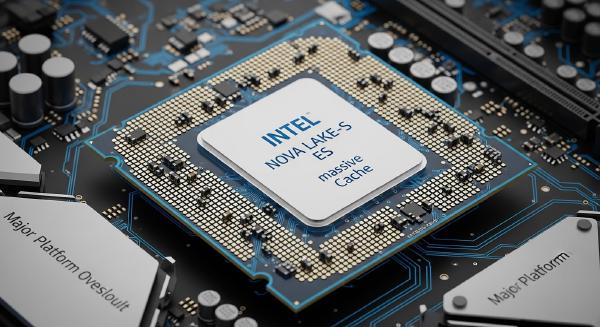
Intel’s upcoming Nova Lake-S desktop processors are shaping up to be one of the company’s most ambitious architectural updates in years. Recent leaks indicate that the Core Ultra 400S family will introduce two new 18-core Core Ultra 5 processors, bringing a redesigned hybrid architecture, a brand-new socket, and Intel’s new bLLC (Big Last Level Cache) technology.
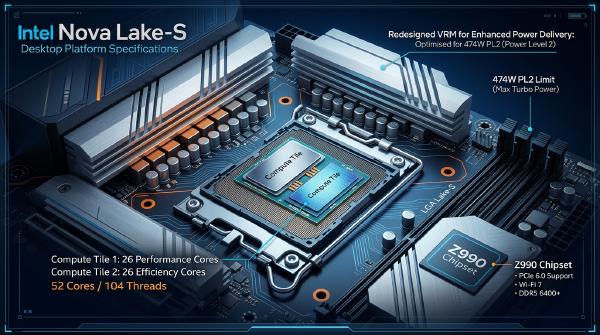
Rather than competing solely on clock speeds, Nova Lake-S appears to focus on three key areas: larger cache capacity, improved efficiency, and significantly higher scalability across the desktop lineup. If the leaked specifications prove accurate, Intel is positioning these processors to challenge AMD’s cache-centric gaming CPUs while preparing a platform capable of scaling to as many as 52 cores.
🚀 A New 18-Core Design for the Mainstream Desktop #
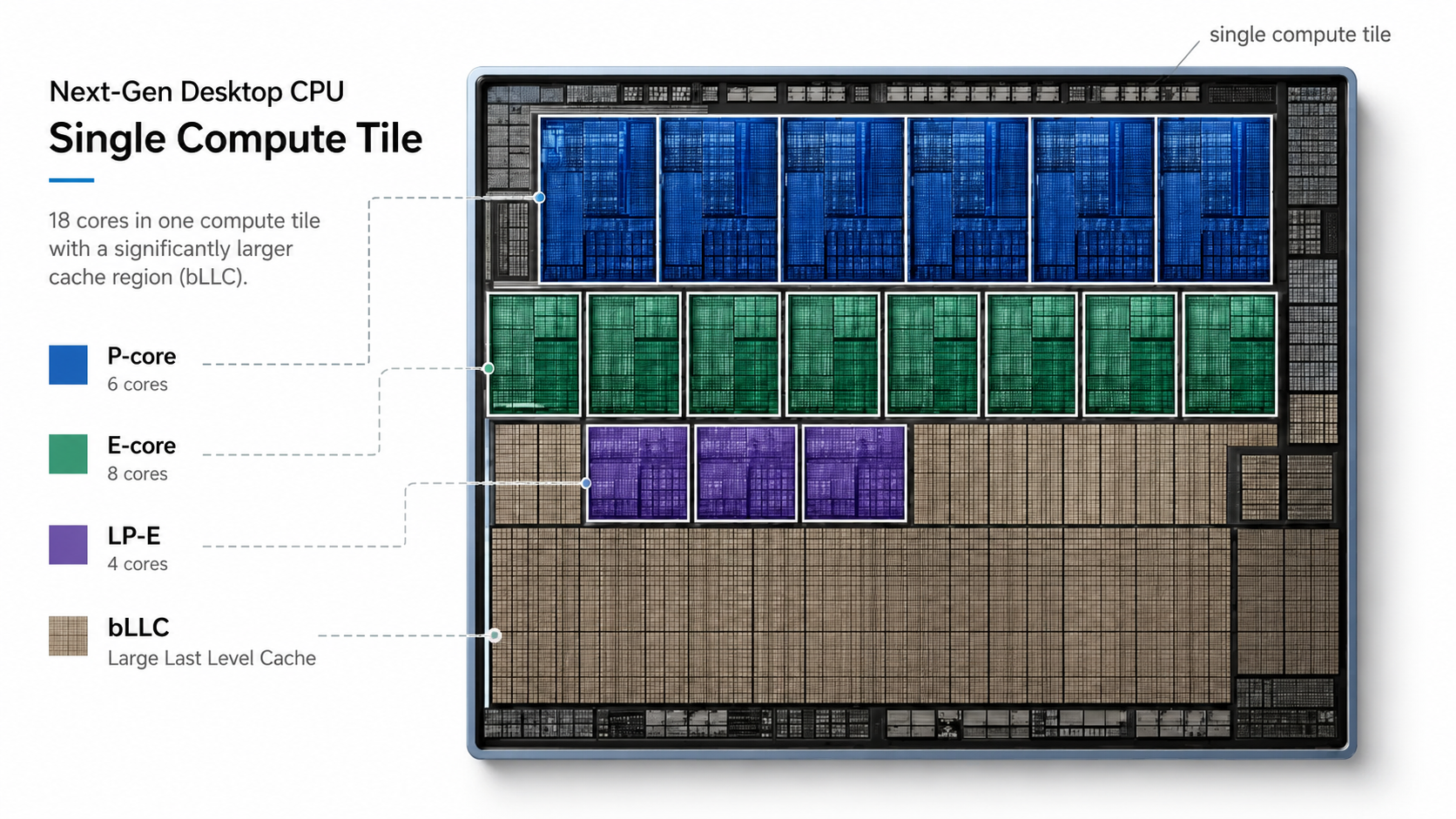
The leaked Core Ultra 5 models adopt a single compute tile design built around Intel’s next-generation hybrid architecture.
Unlike previous generations, Hyper-Threading is absent, meaning every physical core executes a single hardware thread.
Core Configuration #
| Core Type | Architecture | Count |
|---|---|---|
| Performance Cores (P-Cores) | Coyote Cove | 6 |
| Efficiency Cores (E-Cores) | Arctic Wolf | 8 |
| Low-Power Efficiency Cores (LP-E) | Arctic Wolf | 4 |
| Total | — | 18 Cores / 18 Threads |
This configuration reflects Intel’s continued evolution toward specialized cores that handle different classes of workloads.
- P-Cores prioritize high single-threaded performance for gaming and latency-sensitive applications.
- E-Cores improve multi-threaded throughput while maintaining power efficiency.
- LP-E Cores are designed to handle background processes and low-priority workloads with minimal energy consumption.
Together, these cores aim to deliver better workload scheduling across both productivity and gaming scenarios.
🧠 bLLC: Intel’s New Cache Strategy #
Perhaps the most significant architectural addition is bLLC (Big Last Level Cache).
According to current leaks, single-tile Nova Lake-S processors may include up to 144 MB of last-level cache, representing a substantial increase over previous desktop generations.
The strategy closely mirrors an industry-wide trend toward larger cache hierarchies that reduce memory latency and improve performance in workloads that repeatedly access shared data.
Applications expected to benefit include:
- Modern PC games
- Simulation software
- Electronic design automation (EDA)
- Scientific computing
- Software development and compilation
- AI inference with CPU-resident models
For gaming in particular, additional cache can reduce memory access latency, helping improve frame consistency and minimum frame rates.
Intel’s approach positions bLLC as a direct response to AMD’s successful 3D V-Cache technology, which has become a defining feature of Ryzen X3D processors.
⚙️ Two Power Profiles Target Different Users #
Intel is expected to launch the new 18-core processors in two distinct power configurations.
125W K-Series #
Designed for enthusiasts and overclockers, the unlocked K-Series models prioritize maximum performance and tuning flexibility.
Typical use cases include:
- High-refresh-rate gaming
- Content creation
- Workstations
- Custom liquid-cooled systems
- Performance-focused desktop builds
65W Non-K Models #
The standard models target users seeking a balance between performance and efficiency.
These processors are well suited for:
- Small form factor PCs
- Quiet desktop systems
- Home office workstations
- General productivity
- Energy-conscious builds
Offering identical core counts across different power envelopes gives system builders greater flexibility when selecting cooling solutions and overall system designs.
🖥️ Nova Lake-S Platform Specifications #
Nova Lake-S introduces a completely new desktop platform with several notable upgrades.
| Feature | Specification |
|---|---|
| Processor Family | Core Ultra 400S |
| Socket | LGA 1954 |
| Memory Support | DDR5-8000 (1DPC 1R) |
| CUDIMM Support | Yes |
| PCI Express | Up to 36 PCIe 5.0 lanes |
| Manufacturing Process | TSMC N2P |
| Maximum Core Count | Up to 52 cores (dual compute tile variants) |
The move to LGA 1954 indicates another platform transition, meaning existing LGA 1851 motherboards are unlikely to support Nova Lake-S processors.
Support for faster DDR5 memory and Compute DIMMs (CUDIMMs) also reflects Intel’s focus on increasing memory bandwidth for next-generation desktop workloads.
🔬 Coyote Cove and Arctic Wolf Architectures #
Although Intel has not officially detailed these architectures, leaked information suggests each core type is optimized for a specific role.
Coyote Cove #
The next-generation performance core is expected to emphasize:
- Higher instructions per clock (IPC)
- Improved branch prediction
- Better execution efficiency
- Lower latency for interactive workloads
These enhancements are particularly important for gaming and lightly threaded applications.
Arctic Wolf #
Both the standard E-Cores and LP-E Cores reportedly use the Arctic Wolf architecture.
Their responsibilities include:
- Parallel processing
- Background services
- Operating system tasks
- Highly concurrent workloads
- Power-efficient execution
This layered approach enables the processor scheduler to allocate workloads more intelligently, maximizing overall system responsiveness.
🎮 Gaming and Productivity Outlook #
Large cache capacities combined with improved hybrid scheduling could make Nova Lake-S particularly competitive in gaming.
Modern game engines increasingly rely on:
- Fast memory access
- Low-latency communication between cores
- Efficient asset streaming
- Background task management
A substantially larger last-level cache may reduce dependence on main memory, improving responsiveness in cache-sensitive titles.
Productivity applications may also benefit, particularly those involving:
- Software compilation
- Video editing
- 3D rendering
- Virtual machines
- Parallel development workloads
The extent of these gains will ultimately depend on Intel’s final implementation, clock speeds, memory controller performance, and operating system scheduling.
⚔️ Intel vs. AMD: A Major Desktop Battle Ahead #
Nova Lake-S is expected to compete directly against AMD’s next-generation Olympic Ridge processors based on the Zen 6 architecture.
While both companies appear poised to leverage TSMC’s advanced N2P manufacturing technology, their strategies differ.
Intel’s Approach #
Intel appears to be emphasizing:
- Large bLLC cache
- Aggressive hybrid core scaling
- High core-count desktop processors
- Expanded memory bandwidth
- Platform modernization
AMD’s Approach #
AMD is expected to continue focusing on:
- Zen 6 architectural improvements
- Next-generation 3D V-Cache
- Integrated AI acceleration
- Rack-to-desktop architectural consistency
- Continued IPC improvements
Rather than process technology alone determining the winner, the competition is likely to revolve around several key metrics:
- Single-threaded performance
- Multi-threaded scalability
- Cache efficiency
- Platform stability
- Power efficiency
- Memory subsystem performance
📅 What to Expect Before Launch #
Although Intel has not officially announced these processors, additional information is expected to emerge throughout 2026.
Areas to watch include:
- Official processor specifications
- Motherboard chipset announcements
- Independent performance benchmarks
- Power consumption measurements
- Pricing and product segmentation
- BIOS and memory compatibility
These details will provide a clearer picture of how Nova Lake-S compares with competing desktop platforms.
💡 Conclusion #
The leaked Nova Lake-S lineup suggests Intel is preparing a significant evolution of its desktop processor strategy.
The addition of 18-core Core Ultra 5 models, the introduction of bLLC cache, support for DDR5-8000, and a new LGA 1954 platform indicate that Intel is prioritizing architectural improvements alongside raw core counts.
If these specifications are confirmed, Nova Lake-S could become one of Intel’s strongest desktop offerings in recent years, particularly for gamers and power users who benefit from larger cache hierarchies and hybrid computing designs.
With AMD’s Zen 6 processors expected to arrive on a similar timeline, the next generation of desktop CPUs is shaping up to be one of the industry’s most closely watched battles.