AMD EPYC Embedded 9006: Zen 6 Venice Comes to Embedded Systems
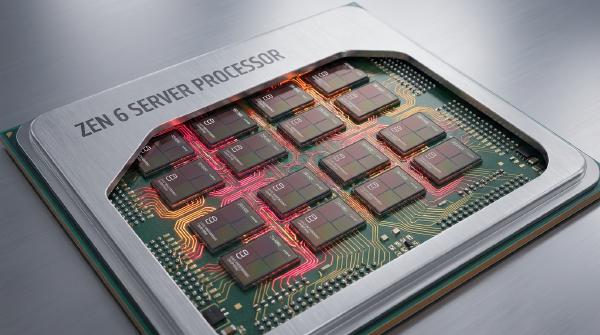
AMD has introduced the EPYC Embedded 9006 processor series, bringing its Zen 6 server architecture to embedded infrastructure at the same time as the mainstream sixth-generation EPYC platform.
Built around the SP7 platform, the new processors scale up to 256 cores and 512 threads. They support 16-channel DDR5 memory, PCIe Gen 6, and CXL 3.1, with a product longevity commitment of seven years.
The timing is significant. Embedded processor families have often followed mainstream server launches, leaving equipment manufacturers waiting for a newer architecture to become available in products designed for long deployment cycles. With EPYC Embedded 9006, AMD is aligning the embedded and server product launches around the same Zen 6 generation, codenamed Venice.
The target market is not conventional desktop computing. AMD is positioning these processors for semiconductor automated test equipment, high-end network appliances, and enterprise storage controllers—systems that need substantial compute and I/O capacity but also require predictable availability and long-term support.
🧩 EPYC Embedded 9006 Platform Specifications #
The EPYC Embedded 9006 family uses Zen 6 and Zen 6c cores on the SP7 platform. The two core designs address different performance and density requirements, allowing AMD to offer products ranging from high-frequency configurations to processors with very high core counts.
The largest configuration reaches 256 cores and 512 threads.
Memory and I/O #
The platform’s main specifications include:
| Component | Specification |
|---|---|
| CPU architecture | AMD Zen 6 / Zen 6c |
| Maximum cores | 256 |
| Maximum threads | 512 |
| Socket | SP7 |
| Memory channels | 16 |
| Memory support | DDR5 RDIMM up to 8,000 MT/s |
| MRDIMM support | Up to 12,800 MT/s with supported configurations |
| Maximum memory capacity | Up to 8TB, subject to supported DIMM configurations |
| PCIe connectivity | Up to 96 PCIe Gen 6 lanes |
| CXL support | CXL 3.1 |
| Product longevity | Seven years |
Sixteen memory channels provide substantial aggregate bandwidth for workloads that need to feed hundreds of CPU cores. Support for MRDIMM-12800 is particularly relevant to memory-intensive applications, although actual speeds and capacities depend on the supported memory configuration.
PCIe Gen 6 doubles the per-lane signaling rate compared with PCIe Gen 5, reaching 64 GT/s. CXL 3.1 adds support for memory expansion and coherent device connectivity, giving system designers more options for building high-capacity platforms.
Six processor models #
AMD’s initial lineup covers six configurations with different core counts, frequencies, cache capacities, and power envelopes.
| Processor | Cores / Threads | Base Clock | Max Boost | L3 Cache | TDP |
|---|---|---|---|---|---|
| EPYC Embedded 9976 | 256 / 512 | 2.55 GHz | 4.1 GHz | 1,024 MB | 600W |
| EPYC Embedded 9946 | 192 / 384 | 3.05 GHz | 4.1 GHz | 768 MB | 600W |
| EPYC Embedded 9846 | 168 / 336 | 2.90 GHz | 4.1 GHz | 768 MB | 500W |
| EPYC Embedded 9756 | 128 / 256 | 3.20 GHz | 4.1 GHz | 512 MB | 500W |
| EPYC Embedded 9656 | 96 / 192 | 2.85 GHz | 4.1 GHz | 512 MB | 400W |
| EPYC Embedded 9556 | 64 / 128 | 3.60 GHz | 5.1 GHz | 192 MB | 400W |
The 9946 designation is used in AMD’s current product specifications. Some early reports have referred to the 192-core model as the 9966.
The lineup illustrates two different design priorities. The 9976 and 9946 maximize parallel processing capacity, while the 9556 offers fewer cores but a higher advertised boost frequency. Embedded equipment manufacturers can choose a configuration according to whether their applications are limited by parallel throughput, per-core performance, memory bandwidth, or power constraints.
The 400W–600W TDP range also makes platform-level thermal design a serious consideration. These processors are intended for substantial embedded systems, not small, passively cooled devices.
⏳ Seven-Year Product Longevity Matters More Than a Typical Server Upgrade #
Embedded infrastructure has a different replacement cycle from ordinary servers.
A data-center operator may refresh server hardware every few years. Semiconductor test equipment, industrial networking appliances, and enterprise storage platforms can remain deployed much longer. Their processors must be available throughout product development, validation, manufacturing, installation, and maintenance.
AMD is committing to seven-year product longevity for the EPYC Embedded 9006 series, alongside ongoing security updates and embedded-focused support.
That commitment helps equipment manufacturers plan around a stable processor platform. It reduces the risk of having to redesign a system because a key CPU model becomes unavailable during its commercial lifetime.
Long-term availability also affects qualification costs. Replacing a processor can trigger changes to the motherboard, firmware, thermal design, power delivery, and operating-system validation. In regulated or mission-critical applications, revalidating the entire system can be expensive.
SP7 and future platform planning #
The EPYC Embedded 9006 series uses AMD’s SP7 socket, aligning it with the sixth-generation EPYC server platform.
AMD’s launch materials emphasize the shared platform and architecture, but they do not establish a blanket guarantee that every future SP7 processor will be a drop-in replacement for every embedded design. Compatibility with a future processor generation will depend on the board design, firmware, power delivery, thermal limits, and AMD’s platform qualification requirements.
For embedded developers, the safer planning assumption is to treat the seven-year product commitment as the defined lifecycle benefit and verify future socket compatibility with AMD and the relevant system vendor before designing around an upgrade path.
🔐 Security From Boot to Runtime #
Embedded systems increasingly sit at the boundary between enterprise networks, industrial equipment, and sensitive data. A compromised firewall or storage controller can expose far more than the processor itself.
AMD is building several security mechanisms into the EPYC Embedded 9006 platform.
The security architecture includes:
- AMD Root of Trust (ART): Establishes trust in boot firmware and supports post-quantum cryptographic firmware signing.
- AMD Security Processor (ASP): Provides runtime security services and manages virtual-machine memory protection keys.
- Caliptra: An open-source root-of-trust implementation that supports verification of device identity and platform integrity.
These mechanisms address different stages of the system lifecycle.
Secure boot helps ensure that the platform starts from trusted firmware. Runtime protections help isolate workloads and protect virtualized environments. Device identity and integrity verification give remote management systems a way to check whether a platform is running expected firmware.
For networking and storage equipment deployed in customer environments, these protections can become part of a broader infrastructure security model.
The distinction is that processor-level security features provide building blocks, not a complete security policy. Firmware configuration, hypervisor support, operating-system updates, and system integration still determine how effectively a finished product uses them.
🏭 Three Main Application Areas #
AMD identifies three primary markets for the EPYC Embedded 9006 series: semiconductor automated test equipment, high-end network firewalls, and enterprise storage controllers.
All three are seeing higher data rates and more demanding processing requirements as AI infrastructure expands.
1. Semiconductor automated test equipment #
Semiconductor automated test equipment (ATE) validates chips and memory devices during manufacturing.
As newer components arrive, test systems must handle faster interfaces and larger volumes of data. DDR5 RDIMMs, MRDIMMs, CXL memory devices, and PCIe Gen 6 SSDs all increase the demands placed on test infrastructure.
The CPU coordinates test sequences, manages data movement, and processes results from multiple devices under test.
More CPU cores allow test systems to execute more operations in parallel. Higher memory bandwidth helps keep those cores supplied with data, while PCIe Gen 6 provides faster connectivity to next-generation storage and test hardware.
For ATE manufacturers, the goal is to increase the number of devices that can be tested simultaneously without creating a bottleneck in the control system.
2. High-end network firewalls #
Network appliances face growing throughput requirements as enterprise networks move toward 400G and 800G connectivity.
A firewall must do more than forward packets. It may need to inspect traffic, apply security policies, track sessions, process exceptions, and coordinate with specialized data-plane accelerators.
These tasks can consume substantial CPU resources, especially when the appliance handles large numbers of concurrent connections or complex security rules.
The EPYC Embedded 9006’s high core counts and PCIe Gen 6 connectivity give system designers more processing capacity and bandwidth for connecting network interfaces and acceleration hardware.
AMD reports up to 1.3x higher firewall throughput per watt compared with the previous generation in its published workload comparison. This is a specific vendor benchmark, not a guarantee that every firewall configuration will achieve the same improvement.
3. Enterprise storage controllers #
AI infrastructure is increasing the volume of data that storage systems must ingest, process, and deliver.
Storage controllers coordinate NVMe devices, manage data movement, and execute services such as compression, caching, RAID operations, and data protection.
These workloads benefit from both CPU throughput and high-speed connectivity.
PCIe Gen 6 can connect next-generation SSDs and storage components at higher per-lane data rates. CXL 3.1 adds another option for systems that need expanded memory capacity or coherent access to connected devices.
AMD also highlights its Intelligent Storage Acceleration Library (ISA-L) benchmark. The company reports up to 1.5x higher performance than the previous generation in this benchmark, which measures processor performance on functions commonly used in storage services.
The benefit for a finished storage controller will depend on its software stack, device topology, workload mix, and use of hardware acceleration.
📈 Performance Gains and Platform Trade-Offs #
AMD’s headline performance claims compare EPYC Embedded 9006 with the previous-generation EPYC Embedded 9005 series.
The company reports:
| Metric | Claimed improvement |
|---|---|
| Overall throughput | Up to 1.8x |
| Memory bandwidth | Up to 2.7x |
| I/O bandwidth | Up to 1.5x |
| Firewall throughput per watt | Up to 1.3x |
| ISA-L storage benchmark | Up to 1.5x |
These figures describe different workloads and platform capabilities. They should not be combined into a single expectation for every application.
The memory bandwidth improvement is particularly relevant to systems with high core counts. Adding CPU cores without increasing memory bandwidth can leave more execution resources waiting for data. Sixteen DDR5 channels and supported MRDIMM configurations help address that balance.
PCIe Gen 6 similarly increases the bandwidth available to connected devices, but the platform makes a trade-off in total lane count.
PCIe Gen 6: Fewer lanes, higher per-lane bandwidth #
The previous SP5 platform offered up to 128 PCIe Gen 5 lanes. The SP7 platform provides up to 96 PCIe Gen 6 lanes.
At first glance, reducing the lane count may look like a regression. But each PCIe Gen 6 lane operates at twice the signaling rate of a PCIe Gen 5 lane.
The comparison is therefore not simply 128 lanes versus 96 lanes. It is a trade-off between the number of physical connections and the bandwidth available on each connection.
For devices that need many independent links, such as large collections of accelerators or storage devices, the reduced lane count may affect system topology. For workloads that prioritize high bandwidth per connection, Gen 6 can provide a substantial advantage.
System designers will need to evaluate the number of devices, their lane-width requirements, switch usage, and aggregate bandwidth rather than relying on the generation number alone.
🧮 Why Embedded Systems Need Data-Center-Class CPUs #
The EPYC Embedded 9006 launch reflects a broader change in the embedded market.
Embedded no longer necessarily means low-power, low-core-count computing. Modern network appliances, storage controllers, and semiconductor test systems can be large, high-performance platforms with demanding memory and I/O requirements.
AI infrastructure is accelerating that trend. Semiconductor manufacturers need to validate increasingly complex devices. Storage systems must manage faster SSDs and larger data pipelines. Network appliances must inspect and secure higher volumes of traffic.
These workloads need the same broad capabilities found in mainstream data-center processors, but with a different set of commercial requirements:
- Long-term product availability.
- Stable platform qualification.
- Predictable firmware and security support.
- High memory and I/O bandwidth.
- Clear thermal and power characteristics.
- A processor roadmap that aligns with equipment deployment cycles.
AMD’s strategy is to bring its latest server architecture into these markets without making embedded customers wait for a separate, delayed product generation.
The result is a platform that combines up to 256 Zen 6 cores, 16-channel DDR5 memory, PCIe Gen 6, CXL 3.1, and seven-year product longevity. For equipment manufacturers planning their next generation of test systems, firewalls, and storage controllers, the key question is no longer just how fast the processor is. It is whether the complete platform can deliver that performance reliably throughout a long product lifecycle.