Intel Xeon 7 Diamond Rapids: Can It Catch AMD EPYC?
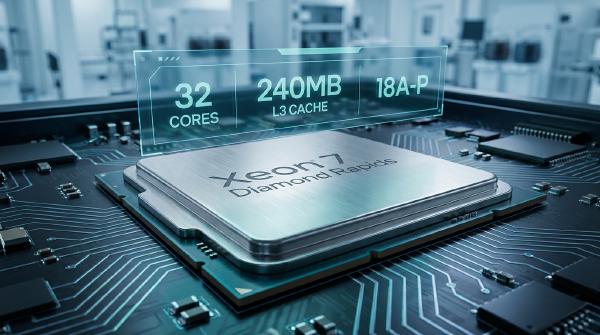
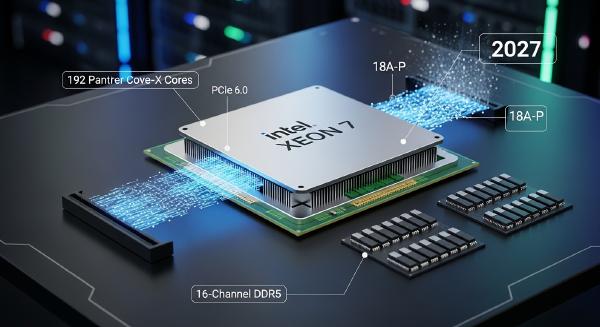
Intel has publicly showcased physical samples of its next-generation Diamond Rapids “Xeon 7” server processor for the first time at the Tencent Global Digital Ecosystem Summit. Designed for next-generation data centers and agentic AI infrastructure, the processor is expected to feature up to 256 Performance-cores (P-cores), compute chiplets manufactured on Intel 18A-P, and a new LGA 9324 socket.
The launch is scheduled for 2027, but Intel’s competitive challenge is already clear: AMD’s EPYC lineup is advancing rapidly, and Intel’s next-generation processor will need to compete against an established alternative rather than an aging platform.
The showcased Diamond Rapids sample provides a closer look at Intel’s hardware strategy. According to the specifications disclosed at the event, the processor uses the Panther Cove-X microarchitecture, omits Hyper-Threading (SMT), and shares up to 1.28GB of Last-Level Cache (LLC).
The platform also introduces major changes to memory and I/O connectivity:
- 128 PCIe Gen6 lanes, with CXL 3.0 support.
- 16-channel memory, supporting MRDIMMs at up to 12,800 MT/s.
- Up to 1.6TB/s of theoretical memory bandwidth.
- Maximum TDP of up to 650W.
- A new LGA 9324 socket, part of Intel’s Oak Stream platform.
These specifications indicate that Intel is targeting much more than traditional enterprise computing. High memory throughput, extensive I/O, and a large number of CPU cores are increasingly relevant to AI inference, cloud orchestration, and workloads involving large numbers of concurrent agents.
🏭 Diamond Rapids Introduces Intel 18A-P to Flagship Server CPUs #
Diamond Rapids uses a disaggregated chiplet architecture, separating compute and I/O functions across different manufacturing processes.
Its key manufacturing and packaging components are:
- Compute chiplets: Manufactured using Intel 18A-P.
- I/O chiplets: Manufactured using Intel 3.
- Advanced packaging: Foveros Direct 3D hybrid bonding connects the chiplets.
This makes Diamond Rapids Intel’s first data center CPU built around the 18A-P process.
The separation of compute and I/O chiplets gives Intel more flexibility when designing the processor. High-performance compute dies can use the newest process technology, while I/O components can remain on a different manufacturing node better suited to their requirements.
It also reflects a broader industry trend. As processors grow larger and more complex, chiplet architectures allow manufacturers to combine specialized dies rather than building every component on one monolithic piece of silicon.
The new LGA 9324 platform #
The physical sample shown at the summit features a redesigned Integrated Heat Spreader (IHS) and a pin layout designed for the new LGA 9324 socket.
The socket is part of Intel’s Oak Stream server platform and represents a new platform transition for the Xeon lineup.
A change of this scale affects more than the processor itself. Server manufacturers and data center operators will need to account for motherboard designs, power delivery, cooling systems, memory configurations, and platform validation.
The reported maximum TDP of 650W also highlights the thermal and power-delivery demands of the highest-end configurations.
Intel has confirmed that Diamond Rapids has entered production and remains on track for a 2027 launch. However, the final performance picture will depend on production specifications, clock speeds, power limits, and the configurations actually delivered to customers.
For earlier context on the processor’s development, see Intel’s Diamond Rapids Xeon 7 architecture and roadmap.
🤖 Why Intel Is Positioning Xeon 7 for Agentic AI #
Intel describes Diamond Rapids as a CPU purpose-built for agentic AI infrastructure.
That positioning is significant because AI infrastructure is not composed entirely of GPUs. CPUs still handle orchestration, application logic, data movement, storage access, networking, and the execution of many tasks that surround model inference.
Agentic AI systems can make these requirements even more demanding.
A single agent may repeatedly call tools, execute code, retrieve information, communicate with other agents, and process intermediate results. Running many such workflows concurrently requires substantial general-purpose computing capacity.
Diamond Rapids combines its high core count with several instruction-set and platform features intended to support these workloads:
- APX: Intel’s Advanced Performance Extensions, designed to improve general-purpose CPU execution.
- AMX: Advanced Matrix Extensions, which accelerate matrix operations used in AI and other compute-intensive workloads.
- AVX 10.2: An updated vector instruction-set family for supported workloads.
- Large LLC: Up to 1.28GB of shared last-level cache.
- High memory bandwidth: Up to 1.6TB/s through the 16-channel memory subsystem.
These capabilities are intended to improve performance across cloud computing, AI inference, and data-intensive enterprise applications.
Tencent Cloud collaboration #
At the same summit, Intel announced joint development efforts involving Diamond Rapids and Tencent Cloud CVM.
The collaboration provides an early indication of ecosystem alignment around Intel’s next-generation server platform. Cloud providers are important partners because they can evaluate new processors against large-scale production workloads before wider deployment.
Intel also discussed upgrades to Tencent Cloud’s existing infrastructure, moving from Granite Rapids-AP (Xeon 6) to Clearwater Forest-AP (Xeon 6+).
Tencent shared several performance figures for its sandbox infrastructure:
- Xeon 6+ environments support more than 350 concurrent sandboxes.
- Average sandbox creation latency is approximately 200ms.
- The platform achieves 1.46x higher concurrency than the existing test environment.
- Tencent’s Cube Sandbox can deploy hundreds of thousands of sandboxes within minutes and is already in production.
These figures illustrate why CPU performance and deployment density matter to AI infrastructure. Agent-based systems may need to create isolated execution environments for code, tools, and individual tasks, often at substantial concurrency.
AMX and small language model inference #
Intel also highlighted AMX as an important part of its AI strategy.
According to the company’s figures, AMX can accelerate small language model (SLM) inference by making better use of CPU execution resources that might otherwise remain idle.
Intel claims performance improvements of 1.3x to 3.4x over traditional AVX-512 for the workloads it presented.
The company also argues that optimized CPU inference can deliver cost-efficiency comparable to GPU-based alternatives in certain small-model scenarios.
That claim needs to be evaluated carefully. CPU and GPU inference costs depend on model size, quantization, batch size, latency requirements, software optimization, and hardware utilization. A CPU may be a practical choice for smaller models or workloads with modest throughput requirements, but that does not make it a general replacement for accelerators.
Still, AMX gives Intel another way to position Xeon as an active compute platform for AI rather than merely a host processor coordinating GPUs.
⚔️ AMD EPYC Venice Raises the Competitive Bar #
Diamond Rapids is expected to launch in 2027, putting it in direct competition with AMD’s EPYC 9006 “Venice” family.
Built on the Zen 6 architecture, Venice is already positioned as a high-core-count server platform with two distinct core configurations.
| Feature | Zen 6C | Zen 6 |
|---|---|---|
| Core design | High-density | Standard-performance |
| Maximum cores | Up to 256 | Up to 96 |
| Maximum threads | Up to 512 | Up to 192 |
| Maximum L3 cache | Up to 1,024MB | Up to 384MB |
The two designs serve different priorities.
Zen 6C emphasizes core density and parallel throughput, making it suitable for cloud and highly threaded workloads. Standard Zen 6 configurations focus on a different balance of per-core performance and overall compute capacity.
AMD’s reported Zen 6 improvements include a 27% IPC increase over Zen 5, with claimed gains of approximately 20% in enterprise and cloud workloads and 31% in AI workloads.
Those figures provide an indication of AMD’s architectural ambitions, although actual results will vary by processor configuration and application.
Venice platform specifications #
AMD’s high-end Venice platform also makes substantial investments in memory and I/O.
Its reported platform features include:
- SP7 socket and chiplet-based processor architecture.
- Elevated Fan-Out Bridge packaging.
- 16-channel memory, supporting MRDIMMs up to 12,800 MT/s.
- Up to 1.6TB/s of theoretical memory bandwidth.
- Up to 128 PCIe Gen6 lanes, alongside additional PCIe Gen4 connectivity.
- CXL 3.1 support.
- Maximum TDP of up to 600W.
The comparison with Diamond Rapids is notable. Both platforms are moving toward 16-channel memory, PCIe Gen6, and bandwidth levels around 1.6TB/s.
That means Intel cannot rely on memory bandwidth or I/O connectivity alone to differentiate its next-generation server CPU.
The real competition will involve core performance, cache behavior, platform efficiency, software optimization, and total system cost.
What the benchmark results suggest #
Phoronix benchmark results cited in the supplied reporting indicate that 6th-generation EPYC Venice outperforms Intel Granite Rapids and NVIDIA Vera in selected agentic AI workloads.
These results should not be treated as a direct prediction of Diamond Rapids performance. Diamond Rapids is a future processor with a different architecture and platform, and final comparisons will require production hardware tested under consistent conditions.
Nevertheless, the results illustrate the competitive environment Intel will face when Xeon 7 arrives.
For more background on how server CPU performance is changing across AI and HPC workloads, see KAD’s comparison of NVIDIA Vera, AMD EPYC, and Intel Xeon.
📉 Why Intel May Need Coral Rapids to Regain Leadership #
Intel’s challenge is not simply producing a processor with more cores.
AMD has spent several generations strengthening EPYC’s position in cloud computing and enterprise infrastructure. Customers have more options when selecting server platforms, and migrating workloads to a competing architecture can become easier as software ecosystems mature.
According to the statements and industry reporting surrounding Intel’s roadmap, the company does not expect Diamond Rapids alone to restore clear performance leadership over AMD.
Instead, Intel is looking toward Coral Rapids, the planned successor scheduled for 2028, as a more significant opportunity to close the competitive gap.
That is a notable admission about the company’s position.
Diamond Rapids is still an important product. It introduces Intel 18A-P to flagship server CPUs, increases core density, and brings a substantially upgraded memory and I/O platform.
But AMD’s Venice family already targets many of the same infrastructure requirements.
Core count is only one part of the competition #
A 256-core processor sounds impressive, but core count alone does not determine server performance.
For data center operators, the more relevant questions include:
- How much work can each core complete?
- How efficiently does the processor use its memory bandwidth?
- How does cache capacity affect real application performance?
- What is the performance per watt under sustained load?
- How much does the complete platform cost?
- Can the manufacturer deliver enough processors to meet deployment schedules?
The omission of Hyper-Threading also deserves attention.
Diamond Rapids is designed around physical P-cores without SMT. This may simplify certain aspects of core resource management, but it also means that Intel cannot rely on additional hardware threads to increase the advertised thread count.
Whether that design delivers better performance depends on the workload. Some applications benefit from SMT, while others are limited by execution resources, memory bandwidth, or contention between threads.
Intel will need to demonstrate that its architectural choices translate into competitive results across a broad range of production workloads.
Enterprise migration adds pressure #
Industry reports also point to a growing number of enterprises adopting AMD-based server platforms.
Once an organization moves workloads to a new CPU architecture, the decision can influence procurement, software validation, virtualization infrastructure, and long-term platform planning.
That creates a challenge for Intel beyond benchmark performance.
Even if Diamond Rapids delivers competitive results, Intel must convince customers that the complete platform offers a compelling reason to choose Xeon for their next deployment.
For large cloud providers, availability and predictable supply can matter just as much as peak performance. For enterprise customers, migration costs and software compatibility may be equally important.
🔍 What Diamond Rapids Needs to Prove in 2027 #
Diamond Rapids represents two important developments for Intel: the arrival of 18A-P in flagship server silicon and a new Xeon platform designed around high-density AI and cloud workloads.
Its specifications are ambitious:
| Specification | Diamond Rapids Xeon 7 |
|---|---|
| Planned launch | 2027 |
| Maximum core count | 256 P-cores |
| Core architecture | Panther Cove-X |
| Manufacturing process | Intel 18A-P compute, Intel 3 I/O |
| Socket | LGA 9324 |
| Last-Level Cache | Up to 1.28GB |
| Memory channels | 16 |
| Memory support | MRDIMM up to 12,800 MT/s |
| Peak memory bandwidth | Up to 1.6TB/s |
| PCIe | 128 PCIe Gen6 lanes |
| CXL | CXL 3.0 |
| Maximum TDP | Up to 650W |
| SMT | Not supported |
These specifications establish the platform’s intended capabilities, but they do not yet establish its real-world performance.
Several questions remain open:
- How competitive is its per-core performance? A high core count is useful only if the architecture can deliver sufficient throughput across real applications.
- How efficiently does it use its memory subsystem? The 16-channel design offers substantial bandwidth, but actual application performance depends on memory latency and access patterns.
- What does the 650W power envelope mean in practice? Cooling, power delivery, and rack density will influence deployment economics.
- How mature is the software ecosystem? Compiler support, virtualization, AI frameworks, and cloud platform optimization will affect adoption.
- Can Intel deliver at scale? Production volume and platform availability will matter as much as launch specifications.
The comparison with AMD will also evolve before Diamond Rapids reaches customers. Intel is not competing against a fixed target: AMD will continue developing its EPYC roadmap, and the products available in 2027 may differ from the configurations being discussed today.
Intel’s Roadmap Is Ambitious, but the Benchmarks Will Decide #
Diamond Rapids is an important milestone for Intel’s server business. It brings 18A-P into flagship data center processors, introduces a new socket and platform, and targets the growing demand for CPU capacity in AI inference and agentic infrastructure.
The collaboration with Tencent also shows that Intel is working to build cloud-provider support around its next-generation Xeon products.
However, AMD’s EPYC Venice family sets a demanding competitive baseline. Both companies are targeting high core counts, extensive memory bandwidth, and modern I/O connectivity. Intel will need to demonstrate advantages in actual workloads rather than relying on specifications alone.
The longer-term roadmap is equally revealing. Intel is positioning Diamond Rapids as a major step forward, while Coral Rapids is expected to play a larger role in restoring competitiveness against AMD.
For server buyers, the practical question is not which company has the more impressive roadmap. It is which platform delivers the best combination of performance, power efficiency, availability, and total cost of ownership when production systems are ready.
Diamond Rapids will get its chance to answer that question in 2027.