HPE ProLiant DL394 Gen12: NVIDIA Vera CPU, Memory Architecture, and Platform Analysis
Modern AI infrastructure is evolving beyond the traditional division of labor between CPUs and GPUs. GPUs execute model training and inference, while CPUs increasingly handle the execution environments surrounding those models.
Several workload trends are driving this change:
- Agentic AI: AI agents depend on CPUs to execute tools, run code, access databases, process files, and coordinate external applications.
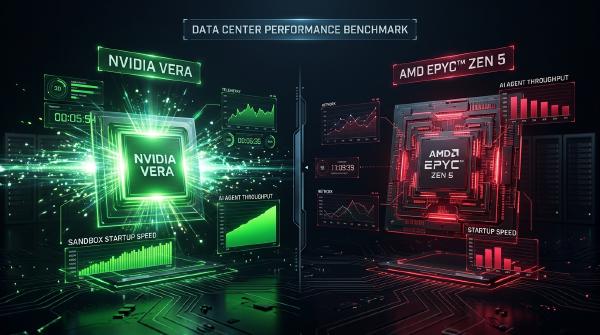
- Sandbox execution: Generated code frequently needs to run in isolated environments for testing, validation, and optimization. These environments consume CPU resources independently of model inference.
- Reinforcement learning: RL training involves repeated interactions between models and execution environments. The CPU-side environment evaluates actions, calculates rewards, and returns feedback.
- Latency-sensitive orchestration: Many agent workflows execute sequentially. A model cannot continue until a tool call, database query, or code execution task finishes. CPU latency therefore directly affects end-to-end response time.
These requirements make CPU performance, memory bandwidth, and system-level responsiveness increasingly important in AI infrastructure.
HPE has introduced another interesting platform in this category: the HPE ProLiant Compute DL394 Gen12, powered by NVIDIA’s Vera CPU.
As with the previously discussed ProLiant DL585a Gen13 and DL525 Gen13, HPE’s detailed product documentation provides an opportunity to examine the hardware architecture before widespread deployment.
The DL394 Gen12 is particularly interesting because it is not designed as a conventional enterprise server. Its architecture prioritizes high memory bandwidth and CPU throughput for specialized workloads.
🎯 Product Positioning: A Server Designed Beyond General-Purpose Computing #
According to HPE’s QuickSpecs documentation, the ProLiant Compute DL394 Gen12 is the company’s first server powered by the NVIDIA Vera CPU.
Its primary design goals are memory-bandwidth-intensive and CPU-intensive workloads.
This positioning distinguishes it from conventional enterprise servers intended to run general-purpose applications such as web services, standard databases, and business software.
HPE identifies several target workload categories:
- Agentic AI: CPU-intensive orchestration, tool execution, and data processing for autonomous AI applications.
- EDA (Electronic Design Automation): Chip-design simulation and verification, where memory bandwidth can become a significant performance constraint.
- Large-scale simulation: Engineering and scientific workloads involving large datasets and intensive numerical processing.
- Scientific computing: High-throughput computational workloads that benefit from substantial memory bandwidth.
The front of the DL394 Gen12 provides eight EDSFF E1 NVMe drive bays and four hot-swappable power supply modules.
This configuration reflects a system designed around high-density compute and memory throughput rather than maximum storage capacity or broad peripheral flexibility.
🏗️ Internal Architecture: Dual-Socket NVIDIA Vera in a 2U Chassis #
The DL394 Gen12 uses a conventional 2U rackmount enclosure, but its internal layout is optimized for two high-power NVIDIA Vera processors.
The front panel provides:
- Eight hot-swappable EDSFF E1 NVMe SSD bays.
- Four hot-swappable redundant power supply modules.
- Power supplies rated at 2000W per module.
Removing the top cover reveals the system’s major architectural components.
The two Vera processors occupy much of the left side of the chassis. PCIe expansion slots and GPU installation areas occupy the right side, while a centralized fan wall separates the major compute and expansion regions.
The power distribution board sits above the CPU area, and the front-accessible EDSFF drive cage is positioned near the front of the enclosure.
Internal component breakdown #
| Component | Function |
|---|---|
| Dual Vera CPUs and heatsinks | Main CPU compute subsystem |
| Power distribution board | Distributes power to system components |
| Central fan wall | Provides airflow for CPUs and expansion cards |
| GPU expansion bays | Supports up to two double-width FHFL GPUs |
| HHFL PCIe slots | Provides additional PCIe expansion |
| DC-SCM module | Provides the server management control subsystem |
| PCIe riser cards | Adapts PCIe expansion interfaces to the chassis layout |
| SOCAMM memory modules | Provides high-bandwidth LPDDR5X memory |
| EDSFF drive cage | Houses front-accessible NVMe storage |
| Redundant power supplies | Supplies power through four hot-plug modules |
The platform supports up to two double-width, full-height, full-length GPUs. This allows the DL394 Gen12 to combine substantial CPU resources with accelerator-based workloads.
The cooling design is especially important. Two Vera CPUs operating at approximately 480W each create a substantial thermal load in a 2U enclosure. The centralized fan wall and heatsink arrangement must maintain sufficient airflow across the processors and PCIe expansion area.
🔌 Rear Panel: Management Interfaces, PCIe Expansion, and Network Limitations #
The rear panel provides the system’s management, service, power, and expansion interfaces.
Four C14 power connectors are positioned on the right side. Although the power supply modules are inserted from the front, the power cabling can be connected from the front or rear depending on the system configuration.
The remaining rear-panel area contains PCIe expansion slots and management interfaces.
Rear-panel interface breakdown #
| Interface or Component | Description |
|---|---|
| USB-C serial debug port | System-level debugging |
| BMC reset button and warning LED | Management-controller reset and status indication |
| Power button and white LED | System power control and status |
| UID button and blue LED | Unit identification |
| Fault LED | Hardware fault indication |
| GPU expansion slots | Supports up to two double-width FHFL GPUs |
| Four C14 power connectors | Power input for the four power supply modules |
| PCIe expansion slots | Supports additional PCIe cards |
| 1 GbE host NIC | Basic host network connectivity |
| USB-C host service port | Host-side service interface |
| Dedicated iLO management port | HPE out-of-band management |
| Two USB 3.2 Gen1 ports | Marked as NOT USED |
| VGA port | Basic display output |
Two notable design observations #
1. USB ports are physically present but marked NOT USED
The two USB 3.2 Gen1 ports are labeled as unused. Their presence on the rear panel does not necessarily mean that the interfaces are enabled or supported in the initial firmware configuration.
This distinction matters when planning service procedures or peripheral integration. Physical connectors should not be treated as fully supported interfaces without confirmation from the platform documentation and firmware.
2. No OCP NIC expansion
One notable omission is support for OCP network adapters.
Organizations requiring higher-speed networking or DPU acceleration will need to use standard PCIe CEM add-in cards rather than relying on an OCP NIC slot.
This affects both expansion planning and the available internal PCIe resources.
Motherboard layout and OCP MHS considerations #
Reference designs for dual-socket Vera platforms, including Supermicro’s G3DBV motherboard, illustrate the general packaging approach.
Two BGA-mounted processors occupy the central area, with SOCAMM2 memory modules positioned nearby. PCIe I/O connectors are arranged toward the outer edges of the board.
The layout reduces the physical distance between processors and memory while preserving space for high-speed expansion interfaces.
However, the design does not strictly follow the conventional OCP MHS motherboard layout. It lacks standard OCP NIC and DC-SCM edge connectors.
The DL394 Gen12’s DC-SCM management module therefore appears to rely on a cabling-based connection to the mainboard rather than the standard edge-connector arrangement found in some OCP-oriented platforms.
⚙️ NVIDIA Vera CPU: 88 Arm Cores and 1.2 TB/s Memory Bandwidth #
The Vera CPU is the central component of the DL394 Gen12.
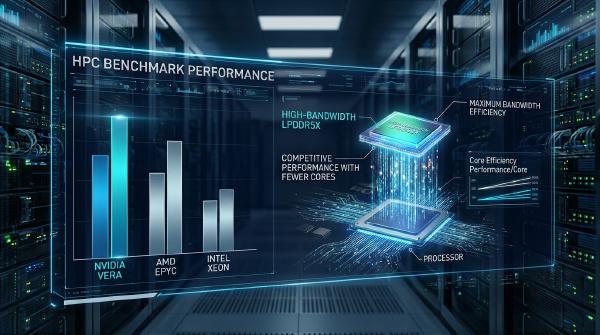
Its architecture combines NVIDIA-designed Arm CPU cores with a high-bandwidth LPDDR5X memory subsystem. The emphasis is not simply on maximizing core count, but on sustaining high data throughput across CPU-intensive workloads.
CPU architecture and core configuration #
Vera uses NVIDIA’s custom Olympus CPU core, based on the Arm v9.2 instruction set.
Its reported characteristics include:
- CPU cores: 88 per processor.
- Threads: 176 per processor.
- Instruction set: Arm v9.2.
- Vector processing: Six 128-bit SVE2 units.
- Multithreading: Spatial Multithreading.
The Spatial Multithreading design is an important distinction from conventional descriptions of x86 simultaneous multithreading.
Rather than treating two threads as ordinary software contexts competing for shared execution resources, NVIDIA describes its approach as spatially partitioning execution resources to support concurrent thread execution.
The practical objective is to improve processor utilization across workloads with varying execution characteristics.
Cache hierarchy #
The reported cache configuration is:
| Cache Level | Capacity |
|---|---|
| L1 | 96 KB |
| L2 | 2 MB per core |
| L3 / SCF | 164 MB total |
The relatively large per-core L2 cache and shared L3 subsystem help reduce the frequency of accesses to external memory.
For workloads involving frequent data reuse, cache capacity and latency can be just as important as peak memory bandwidth.
Memory subsystem #
Memory bandwidth is one of Vera’s most important architectural features.
Each processor supports LPDDR5X memory with the following reported characteristics:
| Specification | Per-CPU Configuration |
|---|---|
| Memory technology | LPDDR5X |
| Maximum capacity | Up to 1.5 TB |
| Memory channels | 32 |
| Channel width | 32 bits |
| Aggregate memory bandwidth | Up to 1.2 TB/s |
The 32-bit channel arrangement provides an aggregate interface width equivalent to sixteen 64-bit channels.
For comparison, mainstream x86 server platforms using conventional DDR5 configurations can deliver substantially lower memory bandwidth per socket. The exact difference depends on the processor generation, memory speed, channel population, and whether advanced memory modules such as MRDIMMs are used.
Vera’s design places particular emphasis on bandwidth and energy efficiency.
This makes it attractive for workloads that repeatedly stream large datasets through the CPU, including scientific simulations, graph processing, and selected AI data-processing tasks.
PCIe and CPU interconnects #
Each Vera processor provides:
- 88 PCIe Gen6 lanes.
- Up to x16, x8, x4, and x2 lane configurations.
- CXL 2.0 and CXL 3.1 support.
- Second-generation NVLink-C2C connectivity.
A PCIe Gen6 x16 connection provides approximately 256 GB/s of aggregate bidirectional bandwidth under the standard transfer-rate calculation.
NVLink-C2C provides a separate high-bandwidth chip-to-chip connection, enabling tighter integration between CPUs and compatible NVIDIA accelerators.
These interfaces are important because modern AI servers need to move data efficiently between processors, accelerators, memory, and I/O devices.
Power and thermal characteristics #
The reported Vera CPU TDP is approximately 480W, with programmable total compute power ranging from 250W to 500W.
A dual-socket configuration therefore represents a substantial CPU power requirement before accounting for GPUs, memory, storage, networking, and cooling.
The fact that HPE integrates two such processors into a 2U air-cooled server makes thermal engineering a critical part of the platform design.
🧠 Memory Architecture: LPDDR5X SOCAMM and the Cost of Fixed Capacity #
The memory subsystem is arguably the most distinctive part of the DL394 Gen12.
Unlike conventional servers that use replaceable DDR5 RDIMM modules, the DL394 Gen12 uses LPDDR5X SOCAMM memory.
SOCAMM is a compact memory-module form factor designed to bring low-power DRAM closer to the processor while supporting high bandwidth.
Its physical and electrical characteristics make it particularly suitable for high-density compute platforms.
Memory configuration #
The documented configuration provides eight memory modules per CPU, or sixteen modules across the complete dual-socket system.
The listed capacity options are:
| Per-CPU Configuration | Module Population | Dual-Socket Total |
|---|---|---|
| 768 GB | 8 × 96 GB | 1.5 TB |
| 1.5 TB | 8 × 192 GB | 3 TB |
| 512 GB | 8 × 64 GB | 1 TB |
Some of these configurations are identified as future options rather than immediately available configurations.
The most important limitation appears in HPE’s memory documentation:
“The memory is not field upgradable – the memory chosen is the memory that will always stay with the system.”
In practical terms, the memory capacity selected when purchasing the server is fixed for the system’s operational lifetime. Customers cannot treat the memory subsystem like a conventional RDIMM-based server and expand it later by installing additional modules.
Why use SOCAMM instead of conventional RDIMMs? #
There are several engineering reasons behind this design choice.
1. Higher memory bandwidth
LPDDR5X provides high transfer rates, while the SOCAMM packaging approach allows memory to be placed close to the processor.
Shorter signal paths and an optimized memory layout help support the bandwidth requirements of the Vera architecture.
2. Lower memory power consumption
LPDDR technology is designed for power efficiency. In a server containing two high-power processors and potentially multiple GPUs, reducing memory power consumption can contribute to overall system efficiency.
3. Compact physical packaging
SOCAMM modules occupy less space than conventional server memory arrangements, allowing motherboard designers to optimize the layout around processors and high-speed I/O.
For a platform prioritizing memory bandwidth per unit of rack space, this packaging approach has clear advantages.
The trade-off: Reduced upgrade flexibility #
The performance benefits come with an important operational compromise.
Conventional RDIMM-based servers allow administrators to purchase a smaller initial memory configuration and expand capacity later. The DL394 Gen12 does not offer the same flexibility.
This creates several purchasing considerations:
- Memory capacity must be planned before deployment.
- Future workload growth cannot be addressed through ordinary memory upgrades.
- Initial procurement costs may be higher because customers need to select sufficient capacity upfront.
- Replacing or upgrading the memory configuration may require replacing the system or using an approved service-level procedure.
There may also be supply-chain considerations. High-capacity SOCAMM modules are part of a relatively specialized server memory ecosystem, and availability can affect system lead times and configuration costs.
For workloads with predictable memory requirements, this trade-off may be acceptable. EDA, scientific simulation, and other bandwidth-sensitive applications often have well-defined capacity requirements before deployment.
For general-purpose enterprise environments, however, the lack of field-upgradable memory is a significant limitation.
For more background on the processor’s memory architecture, see NVIDIA Vera CPU Specifications: 88 Cores, 176 Threads, and 1.5TB LPDDR5X.
🐧 Software Ecosystem: Early Certification for Vera-Based Servers #
Hardware capability alone does not determine whether a server is ready for enterprise deployment.
Operating-system support, drivers, firmware integration, virtualization compatibility, and application validation are equally important.
According to the DL394 Gen12 QuickSpecs documentation, its initial operating-system certification plans cover three Linux distributions:
| Operating System | Status |
|---|---|
| RHEL4NV | Initial certification plan |
| Ubuntu 26.04 | Initial certification plan |
| SUSE Linux Enterprise Server 15 SP6 | Initial certification plan |
These entries are identified as initial certification plans, so they should not automatically be interpreted as completed certifications.
What the initial OS list tells us #
1. The software ecosystem is still developing
The initial list is relatively limited compared with the operating-system choices available for mature x86 server platforms.
Enterprise customers will need to verify the final HPE support matrix before selecting an operating system for production deployment.
2. NVIDIA is working closely with Linux vendors
The inclusion of RHEL4NV indicates a close relationship between NVIDIA’s platform software and enterprise Linux distributions.
This approach is important for a new CPU architecture because the operating system must support the processor’s scheduling, memory management, power management, and platform-specific features.
3. Windows and virtualization support require confirmation
The initial documentation does not list Windows Server or VMware vSphere as certified operating systems or hypervisor platforms.
Organizations planning to run Windows workloads or conventional virtualization environments should therefore confirm support directly with HPE before purchasing.
The same applies to KVM-based deployments: Linux availability alone does not establish that every virtualization configuration is supported or certified.
Why software maturity matters for agentic AI #
Agentic AI workloads depend on more than CPU execution speed.
Their performance also relies on:
- Process scheduling and isolation.
- Container and sandbox support.
- Memory allocation and NUMA behavior.
- High-performance networking.
- GPU driver and runtime compatibility.
- Storage access and data movement.
- Monitoring and management integration.
A new CPU platform must provide a stable software environment across these layers before its hardware performance can translate into predictable production results.
🔋 Initial CTO Configuration: 1.5 TB Memory and Four 2000W Power Supplies #
HPE’s initial Configure-to-Order offering provides a useful view of the system’s intended deployment profile.
The documented model is:
HPE ProLiant Compute DL394 Gen12 2P 768GB SOCAMM Configure-to-Order Server
- SKU:
P95388-B21 - Form factor: 2U rackmount
- Processors: Two NVIDIA Vera CPUs
- Memory: 768 GB per CPU
- Total memory: Approximately 1.5 TB
- Power supplies: Four HPE 2000W CRPS hot-plug modules
- Rail kit: Included by default
Initial configuration summary #
| Component | Configuration |
|---|---|
| CPU | 2 × NVIDIA Vera |
| Memory per CPU | 768 GB |
| Total installed memory | 1.5 TB |
| Memory modules | 16 × 96 GB |
| Power supply | 4 × 2000W |
| GPU expansion | Up to 2 double-width GPUs |
| PCIe expansion | Multiple FHFL and HHFL slots |
| Chassis | 2U rackmount |
The initial memory configuration is substantial. With approximately 1.5 TB installed, the server is clearly aimed at organizations running large working sets and memory-intensive applications.
It is not an entry-level development platform intended primarily for small-scale experimentation.
Understanding the four-power-supply configuration #
The system uses four 2000W power supply modules, giving a nominal combined module rating of 8000W.
However, the actual usable system power depends on the power-input voltage, power supply operating conditions, redundancy policy, and the chassis power-distribution design.
It is important not to interpret the four-module configuration as an unconditional 8000W system power budget.
The power architecture must account for:
- Two Vera processors, each operating around 480W at the stated TDP.
- Up to two high-power GPUs.
- LPDDR5X memory modules.
- PCIe expansion cards and networking devices.
- NVMe storage.
- Fans, management controllers, and other system components.
The four-module arrangement provides the power density and redundancy options required by this class of server.
The exact redundancy mode—such as N+N or N+1—should be confirmed against the supported HPE power configuration rather than inferred solely from the number of installed modules.
PCIe expansion considerations #
The CTO configuration provides multiple PCIe expansion positions, including FHFL and HHFL slots.
This is important because the platform is not limited to CPU-only workloads. Customers can add supported GPU accelerators, networking adapters, and other PCIe devices according to the system’s slot and power constraints.
The absence of an OCP NIC slot makes PCIe resource planning especially important.
Organizations requiring high-speed network adapters or DPUs should evaluate the available PCIe slots alongside GPU requirements before finalizing the configuration.
🔍 What the DL394 Gen12 Means for AI Infrastructure #
The DL394 Gen12 illustrates a broader change in server architecture.
Historically, GPU servers were often designed around a relatively simple division of responsibilities:
- The CPU managed operating-system tasks, application orchestration, and system I/O.
- The GPU performed the majority of accelerated model computation.
That division is becoming less representative of modern AI workloads.
Agentic AI increases CPU-side work #
An AI agent may need to perform several operations after generating an initial response:
- Interpret a tool request.
- Launch a sandbox or execution environment.
- Run code or query an external service.
- Retrieve and process the resulting data.
- Update application state.
- Return the result to the model for another inference step.
Many of these operations are CPU-intensive, and several must complete before the next model invocation can begin.
As a result, CPU execution latency can become a bottleneck even when GPU inference performance is excellent.
Memory bandwidth becomes a system-level consideration #
The Vera CPU’s 1.2 TB/s memory bandwidth is relevant to workloads that repeatedly process large datasets.
Examples include:
- Scientific simulations.
- EDA workloads.
- Large-scale data preprocessing.
- Graph analytics.
- CPU-side AI orchestration.
- High-throughput execution environments.
For these workloads, increasing core count without increasing memory bandwidth may produce diminishing returns.
Vera’s LPDDR5X subsystem attempts to address that imbalance by supplying data to the processor at a substantially higher rate than conventional server memory configurations.
NVIDIA’s move toward complete computing platforms #
The DL394 Gen12 also reflects NVIDIA’s broader strategy.
The company is expanding beyond GPU accelerators into a more integrated infrastructure stack that includes:
- CPUs.
- GPUs.
- High-bandwidth memory.
- CPU-GPU interconnects.
- Networking and storage components.
- System software and development tools.
This approach allows NVIDIA to optimize the interaction between different compute components rather than relying entirely on independently designed server subsystems.
For another perspective on Vera’s role in this strategy, see NVIDIA Unveils 88-Core Vera CPU, Built Specifically for the Agentic AI Era.
⚖️ Deployment Considerations: Where the DL394 Gen12 Fits #
The DL394 Gen12 is not necessarily the right choice for every enterprise environment.
Its architecture makes the most sense when workload requirements align with its strengths.
| Workload or Requirement | Suitability |
|---|---|
| Memory-bandwidth-intensive scientific computing | Strong architectural fit |
| EDA simulation and verification | Strong architectural fit |
| CPU-intensive agentic AI workloads | Strong architectural fit |
| Large-scale data processing | Potentially strong fit |
| GPU-accelerated AI workloads | Depends on GPU configuration |
| General-purpose enterprise applications | Requires workload evaluation |
| Flexible, incremental memory expansion | Poor fit |
| Windows Server deployment | Requires support confirmation |
| Conventional virtualized infrastructure | Requires support confirmation |
Several factors should be evaluated before deployment.
Memory capacity must be planned upfront. The non-field-upgradable memory design makes initial capacity selection a long-term infrastructure decision.
Software support must be verified. Initial certification plans do not guarantee that every production operating system, hypervisor, driver, or application stack is ready.
Power and cooling infrastructure must be sufficient. A dual-socket Vera system with GPU expansion can require substantial rack power and cooling capacity.
PCIe resources need careful allocation. The absence of OCP NIC support means networking and DPU requirements must be considered alongside GPU expansion.
Performance should be validated with real workloads. Peak memory bandwidth and core count are useful specifications, but application performance depends on software behavior, memory locality, concurrency, and data-access patterns.
The most useful evaluation is therefore a representative workload test rather than a comparison based solely on CPU specifications.