Intel Diamond Rapids Xeon 7: 192 Cores, PCIe 6.0, and a Bold Architectural Shift
At COMPUTEX 2026, Intel officially disclosed the core specifications of its next-generation Diamond Rapids Xeon 7 server processor family, scheduled for release in 2027. While the headline figures—192 cores, PCIe 6.0 support, and 16-channel DDR5 memory—are impressive, the most surprising announcement was the temporary removal of Hyper-Threading (SMT).
The move represents one of the most significant architectural changes Intel has made in the server CPU market in recent years. As data center workloads increasingly shift toward AI inference, agentic AI platforms, cloud-native services, and large-scale distributed computing, Intel appears to be prioritizing single-thread performance, memory throughput, and platform scalability over traditional thread-density metrics.
For infrastructure architects, cloud providers, and enterprise procurement teams, Diamond Rapids offers an early glimpse into Intel’s strategy for competing in the next generation of AI-driven data centers.
🚀 Diamond Rapids Overview #
Diamond Rapids succeeds the Granite Rapids generation and introduces substantial improvements across compute density, memory bandwidth, and I/O capabilities.
Key Specifications #
| Feature | Intel Diamond Rapids Xeon 7 |
|---|---|
| Release Timeline | 2027 |
| Process Technology | Intel 18A-P |
| CPU Cores | Up to 192 |
| Core Architecture | Panther Cove-X |
| Memory Support | 16-Channel DDR5 |
| PCIe Support | PCIe Gen6 |
| Socket | LGA 9324 |
| Maximum TDP | Up to 650W |
| Multi-Socket Support | Yes |
| Hyper-Threading (SMT) | Disabled |
| Successor Restoring SMT | Coral Rapids (2028) |
The processor family is positioned as Intel’s flagship offering for hyperscale cloud infrastructure, AI inference deployments, and high-performance enterprise computing environments.
🏭 First Server CPU Built on Intel 18A-P #
One of the most notable advancements is the adoption of Intel’s 18A-P manufacturing process, marking the first mass-produced server product built on this node.
The 18A-P process is an optimized derivative of Intel’s 18A technology, which was previously introduced with the Clearwater Forest Xeon 6+ family.
Key objectives of the 18A-P node include:
- Improved performance-per-watt
- Higher transistor efficiency
- Lower operating power consumption
- Better thermal characteristics under sustained workloads
For modern data centers, power efficiency is no longer merely a technical specification—it is a major economic factor. As infrastructure operators increasingly face power delivery and cooling constraints, improvements in energy efficiency directly influence total cost of ownership (TCO).
🧩 Chiplet Architecture and Core Expansion #
Diamond Rapids utilizes a chiplet-based design consisting of:
- Four compute chiplets
- Two large central I/O dies
This modular approach enables Intel to scale core counts while maintaining manufacturing flexibility and improving yields.
50% Increase in Core Count #
Compared to the previous-generation Granite Rapids platform:
| Generation | Maximum Core Count |
|---|---|
| Granite Rapids | 128 |
| Diamond Rapids | 192 |
This represents a precise 50% increase in physical cores.
The processor exclusively utilizes Panther Cove-X performance cores, which are optimized for:
- High single-thread performance
- Cloud-native workloads
- AI inference engines
- Infrastructure-as-a-Service (IaaS) environments
- Large-scale virtualization
Rather than pursuing a heterogeneous architecture, Intel appears to be emphasizing consistent high-performance cores across the entire product stack.
⚡ Hyper-Threading Removed—At Least for Now #
The most unexpected announcement surrounding Diamond Rapids is the temporary removal of Hyper-Threading, also known as Simultaneous Multi-Threading (SMT).
For decades, Hyper-Threading has been a defining feature of Intel server processors, allowing a single physical core to execute multiple software threads simultaneously.
However, Diamond Rapids will ship without SMT support.
Intel has not yet provided a detailed explanation for the decision, but several industry trends may help explain the shift:
Focus on AI and Cloud Workloads #
Many modern AI inference and cloud-native workloads derive greater benefit from stronger physical cores than from increased logical thread counts.
Improved Resource Isolation #
Disabling SMT can improve:
- Predictable latency
- Security isolation
- Cache utilization
- Resource scheduling efficiency
These characteristics are particularly valuable in multi-tenant cloud environments.
Power and Thermal Optimization #
Removing SMT may allow Intel to dedicate more power and silicon resources toward maximizing per-core performance and energy efficiency.
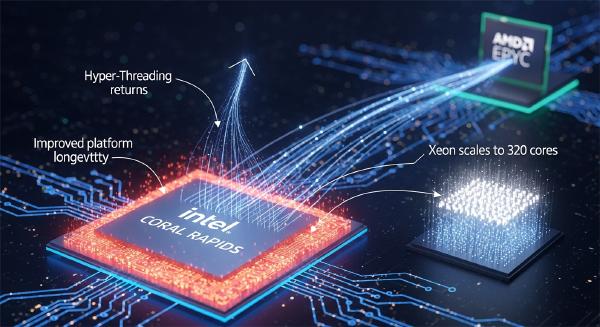
Intel has confirmed that Hyper-Threading is expected to return with Coral Rapids, the company’s planned 2028 server platform.
🔮 16-Channel DDR5 Doubles Memory Bandwidth #
Memory bandwidth is becoming one of the primary bottlenecks in modern computing systems.
As AI models, analytics workloads, and distributed databases continue to grow, feeding data to CPU cores efficiently becomes increasingly important.
Diamond Rapids addresses this challenge through support for 16-channel DDR5 memory, effectively doubling memory bandwidth compared to previous generations.
Workloads That Benefit Most #
The increase is particularly relevant for:
- AI inference platforms
- Agentic AI frameworks
- Large-scale analytics
- Distributed databases
- In-memory computing
- High-performance storage systems
In these environments, memory throughput often determines overall system performance more than raw CPU frequency.
🔌 PCIe 6.0 Enables Next-Generation Expansion #
Diamond Rapids is also Intel’s first Xeon platform to support PCIe Gen6.
This upgrade substantially increases available I/O bandwidth and prepares the platform for future accelerator-rich server designs.
PCIe 6.0 Benefits #
The new interface improves connectivity for:
- AI accelerators
- GPUs
- High-speed NICs
- NVMe storage arrays
- Computational storage devices
- Advanced networking infrastructure
As modern servers increasingly incorporate multiple accelerators, PCIe bandwidth has become a critical platform consideration.
PCIe 6.0 positions Diamond Rapids to support next-generation AI infrastructure without becoming constrained by I/O limitations.
🏗️ Platform Compatibility and Upgrade Flexibility #
Intel has designed the Diamond Rapids platform with long-term scalability in mind.
The LGA 9324 socket supports:
- Standard 192-core configurations
- Future higher-density products
- Planned 512-core variants
This compatibility offers several advantages for data center operators:
- Reduced motherboard replacement costs
- Simplified infrastructure upgrades
- Lower deployment risk
- Extended platform lifespan
Organizations can scale CPU performance across multiple generations while minimizing hardware redesign efforts.
🎯 Competitive Positioning Against AMD #
Diamond Rapids is expected to compete directly with AMD’s future EPYC Venice processors, which are rumored to feature up to 256 Zen 6C cores.
Diamond Rapids vs Future EPYC Venice #
| Feature | Intel Diamond Rapids | AMD EPYC Venice |
|---|---|---|
| Architecture | x86 | x86 |
| Maximum Cores | 192 | Up to 256 |
| Memory Channels | 16 DDR5 | Expected High-Density DDR5 |
| PCIe Support | PCIe 6.0 | PCIe 6.0 Expected |
| Primary Focus | Single-thread and AI workloads | High-density cloud workloads |
While AMD may retain a raw core-count advantage, Intel is clearly emphasizing:
- Stronger per-core performance
- Higher memory throughput
- AI-oriented workload optimization
- Improved energy efficiency
For cloud service providers and inference-heavy deployments, these factors may prove more important than maximum thread counts alone.
🤝 Potential NVIDIA Integration #
Intel also revealed ongoing efforts to develop a customized Xeon variant featuring NVLink connectivity for NVIDIA platforms.
Such a partnership would be strategically significant.
Modern AI infrastructure increasingly combines:
- NVIDIA GPUs
- High-bandwidth interconnects
- CPU orchestration layers
- Distributed storage systems
An NVLink-enabled Xeon platform could improve CPU-to-GPU communication efficiency and strengthen Intel’s role within NVIDIA-centric AI deployments.
If successful, this initiative would expand Intel’s presence in one of the fastest-growing segments of the data center market.
📈 What Diamond Rapids Means for Data Centers #
Diamond Rapids reflects a broader industry shift away from simply increasing core counts.
Modern data centers increasingly prioritize:
- Single-thread performance
- Memory bandwidth
- Accelerator connectivity
- Energy efficiency
- Platform longevity
Intel’s decision to introduce PCIe 6.0, double memory bandwidth, and optimize around Panther Cove-X cores demonstrates a focus on real-world infrastructure bottlenecks rather than headline specifications alone.
The temporary removal of Hyper-Threading may initially generate debate, but it also signals Intel’s willingness to rethink long-standing design assumptions as AI workloads reshape data center requirements.
🏁 Conclusion #
The Diamond Rapids Xeon 7 family represents one of Intel’s most ambitious server CPU updates in years. Built on the new 18A-P process and featuring up to 192 Panther Cove-X cores, PCIe 6.0 connectivity, and 16-channel DDR5 memory, the platform is clearly designed for the next generation of cloud and AI infrastructure.
Although the absence of Hyper-Threading may surprise enterprise customers, Intel appears confident that stronger physical cores, increased memory bandwidth, and improved platform scalability will better align with evolving data center workloads.
With AMD preparing EPYC Venice and NVIDIA continuing to expand deeper into data center CPUs, the battle for enterprise computing leadership in 2027 is shaping up to be one of the most competitive periods in server processor history.