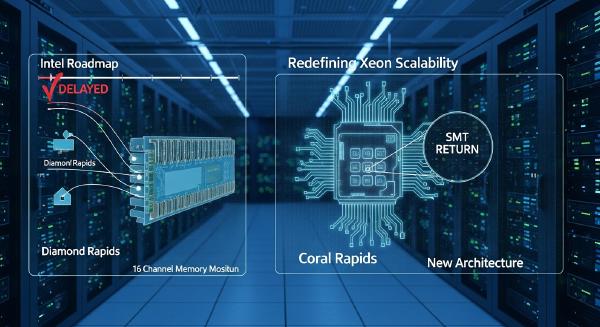
Intel Coral Rapids Leak Reveals 320-Core Xeon and SMT Return
Intel appears to be preparing a major shift in its server CPU strategy. Newly surfaced details surrounding the next-next-generation Xeon platform, Coral Rapids, suggest a renewed focus on high-density parallel computing, significantly higher core counts, and the return of Simultaneous Multithreading (SMT), better known as Hyper-Threading.
If the leaked specifications prove accurate, Coral Rapids could become Intel’s most ambitious server processor architecture in years, positioning the company to compete more aggressively against AMD’s rapidly expanding EPYC lineup and emerging Arm-based data center platforms.
🚀 Why Intel Is Changing Course #
Intel’s roadmap adjustments appear to be driven by both market realities and internal strategic reassessment.
As AMD continues gaining traction in the data center segment through increasingly dense EPYC designs, Intel has faced growing pressure to improve throughput, scalability, and overall performance per socket. A major point of concern has been the planned removal of Hyper-Threading from certain upcoming Xeon generations.
Industry reports indicate that Intel leadership recognized the competitive disadvantage of shipping high-core-count processors without SMT, particularly as rival platforms continue to increase thread density and workload efficiency.
This has led to a restructuring of Intel’s server roadmap:
- Diamond Rapids is now expected to serve primarily as a transitional generation.
- Coral Rapids has become the primary long-term Xeon development focus.
- Engineering resources and supply chain priorities have reportedly shifted toward accelerating Coral Rapids development.
The objective is clear: restore competitiveness in heavily threaded enterprise workloads where raw parallelism increasingly determines performance leadership.
🏗️ Coral Rapids Architecture Overview #
The most notable architectural change is the return of Hyper-Threading.
With SMT enabled, each physical core can execute two threads simultaneously, significantly increasing throughput in virtualization, cloud infrastructure, analytics, and AI workloads.
Based on current leaks, Coral Rapids could scale to an unprecedented 320 cores while maintaining dual-thread execution across the entire processor.
| Platform | Maximum Cores | SMT / Hyper-Threading | Memory Channels | Primary Target |
|---|---|---|---|---|
| Diamond Rapids | 192 | No | 16 | Transitional enterprise platform |
| Coral Rapids | 320 | Yes (640 Threads) | 16–20 (8 on entry models) | AI, cloud, analytics, hyperscale infrastructure |
| AMD EPYC Venice | 256 | Yes (512 Threads) | Not disclosed | Cloud and hyperscale deployments |
From a theoretical perspective, Coral Rapids would deliver substantially higher thread density than previous Xeon generations, potentially allowing Intel to regain ground in environments where workload consolidation and virtualization efficiency are critical.
⚙️ Product Segmentation and Scaling #
Intel appears to be designing Coral Rapids as a highly scalable platform capable of addressing multiple deployment tiers.
Entry-Level Configurations #
Lower-end models are rumored to feature:
- Up to 128 CPU cores
- 8-channel memory support
- Optimizations for workstation and mainstream server deployments
- Improved software compatibility and platform stability
These configurations would target organizations that require enterprise-grade reliability without the need for maximum compute density.
High-End Configurations #
At the upper end of the stack, Coral Rapids could introduce:
- Up to 320 CPU cores
- Up to 640 concurrent threads
- 16 to 20 memory channels
- Significantly increased memory bandwidth
These specifications would position Coral Rapids directly against future high-density EPYC platforms and emerging Arm-based server processors.
The increase from previously rumored 256-core configurations suggests Intel may be aggressively pursuing leadership in raw socket-level compute density.
🔄 Socket Compatibility and Upgrade Economics #
One of the most significant aspects of the leak is Intel’s reported commitment to platform continuity.
Coral Rapids is expected to retain the same socket infrastructure introduced with Diamond Rapids, following Intel’s traditional multi-generation socket strategy.
For enterprise customers, this approach offers several advantages:
- Reduced platform migration costs
- Extended motherboard lifecycle
- Preservation of existing cooling solutions
- Lower infrastructure replacement expenses
- Simplified deployment planning
In large-scale data centers, platform longevity often influences purchasing decisions as much as processor performance. Maintaining socket compatibility could make Coral Rapids a more attractive upgrade path for existing Xeon customers.
📊 Competitive Positioning Against AMD and Arm #
The server processor market is becoming increasingly competitive.
AMD continues to expand its presence through higher core-count EPYC products, while Arm-based alternatives from companies such as Nvidia and Amazon are gaining momentum in cloud-native environments.
Coral Rapids appears designed to address several key battlegrounds simultaneously:
AI and Machine Learning #
Higher thread counts and increased memory bandwidth could improve:
- AI inference workloads
- Large-scale model serving
- Data preprocessing pipelines
- Analytics acceleration
Cloud Infrastructure #
Hyperscalers require dense compute resources capable of supporting large numbers of virtual machines and containers. A 320-core Xeon with SMT enabled could significantly improve workload consolidation ratios.
Data Analytics and HPC #
Large-scale parallel processing remains essential for:
- Scientific computing
- Batch analytics
- Database processing
- Simulation workloads
Media and Content Production #
Rendering, transcoding, and other highly parallel media workloads stand to benefit from increased thread density and memory throughput.
🔮 What Coral Rapids Means for the Future of Xeon #
While these specifications remain unofficial, the broader strategic direction is becoming increasingly clear.
Intel appears to be prioritizing:
- Higher core density
- Greater thread-level parallelism
- Increased memory bandwidth
- Longer platform lifecycles
- Improved competitiveness against AMD and Arm ecosystems
If Coral Rapids launches with the rumored 320-core configuration and full Hyper-Threading support, it could represent one of the most substantial architectural shifts in Xeon’s modern history.
By the time Coral Rapids arrives, likely around the 2028 timeframe, enterprise customers will have more choices than ever. Competition among Intel, AMD, Nvidia, and cloud-specific Arm vendors is expected to intensify, driving faster innovation and better price-to-performance ratios across the entire server industry.
For data center operators, that competition may ultimately be the most important development of all.