Intel Xeon Roadmap Shift: Diamond Rapids Delay and SMT Return
Intel is restructuring its Xeon roadmap with a set of changes that go beyond simple scheduling adjustments. The delay of Diamond Rapids to mid-2027, the transition to 16-channel memory platforms, and the planned return of simultaneous multithreading (SMT) in Coral Rapids collectively signal a deeper architectural recalibration.
Rather than pursuing linear performance scaling, Intel is rebalancing core count, memory bandwidth, packaging strategy, and execution efficiency across generations.
⏳ Diamond Rapids Delay and Platform Realignment #
Diamond Rapids has been pushed back from its earlier timeline, with multiple contributing factors:
- Yield challenges in large-scale multi-chip designs
- Packaging complexity at high core counts
- Platform restructuring toward higher memory bandwidth
At the same time, Intel is simplifying its product stack:
- Cancellation of some 8-channel configurations
- Standardization around 16-channel memory platforms
This indicates a shift toward bandwidth-first system design, acknowledging that memory throughput—not compute—is becoming the dominant constraint.
🔮 Core Scaling: 256 to 512 Cores Without Platform Disruption #
Early Diamond Rapids SKUs are expected to deliver:
- Up to 256 performance cores (P-cores)
- Scaling to 512 total cores using efficient cores (E-cores)
A key design decision:
- Both configurations share the same socket and platform
Implications #
- No motherboard replacement required for upgrades
- Lower infrastructure churn in data centers
- Scaling cost concentrated at the CPU level
This reflects a growing priority: platform stability over generational fragmentation.
🧩 Chiplet Architecture: CBB and IMC Separation #
Diamond Rapids introduces a more disaggregated chiplet design:
Core Building Block (CBB) #
- Dedicated to compute cores
- Scales independently across SKUs
Integrated Memory Controller (IMC) #
- Separated from compute dies
- Handles memory access and routing
Benefits #
- Reduced die complexity
- Improved manufacturing yield
- Greater flexibility in multi-die composition
Trade-Offs #
- Increased packaging complexity
- Higher interconnect bandwidth requirements
- Greater sensitivity to latency between chiplets
This reflects the broader industry trend toward modular silicon design, where integration shifts from monolithic dies to advanced packaging.
📊 16-Channel Memory: Bandwidth Becomes the Bottleneck #
At hundreds of cores, compute is no longer the limiting factor—memory access is.
Why 16 Channels? #
- Provides higher aggregate bandwidth
- Reduces contention for memory access
- Improves performance under cache-miss-heavy workloads
Without this expansion:
- Additional cores would increase stall time, not throughput
- System efficiency would degrade under load
Power Implications #
- Platform TDP approaching 650W
- Significant demands on:
- Power delivery systems
- Cooling infrastructure
This underscores a key shift:
Scaling compute requires proportional scaling of memory bandwidth and power delivery.
🔄 SMT Disabled—But Not Gone #
Diamond Rapids represents the final Xeon generation with SMT disabled by default.
Why Disable SMT? #
- Simplifies scheduling at extreme core counts
- Reduces resource contention within cores
- Improves determinism for certain workloads
However, this is a temporary trade-off.
🔁 Coral Rapids: SMT Returns with a Different Balance #
With Coral Rapids (expected mid-2028), Intel plans to reintroduce SMT.
Key Changes #
- Return to 8-channel memory configuration
- Reintroduction of SMT-enabled P-cores
- Reduced emphasis on extreme core scaling
Rationale #
- Many workloads still benefit from SMT:
- AI inference pipelines
- General-purpose compute
- Mixed utilization scenarios
This marks a strategic shift:
From maximizing parallelism → to improving execution unit utilization.
🔗 NVLink Integration: CPUs as Accelerator Nodes #
Intel is also aligning Xeon designs with emerging heterogeneous compute environments.
Custom x86 SKUs for NVIDIA #
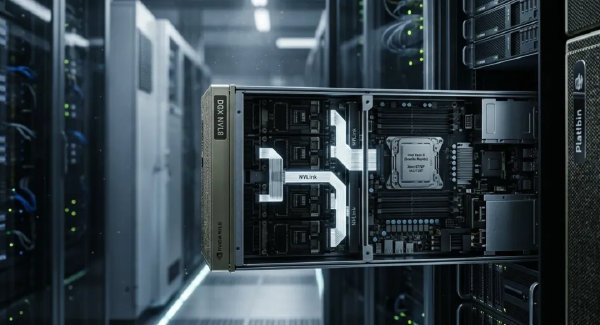
- Support for NVLink interconnect
- Direct integration into GPU clusters
Architectural Implications #
- CPUs act as:
- Scheduling nodes
- Data orchestration engines
- Less focus on standalone CPU performance
- Greater emphasis on:
- Memory coherency
- Interconnect efficiency
This reflects a broader evolution:
CPUs are becoming coordination layers within accelerator-driven systems.
⚖️ Diamond Rapids vs Coral Rapids: Two Different Optimization Points #
The contrast between the two generations is deliberate.
Diamond Rapids #
- Extreme core count scaling
- High memory bandwidth (16-channel)
- Focus on throughput and concurrency
Coral Rapids #
- Reduced core pressure
- Return of SMT for efficiency
- More balanced execution model
Key Insight #
These are not sequential upgrades—they represent different optimization strategies:
- One prioritizes scale
- The other prioritizes utilization
🔮 System-Level Trade-Offs Define Modern Xeon Design #
Across both generations, Intel is navigating fundamental trade-offs:
| Dimension | Trade-Off |
|---|---|
| Core Count | Throughput vs efficiency |
| Memory Channels | Bandwidth vs platform cost |
| SMT | Utilization vs contention |
| Chiplet Design | Yield vs latency |
| Interconnect | Flexibility vs complexity |
These decisions are increasingly interdependent, requiring system-level optimization rather than component-level tuning.
🚀 Conclusion #
Intel’s Xeon roadmap changes highlight a broader shift in server CPU design:
- Core scaling alone is no longer sufficient
- Memory bandwidth and interconnects define system limits
- Packaging and architecture are as critical as silicon design
- Execution efficiency (via SMT and scheduling) remains essential
Key takeaways:
- Diamond Rapids pushes the limits of scale and bandwidth
- Coral Rapids rebalances toward efficiency and utilization
- CPUs are evolving into orchestration nodes within heterogeneous systems
For data center architects, the implication is clear:
Future performance gains will come from balancing system resources holistically, not maximizing any single metric.