Intel Shifts Gaming CPU Strategy to Latency and Scheduling
Intel is recalibrating its desktop gaming CPU strategy with a clear target: AMD’s X3D lineup. However, instead of replicating the large cache approach, Intel is pivoting toward a latency-first, scheduling-driven architecture, focusing on how work is executed rather than simply increasing hardware resources.
This marks a broader transition in CPU design philosophy—from maximizing peak metrics to controlling execution behavior at the system level.
🎯 Why AMD X3D Changed the Playing Field #
AMD’s X3D processors gained a strong advantage in gaming due to their massive L3 cache, which:
- Increases cache hit rates
- Reduces costly memory accesses
- Improves performance in latency-sensitive workloads
For many game engines—especially those built on older APIs—this translates directly into higher and more stable performance.
However, Intel’s analysis suggests that:
Cache is not a universal solution—it is a workload-specific optimization.
Instead of scaling cache, Intel decomposed the problem into latency sources inside the CPU execution model.
⚙️ The Real Bottleneck: Thread Scheduling and Core Topology #
Modern desktop CPUs now exceed 20 cores, introducing new complexity:
- Threads may migrate across cores
- Cache locality is frequently disrupted
- Inter-core communication introduces latency
These effects do not always reduce average FPS—but they manifest as:
- Frametime spikes
- Micro-stutter
- Inconsistent gameplay smoothness
Intel identified that:
Poor scheduling behavior can negate raw hardware advantages.
🧵 Thread Director and APO: Controlling Execution Paths #
To address this, Intel is investing heavily in runtime scheduling intelligence.
Key Technologies #
-
Thread Director
Provides real-time hints to the OS scheduler about optimal core placement -
APO (Application Optimization)
Tunes workload behavior at the application level
Goals #
- Keep threads on optimal cores
- Minimize cross-core migration
- Preserve cache locality
- Reduce scheduler overhead
This approach shifts optimization from static hardware design to dynamic execution control.
⏱️ Latency Over Frequency: A Subtle but Critical Shift #
Recent products already reflect this philosophy.
For example, improvements in chips like the Core Ultra 200S Plus were achieved by:
- Reducing intra-chip latency
- Improving data path efficiency
- Minimizing waiting time between execution stages
Notably, these gains were achieved without significant frequency increases.
Real-World Impact #
- Average FPS may change modestly
- Frametime consistency improves significantly
For gamers, this translates to:
- Smoother gameplay
- Reduced stutter
- More predictable performance
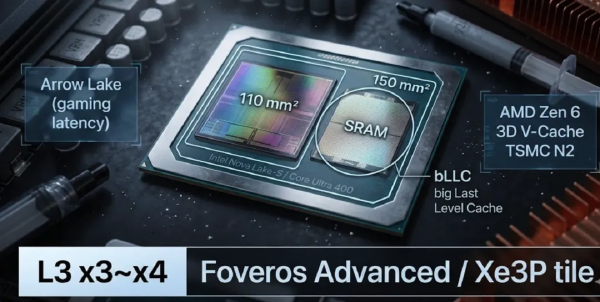
🔮 Rethinking Cache: Not a One-Size-Fits-All Solution #
Intel’s position on cache is pragmatic.
Where Large Cache Works Well #
- Older APIs (DX9, DX11)
- CPU-bound engines
- Random-access-heavy workloads
Where Benefits Diminish #
- Modern APIs (DX12, Vulkan)
- GPU-bound pipelines
- Well-optimized engines with better batching
Conclusion:
Cache is one optimization dimension—not the dominant one across all workloads.
🧩 Software Optimization as a First-Class Performance Lever #
One of the most significant shifts in Intel’s strategy is the elevation of software-level optimization.
Binary Optimization Tool (BOT) #
- Operates directly on execution paths
- Reorders instructions and invocation patterns
- Improves runtime efficiency
Reported Gains #
- ~8% average FPS improvement
- Up to 20%+ in specific scenarios
These gains are notable because they:
- Do not require new silicon
- Scale across existing hardware
- Address inefficiencies invisible at the hardware level
This reinforces a key idea:
Performance is increasingly defined by execution efficiency, not just hardware capability.
🔄 Hardware-Software Co-Design Becomes Mandatory #
As core counts rise and architectures become more heterogeneous:
- Frequency scaling alone is insufficient
- Cache scaling has diminishing returns
- Scheduling complexity increases exponentially
Intel is aligning:
- Hardware architecture
- OS scheduler interaction
- Compiler and runtime optimizations
Into a unified performance strategy.
This represents a shift toward full-stack performance engineering.
🏗️ Forward Roadmap: Nova Lake and Platform Stability #
This strategy will extend into future architectures such as Nova Lake.
Key considerations:
- Longer platform/socket lifecycle
- Reduced upgrade fragmentation
- More time for software optimization maturity
This is critical because:
- Scheduling optimizations require real-world tuning cycles
- Ecosystem alignment takes time (OS, game engines, drivers)
🎮 Mobile and Handheld: Different Constraints, Same Philosophy #
On mobile platforms, Intel is applying similar principles with different constraints.
Arc G3 (Handheld Focus) #
- Designed specifically for handheld devices
- Not a scaled-down laptop GPU
- Optimized for:
- Power efficiency
- Rapid workload fluctuation
- Scheduling responsiveness
Handheld workloads are:
- Highly bursty
- Sensitive to power and thermal limits
In this context:
Efficient scheduling matters more than peak frequency.
📊 From Peak Performance to Execution Control #
Intel’s overall direction can be summarized as a shift from:
| Old Model | New Model |
|---|---|
| Maximize frequency | Minimize latency |
| Increase cache | Optimize scheduling |
| Add more cores | Control execution placement |
| Improve peak FPS | Stabilize frametime |
This reflects a deeper realization:
Modern gaming performance is limited by coordination, not just computation.
🚀 Conclusion #
Intel’s response to AMD X3D is not imitation—but redefinition of the optimization space.
Key takeaways:
- Latency and scheduling are becoming primary performance drivers
- Thread placement and execution control matter as much as hardware specs
- Software optimization is now a first-class contributor to performance
- Frametime stability is a more meaningful metric than peak FPS
For developers and system architects, this signals a broader industry trend:
The future of performance lies in how efficiently work is executed, not just how fast hardware can run.
As CPUs continue to scale in complexity, mastering scheduling behavior and execution flow will become essential—not optional.