Intel Nova Lake-S bLLC vs AMD X3D: The Cache War
As of April 20, 2026, the battle for CPU gaming and data-locality dominance has escalated into a full-scale “Cache War.” Intel’s introduction of bLLC (Big Last Level Cache) in Nova Lake-S marks a direct and aggressive response to AMD’s X3D strategy.
But this is not just a capacity race—it’s a philosophical shift. Intel is moving from cache as a buffer to cache as a persistent data residency layer, reducing dependence on system memory and fundamentally reshaping workload behavior.
⚙️ bLLC: Intel’s On-Die Cache Revolution #
Intel’s bLLC approach differs sharply from AMD’s stacked cache design:
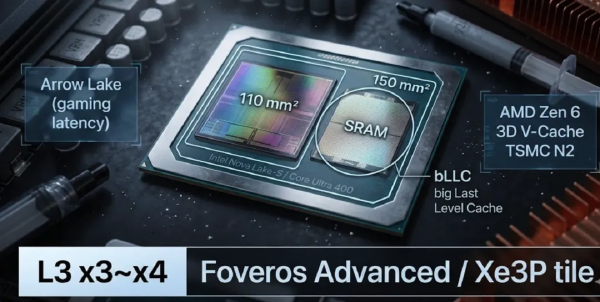
- Fully integrated on-die cache (no external stacking layer)
- Acts as a high-bandwidth, low-latency data reservoir
- Designed to keep active datasets resident rather than frequently reloaded
Silicon Trade-Off #
- Compute tile size (standard): ~98 mm²
- With bLLC: ~154 mm² (~60% increase)
This is a deliberate area-for-performance trade:
- Larger die → higher cost and thermal density
- But significantly improved:
- Frame-time consistency in games
- Cache-sensitive workloads (AI inference, simulation)
Unlike traditional designs, performance gains here come not from clocks—but from data proximity.
🆚 Cache Titans: Intel vs AMD #
Intel’s target is clear: dethrone AMD’s latest cache-heavy flagship, the AMD Ryzen 9 9950X3D2.
| Feature | AMD Ryzen 9 9950X3D2 | Intel Nova Lake-S (bLLC) |
|---|---|---|
| Max Cache | 208 MB | 288 MB |
| Cache Advantage | Baseline | +38% capacity |
| Core Count | 16 (Zen 6 Hybrid) | 52 (16P + 32E + 4LP-E) |
| Cache Design | 3D Stacked SRAM | On-Die Integrated |
| Max Power | ~200W | 175W – 700W+ |
Key Architectural Difference #
-
AMD X3D:
- Vertical stacking
- Maximizes cache density
- Minimal die expansion
-
Intel bLLC:
- Horizontal integration
- Massive die size increase
- Potentially better latency consistency
This is density vs integration—two fundamentally different engineering bets.
🧩 Multi-Tile Scaling: 28 to 52 Cores #
Nova Lake-S introduces a modular scaling strategy to manage both performance and power:
Single Compute Tile #
- Up to 28 cores (8P + 16E + 4 LP-E)
- 144 MB bLLC
- More manageable thermals and power
Dual Compute Tile (Flagship) #
- Up to 52 cores (16P + 32E + 4 LP-E)
- 288 MB bLLC
- LP-E cores remain fixed on the SoC tile
→ avoids OS scheduling complexity
This design allows Intel to scale aggressively without completely breaking software efficiency.
🎯 Market Segmentation: Premium-Only Feature #
Intel is positioning bLLC as an exclusive, high-end capability:
-
Expected only in:
- Core Ultra 7 “D/DX”
- Core Ultra 9 “D/DX”
-
Mainstream chips (Core Ultra 5):
- Standard cache sizes (18–36 MB)
- Focus on efficiency and general workloads
This mirrors AMD’s strategy of reserving X3D for gaming-focused SKUs—but with even more aggressive differentiation.
⚡ The Power Problem: Performance Has a Cost #
The most controversial aspect of Nova Lake-S is its extreme power envelope.
Key Concerns #
- Up to 700W burst power (flagship)
- High leakage current from large on-die SRAM
- Elevated idle power consumption compared to standard CPUs
Cooling Requirements #
To sustain peak performance:
- High-end motherboards are mandatory
- Advanced cooling solutions required:
- 360mm–420mm AIO liquid coolers
- Potential custom loop setups for enthusiasts
While the official TDP may list ~175W, real-world peak behavior tells a very different story.
🔄 A New Battlefield: Latency vs Efficiency #
The cache war is no longer just about size—it’s about how data is handled:
-
Intel (bLLC):
- Keeps data on-die as long as possible
- Prioritizes latency and consistency
- Accepts higher power draw
-
AMD (X3D):
- Expands cache via stacking
- Optimizes efficiency and density
- Maintains lower thermal overhead
This divergence will define performance across:
- Gaming (frame-time stability)
- AI workloads (model locality)
- Simulation and scientific computing
🚀 Final Thoughts #
Intel’s bLLC in Nova Lake-S is one of the boldest architectural bets in recent CPU history. It sacrifices die size and power efficiency to achieve something different:
👉 Turning cache into a primary compute asset—not just a support structure
If successful, this approach could:
- Reduce reliance on high-speed system memory
- Redefine CPU scaling strategies
- Shift optimization priorities for software developers
But the trade-offs are real:
- Extreme power consumption
- Complex thermal requirements
- Premium-only accessibility
The question now is no longer who has more cache—but:
- Do you prefer massive, integrated on-die residency (Intel)?
- Or efficient, stacked cache scaling (AMD)?
The answer will shape the next era of desktop performance.