Ryzen 7 9800X3D: AMD’s Gaming CPU Breakthrough
As of April 20, 2026, the Ryzen 7 9800X3D has firmly established itself as the top gaming CPU on the market. What began as intriguing leaks in late 2024 has now materialized into a defining architectural shift for AMD’s X3D lineup.
Unlike its predecessor, the 7800X3D, this chip removes the long-standing compromise between cache performance and clock speed, transforming X3D from a niche gaming solution into a true all-rounder CPU.
⚙️ Breaking the 5GHz Barrier: Inverted V-Cache #
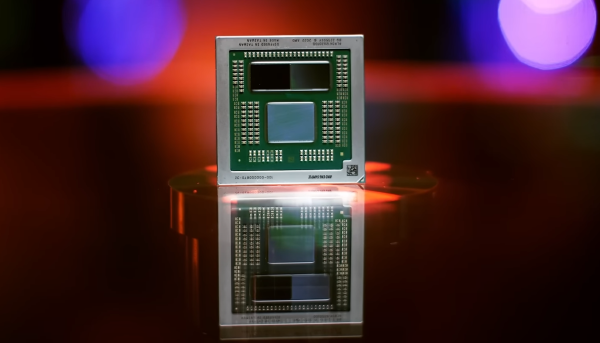
The most important innovation behind the 9800X3D is its Inverted 3D V-Cache architecture.
Traditional Design (7800X3D) #
- V-Cache stacked on top of CPU cores
- Heat trapped between cache and cores
- Limited boost clocks (~5.0 GHz ceiling)
New Design (9800X3D) #
- Core Complex Die (CCD) placed above the cache
- CPU cores now sit closer to the heat spreader (IHS)
- Improved thermal dissipation
👉 Result:
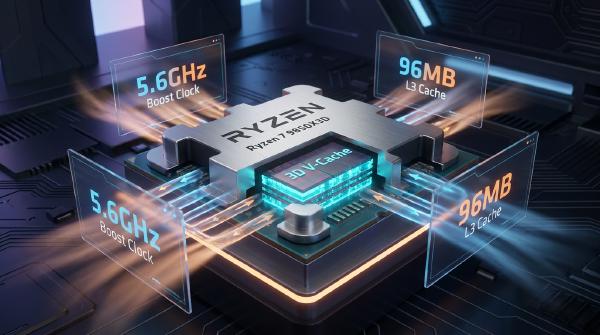
- 5.6 GHz+ achievable frequencies (overclocked)
- Significantly improved sustained boost behavior
This redesign solves the thermal bottleneck that constrained previous X3D generations.
🚀 Performance Leap: Gaming Meets Productivity #
The 9800X3D delivers gains that extend far beyond gaming.
Multi-Core Performance #
- ~25,258 (Cinebench R23)
- ~35% improvement over 7800X3D
This elevates the chip into:
- Content creation
- Streaming
- Video editing workloads
Single-Core Performance #
- ~2,260+ Cinebench R23 (Single-Core)
- Matches high-frequency non-X3D chips like Ryzen 7 9700X
This is unprecedented for an X3D processor, which historically lagged in single-threaded tasks.
🎮 Why the 9800X3D Changed the Market #
The 9800X3D reshaped expectations in three key ways:
1. True Overclocking Returns #
- First X3D chip with a fully unlocked multiplier
- Enables:
- Manual frequency tuning
- Advanced enthusiast overclocking
No longer restricted to PBO and curve optimization.
2. Real Thermal Headroom #
- Improved heat transfer from cores to cooler
- Compatible with:
- High-end air coolers
- Standard AIO liquid solutions
Eliminates the thermal limitations seen in prior X3D CPUs.
3. The “One-Chip” Solution #
Previously:
- X-series: High clocks
- X3D-series: High cache (gaming focus)
Now: 👉 The 9800X3D delivers both
- Top-tier gaming performance
- Competitive application performance
No more trade-offs.
📊 7800X3D vs 9800X3D #
| Feature | Ryzen 7 7800X3D (Zen 4) | Ryzen 7 9800X3D (Zen 5) |
|---|---|---|
| Max Boost Clock | 5.0 GHz | 5.2 GHz (Stock) / 5.6 GHz+ (OC) |
| L3 Cache | 96 MB | 96 MB (Inverted V-Cache) |
| CB R23 Multi-Core | ~18,500 | ~25,300 |
| Overclocking | Limited (PBO) | Fully Unlocked |
| Gaming Performance | Baseline | ~12–15% Faster |
🔄 2026 Context: The Cache War Continues #
The success of the 9800X3D has triggered a broader industry response.
- Intel’s Nova Lake-S introduces bLLC (Big Last Level Cache)
- Focus shifts toward:
- Data locality
- Cache-driven performance scaling
Meanwhile, AMD has extended this strategy into higher-end chips like:
- Ryzen 9 9950X3D2
- Dual-CCD design
- Expanded application of inverted cache stacking
🚀 Final Thoughts #
The Ryzen 7 9800X3D represents a turning point not just for AMD—but for CPU design as a whole.
By solving the thermal limitations of 3D V-Cache, AMD has achieved something critical:
👉 Eliminating the divide between gaming CPUs and performance CPUs
This chip proves that:
- Cache and clock speed no longer have to compete
- Efficiency and performance can coexist
- A single CPU can truly do it all