AMD Overlap Stacking: Breaking the Reticle Limit in 2026
As of April 20, 2026, AMD’s “Overlap” stacking patent—first revealed in late 2024—has evolved into a foundational technology of its Extreme Modular architecture strategy.
By moving beyond traditional side-by-side chiplets and simple vertical stacking, AMD has effectively addressed one of the most fundamental constraints in semiconductor design:
👉 The reticle limit
This innovation enables a new class of processors that are denser, faster, and more flexible than anything seen in previous Zen generations.
⚙️ The Overlap Concept: Escaping the 2D Constraint #
Traditional chiplet-based CPUs (Zen 2 through Zen 5) relied on 2D tiling:
- Chiplets placed side-by-side on a substrate
- Communication over relatively long horizontal interconnects
- Increasing latency as core counts scaled
The Overlap Approach #
AMD’s patented method introduces a partially stacked, offset layout:
- Smaller chiplets are partially overlapped beneath a larger “master” die
- Creates a staircase or shingled structure
- Combines horizontal and vertical integration
Key Advantages #
1. Higher Density
- Pack 16–24 cores into footprints previously limited to ~8 cores
- No significant increase in package thickness
2. Lower Latency
- Uses TSVs (Through-Silicon Vias) for vertical signaling
- Shorter paths vs traditional interposer routing
- Fewer data “hops” between compute, cache, and I/O
3. Better Bandwidth
- Direct vertical pathways improve:
- Core-to-cache communication
- Core-to-memory access
This effectively shifts the architecture from 2D scaling → 3D-aware optimization.
🔥 Thermal & Power Innovation: The Shingled Strategy #
Stacking introduces a major challenge: heat concentration.
AMD’s overlap design mitigates this through strategic layering.
Heat-Aware Placement #
- High-power components (Zen cores) are placed closer to the heat spreader
- Lower-power elements (cache, I/O) are positioned underneath
👉 Avoids stacking “hot-on-hot” regions
Power Gating Precision #
- Each “shingle” has independent power domains
- Fine-grained control allows:
- Selective shutdown of inactive regions
- Reduced leakage and idle consumption
Result (2026 systems):
- ~20% improvement in idle power efficiency
- Better sustained performance under load
This is a critical step toward energy-efficient high-density CPUs.
🚀 Real-World Impact (2026) #
The overlap stacking method plays a key role in AMD’s latest platforms, particularly:
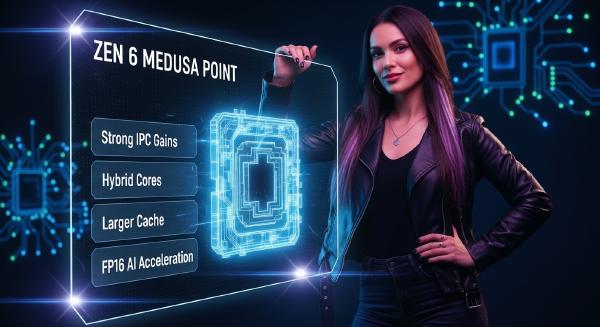
Ryzen AI “Medusa” Series #
Successor to Strix Halo, leveraging overlap architecture for:
Massive Integrated GPU Scaling #
- RDNA GPU tiles placed beneath CPU tiles
- Enables:
- 60+ Compute Units in mobile form factors
- Maintains manageable thermals without extreme cooling
Unified Memory Advancements #
- Overlapped memory controller design
- Integration with stacked LPDDR5X memory
Impact:
- Extremely short data paths
- Latency approaching on-die SRAM behavior
- Significant boost for:
- AI workloads
- Integrated graphics performance
📊 Traditional vs Overlap Stacking #
| Feature | 3D V-Cache (Traditional) | Overlap Stacking |
|---|---|---|
| Alignment | Vertical | Offset / Shingled |
| Thermal Risk | High | Managed Distribution |
| Primary Goal | Cache Expansion | Scalability + Integration |
| Connectivity | Core ↔ Cache | Core ↔ Core / I/O |
| Cost Model | High | Moderate (Reusable Modules) |
🧩 The Rise of “3.5D Packaging” #
Industry experts now describe this approach as:
👉 3.5D Packaging
A hybrid model combining:
- 2D chiplet modularity
- 3D vertical stacking
- Offset integration for thermal and signal optimization
Why It Matters #
- Enables customizable CPU designs
- Supports rapid SKU diversification
- Allows AMD to mix and match:
- CPU tiles
- GPU tiles
- AI accelerators
- I/O modules
All within a unified package design.
🔄 Final Thoughts #
AMD’s overlap stacking represents a fundamental shift in how processors are built:
- No longer constrained by reticle size
- No longer limited to flat chiplet layouts
- No longer forced into trade-offs between density and thermals
Instead, we are entering an era of:
👉 Composable, high-density, thermally-aware silicon design
The broader implication is clear:
As packaging becomes as important as transistor scaling, innovations like overlap stacking may determine the future balance between:
- x86 modular architectures
- ARM-based monolithic efficiency (e.g., Apple Silicon)