AMD Threadripper Halo Station: 96-Core CPU and 4-GPU AI Workstation
AMD is taking local AI computing into workstation territory with the Threadripper Halo Station, a liquid-cooled deskside system designed to run extremely large AI models without depending on cloud infrastructure.
Unveiled during AMD’s IFA 2026 keynote, the system combines a 96-core AMD Threadripper PRO 9995WX processor with up to four AMD Instinct MI350P accelerators. In its fully populated configuration, the platform can provide 576GB of HBM3E accelerator memory, alongside up to 2TB of system DDR5 memory.
AMD’s Senior Vice President and General Manager of Computing and Graphics, Jack Huynh, described the system as the “world’s most powerful workstation” and positioned it specifically around local execution of AI models exceeding one trillion parameters.
The hardware is notable not only for its raw compute capacity, but also for its form factor. Rather than packaging this level of hardware in a conventional rack server, AMD is targeting a deskside workstation with independent liquid cooling for the CPU and accelerators.
However, several critical questions remain unanswered, including pricing, availability, accelerator interconnect topology, system power delivery, and real-world performance at multi-GPU scale.
🔮 Threadripper PRO and MI350P Form the Core Hardware #
The demonstration system combines AMD’s high-end workstation CPU platform with enterprise-class AI accelerators.
96-Core Threadripper PRO 9995WX #
The demo configuration uses the Threadripper PRO 9995WX, based on AMD’s Zen 5 architecture.
Its key specifications include:
- 96 CPU cores
- 192 threads
- Up to 5.4 GHz boost clock
- Up to 2TB DDR5 memory
- Eight-channel memory architecture
- 128 PCIe 5.0 lanes
The large number of PCIe lanes is particularly important for an AI workstation with multiple discrete accelerators. Unlike conventional desktop platforms, the system needs enough high-speed I/O resources to connect several GPUs without immediately running into platform-level bandwidth limitations.
Dual Instinct MI350P Accelerators #
The demo configuration pairs the Threadripper CPU with two Instinct MI350P accelerators.
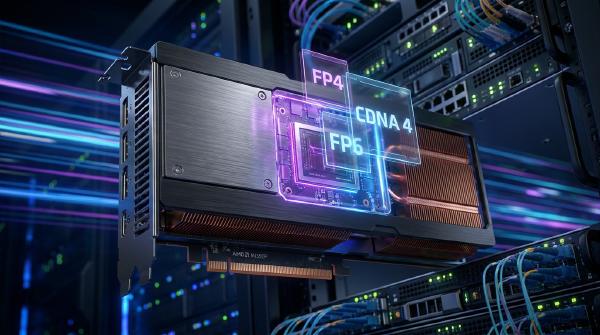
The MI350P is based on AMD’s CDNA 4 architecture and is designed for enterprise AI inference workloads.
Each accelerator provides:
- 144GB HBM3E
- Approximately 4TB/s memory bandwidth
- 600W typical board power
- PCIe form factor
With two cards installed, the demonstration system therefore provides 288GB of HBM3E.
The chassis reportedly has enough expansion capacity for up to four accelerators, increasing aggregate HBM3E capacity to 576GB.
That memory capacity is central to AMD’s local-AI positioning.
⚡ A 1,550W Compute Subsystem Before Cooling and Storage #
The system’s power requirements are substantial.
A fully populated configuration would combine:
- Four 600W MI350P accelerators.
- One 350W Threadripper PRO processor.
That represents approximately 2,750W of theoretical accelerator-plus-CPU board power for a four-GPU configuration.
The two-GPU demonstration system, meanwhile, combines two 600W accelerators with a 350W CPU for approximately 1,550W of processor and accelerator power alone.
Neither figure includes:
- Storage.
- Memory.
- Motherboard power consumption.
- Cooling pumps and fans.
- Power-conversion losses.
- Other system components.
This makes thermal and electrical engineering just as important as compute performance.
💧 Liquid Cooling Makes a Deskside Supercomputer Practical #
AMD’s response to the thermal challenge is an independent liquid-cooling design.
The CPU and each accelerator reportedly receive dedicated liquid-cooling loops.
The objective is not simply to prevent thermal throttling. AMD is explicitly targeting quiet operation in a deskside environment.
This distinction matters.
A high-power GPU server can tolerate substantial acoustic output because it is typically installed in a dedicated server room or data center. A workstation located next to an engineer or researcher cannot rely on the same thermal and acoustic assumptions.
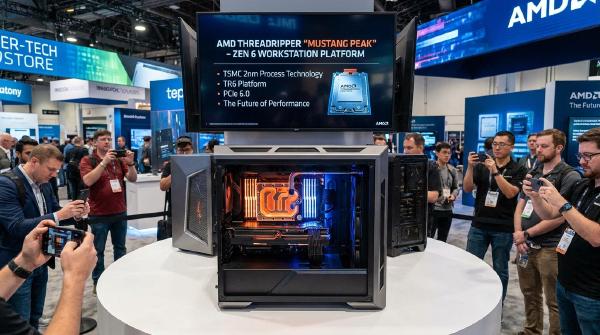
The demonstration system reportedly uses a conventional tempered-glass tower chassis and a standard ATX power-supply form factor, making its physical design resemble an extreme workstation rather than a rackmount server.
The result is essentially a desktop-sized platform carrying a substantial amount of data-center-class accelerator hardware.
🆚 AMD and NVIDIA Take Different Paths to Local AI #
AMD is positioning Threadripper Halo Station directly against systems such as NVIDIA’s DGX Station, but the underlying architectures differ considerably.
NVIDIA’s Integrated Approach #
The cited NVIDIA DGX Station configuration based on the GB300 platform combines a B300 accelerator and Grace CPU through a high-bandwidth NVLink-C2C connection.
The system provides a unified coherent memory architecture with a reported 748GB memory pool and approximately 900GB/s NVLink-C2C bandwidth.
This tightly integrated architecture is designed to make CPU-GPU communication and memory sharing highly efficient.
AMD’s Discrete Approach #
Threadripper Halo Station takes a more modular route.
Instead of relying on a tightly integrated CPU-GPU package, it combines:
- A high-core-count x86 CPU.
- Multiple discrete PCIe accelerators.
- Dedicated HBM3E on each accelerator.
- Large system DDR5 capacity.
The architecture provides a straightforward scaling mechanism: add more accelerator cards to increase aggregate HBM capacity and compute resources.
The four-card configuration reaches 576GB of HBM3E, while the CPU platform can contribute up to 2TB of system memory.
The trade-off is that multi-GPU scaling efficiency depends heavily on how the accelerators communicate with one another.
🧮 Can Four MI350P Cards Really Run Trillion-Parameter Models? #
AMD’s trillion-parameter claim is primarily a memory-capacity argument, rather than proof of a particular inference performance level.
At 4-bit quantization, a one-trillion-parameter model requires roughly:
1 trillion parameters × 4 bits ≈ 500GB
of storage for the model weights alone.
A four-MI350P configuration provides 576GB of aggregate HBM3E, theoretically leaving enough accelerator memory to hold approximately 500GB of 4-bit model weights.
That makes the claim technically plausible from a raw-capacity perspective.
However, model execution involves considerably more than storing weights.
Actual inference also requires memory for:
- KV cache.
- Activations.
- Temporary buffers.
- Communication buffers.
- Runtime metadata.
- Framework overhead.
The effective model size that can be executed therefore depends on quantization format, sequence length, batch size, model architecture, memory allocation strategy, and runtime implementation.
More importantly, aggregate HBM capacity does not automatically equal a unified 576GB memory pool.
The four accelerators are discrete PCIe devices. Efficiently distributing a large model across them requires a communication mechanism capable of moving activations and other intermediate data with sufficiently low overhead.
🔗 Multi-GPU Interconnect Remains the Biggest Unknown #
This is one of the most important undisclosed aspects of Threadripper Halo Station.
AMD has not yet provided detailed public information about the interconnect topology used between the MI350P accelerators.
This matters because PCIe connectivity alone does not tell us how efficiently four accelerators can collaborate on a large model.
For trillion-parameter inference, the system may need to distribute model layers, tensor-parallel workloads, or other computation across multiple GPUs.
The resulting performance depends on:
- Inter-GPU bandwidth.
- Communication latency.
- PCIe topology.
- NUMA placement.
- CPU-to-GPU bandwidth.
- GPU-to-GPU synchronization.
- Software support for model parallelism.
- Collective communication efficiency.
Therefore, 576GB of HBM3E demonstrates capacity, not necessarily performance.
Until AMD publishes detailed benchmarks, it remains difficult to determine how efficiently the platform can execute trillion-parameter models compared with more tightly integrated AI systems.
📋 Several Critical Specifications Are Still Missing #
Despite the impressive hardware configuration, AMD has not yet disclosed several details required to evaluate the system as a production workstation.
Pricing and Availability #
AMD has not announced final pricing or a specific retail availability schedule.
It also remains unclear whether Threadripper Halo Station will be sold directly by AMD or primarily through OEMs and system integrators.
That distinction could have a major impact on pricing, support, and configuration options.
Storage and Platform Configuration #
Other undisclosed areas include:
- Storage configuration.
- Number and type of storage devices.
- Detailed motherboard architecture.
- Power-supply capacity.
- Full cooling specifications.
- Accelerator interconnect implementation.
- Final firmware and software configuration.
These details will determine how close the production system is to the demonstration hardware.
Real-World AI Performance #
Most importantly, AMD has not yet released comprehensive benchmark data showing:
- Large-model inference throughput.
- Tokens per second.
- TPOT.
- Multi-GPU scaling efficiency.
- GPU-to-GPU communication performance.
- Performance across different quantization formats.
- Power efficiency under sustained AI workloads.
Without these numbers, the workstation’s theoretical memory and compute capacity cannot yet be translated into a reliable real-world performance profile.
🏢 AMD’s Local AI Portfolio Expands Upward #
Threadripper Halo Station also fits into AMD’s broader push toward local AI computing.
The company’s current positioning spans several hardware classes, from compact systems to high-end workstations.
At the lower end are compact Ryzen AI Halo platforms, followed by Ryzen AI Max PRO 400-series products targeting laptops and mini PCs.
Threadripper Halo Station sits at the extreme end of that spectrum, combining workstation-class CPU resources with multiple high-power Instinct accelerators.
This creates a broader local-AI hardware stack covering:
Laptop → Mini PC → Compact AI System → High-End AI Workstation
The strategy reflects a larger industry trend: increasingly capable AI models are creating demand for local inference systems that can operate independently of cloud infrastructure.
🏁 Conclusion #
AMD’s Threadripper Halo Station represents an unusually aggressive approach to local AI computing.
The system combines a 96-core Zen 5 Threadripper PRO 9995WX, up to four 600W MI350P accelerators, and as much as 576GB of HBM3E in a deskside liquid-cooled form factor.
From a memory-capacity perspective, the four-GPU configuration has enough aggregate HBM3E to store the weights of a roughly one-trillion-parameter model at 4-bit precision. That gives AMD a credible foundation for its local trillion-parameter AI positioning.
But capacity is only half of the equation.
The critical question is how efficiently those four discrete accelerators can cooperate. Inter-GPU communication, memory management, model-parallel execution, cooling, power delivery, and software optimization will ultimately determine whether the system behaves like a practical local AI supercomputer or simply an extremely powerful collection of PCIe devices.
For now, Threadripper Halo Station establishes an impressive hardware baseline, but the most important numbers are still missing. Pricing, availability, interconnect architecture, and independent multi-GPU AI benchmarks will determine its real-world significance.